What?! Psychic Surgery? Can It Really Help? Dr Scott M. Taubold Explains
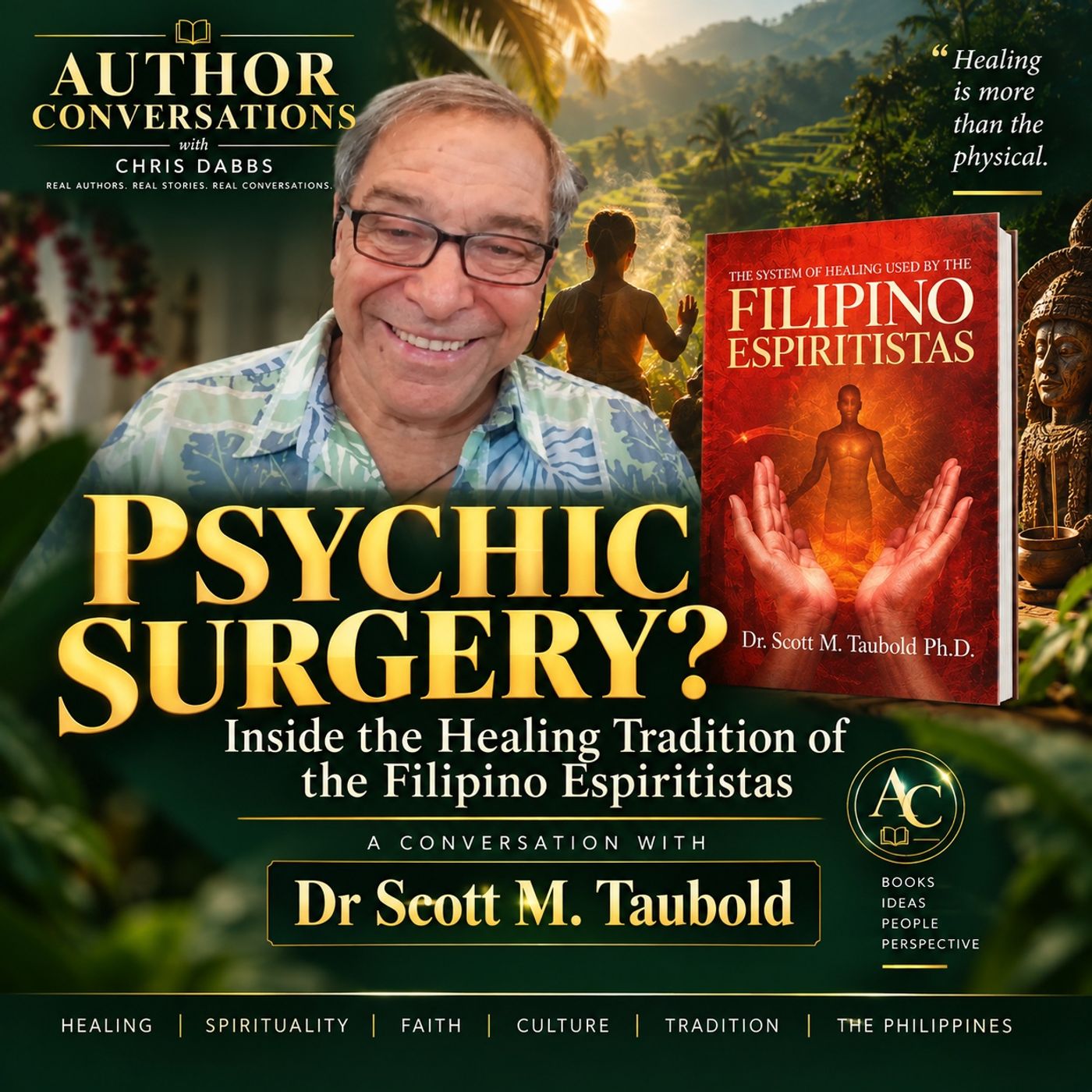
In this edition of Author Conversations, broadcast journalist Chris Dabbs speaks with Dr Scott M Taubold, author of The System of Healing Used by the Filipino Espiritistas.
He discusses the history of what Western observers came to call “psychic surgery”, the role of trance and spiritual belief and the place traditional healers can occupy alongside conventional medicine.
Originally developed from Dr Taubold’s doctoral research, the book explores the healing practices of Filipino Espiritistas — practitioners whose traditions combine indigenous approaches, spirituality, cultural belief and influences including Christianity.
During the conversation, Dr Taubold explains how his interest began after moving to Hawaii, becoming immersed in Filipino culture and later travelling regularly to the Philippines.
The conversation also examines the difficult boundary between observation, belief and scientific evidence. Dr Taubold describes experiences he says he witnessed personally but acknowledges the challenges involved in scientifically proving or disproving such phenomena.
Chris and Dr Scott discuss:
• Why Filipino Espiritista healing became internationally known as “psychic surgery”
• The influence of indigenous Filipino traditions and Christianity
• Scott’s doctoral research and experiences in the Philippines
• Folk healers and their role within local communities
• The relationship between belief, placebo effects and mind-body medicine
• Claims of unusual healing experiences and the limits of scientific investigation
• Why traditional healing practices can disappear as cultures change
• Whether conventional and complementary approaches to health can coexist
• What Scott hopes readers will take from his research
This conversation explores the subject as a cultural, historical and personal account. Experiences and medical or healing claims discussed by the guest should not be interpreted as medical advice or as a substitute for diagnosis or treatment from an appropriately qualified healthcare professional.
ABOUT THE GUEST Dr Scott M Taubold is the author of The System of Healing Used by the Filipino Espiritistas, a work developed from his academic research into Filipino healing traditions.
His interest grew through his experience of Filipino culture, family connections to the Philippines and research into complementary, alternative and mind-body approaches to healing.
🌐 Scott Taubold: psychicsurgery.net
CONTENT / MEDICAL DISCLAIMER
This programme discusses traditional, complementary and spiritual healing practices and includes personal experiences and opinions expressed by the guest. These claims have not necessarily been established through conventional scientific evidence. Nothing in this episode constitutes medical advice and listeners should consult an appropriately qualified healthcare professional regarding medical conditions or treatment.
ABOUT THE PROGRAMME Author Conversations with Chris Dabbs is a long-form interview programme featuring authors, writers and thinkers discussing the stories, ideas and experiences behind their work.
Hosted by Chris Dabbs, a broadcast journalist, interviewer and university lecturer with experience including BBC Radio and Times Radio, Author Conversations goes beyond the standard book promotion interview to explore the ideas behind the page.
🎥 Watch Author Conversations on YouTube:
https://www.youtube.com/@AuthorConversations<br...
[Music] Hi and welcome to Author Conversations. I'm Chris Dabbs and, as usual, you're joining us to listen to an author talking about their work. Today we're talking to Dr Scott Taubold about the book The System of Healing Used by the Filipino Espiritistas. For people who don't know anything about this subject — and I have to say I'm probably one of those people — I'm completely fresh to it. What can you tell us about it? What exactly is this healing tradition, and how is it used and practised by the Filipino Espiritistas?
Okay, well, Espiritista healing was originally called 'psychic surgery' because when Westerners went to the Philippines and observed their healing practices you know they didn't know what to call it. So this one fellow German came up with psychic surgery. So for a period of time in the 70s and into the 80s a lot of Westerners went there to experience this form of healing and they wrote popular books about it. There were a couple of films. Alex Orbito, I believe, came and met Shirley MacLaine. There were some celebrities who were aware of these Filipino Espiritistas, and it was kind of a popular fad type of healing thing there in the 70s and 80s, but you know it's really an amazing effective form of treatment that the Espiritistas do.
That's quite amazing. Now, is this the thing where — I remember back then — there was lots of hullabaloo about it? I think there were lots of charlatans and lots of fake people who were practising and pretending to do psychic healing, or pretending to do some sort of healing without anaesthetic, or surgery without anaesthetic, or something like that. Is that what people were trying to do? Well, yes, that's true, but, you know, these Espiritistas — I mean, they're only human. I believe on some days their ability to do this kind of miraculous work may weaken a little, but therapeutic sleight of hand has been an accepted form of treatment since the shamans.
You know, the shamans didn't have a lot of tools to cure people back in ancient times, but they did have therapeutic sleight of hand as a method of tricking people into getting well, is how I like to say it. So it's kind of like a placebo kind of thing going on. Exactly. Yeah, so in other words, the effect of having the treatment, right, or being treated. Mind-body medicine, yes. No, I like that. I'm very paranoid when I take drugs because I don't know whether or not I should be feeling them or not.
Anyway, let's not go down that route, but yes. Okay, and I don't mean recreational drugs, right? I mean proper prescription drugs. But enough about me there. What first drew you personally to this world and ultimately made you think, 'Well, I need to write a book about this'? Was it a dissertation that you'd done, or was this a book that you just wanted to write? Yes, it's a dissertation, and and this will take some time to explain but I grew up in a very small community in northern California and I came from generations back my ancestors were early pioneers to California and I grew up in an area where they actually speak their own language dialect kind of thing and there's been area where they actually speak their own language — a dialect kind of thing.
There have been dissertations done on that too. They call it Boontling, in Boonville, California. But anyway, I grew up differences until about in my mid-30s I went through a career change and I moved to Hawaii to go back to school well Hawaii is a melting pot of different cultures you know and and all of a sudden I was exposed to all these different cultures and because I worked and went to school in the area I learned what right away that I had to be aware of some of these cultural differences you know and anyway, I moved into a community that was mostly Filipino, and I fell in love with Filipino culture.
By the time I married a Filipina and travelled to the Philippines, I became very interested in their mind-body medicine that they still practise so much over there, and that was my initial interest. As I studied Filipino faith healing, I was going to do a dissertation on it, and I ran into a professor named Stanley Krippner, who had been to the Philippines in the mid-70s and who had done some participant observation kind of research there and he encouraged me to do my dissertation on the Espiritista healing and I told him I said you know there's only been popular books written about it there's not a lot of journal articles scientific journal articles and he said that's okay he said if just whatever literature there is do a review on that of course he had contributed to the literature himself but funny that yeah but yeah so that's So that's kind of how I got started with the project.
It's amazing. So you really had a kind of free rein there. If there wasn't a body of academic literature, you really could delve into all sorts of different popular culture and things like that. Yes, yes, it was a lot of fun, actually. Yeah. Right, okay. So then you actually went to the Philippines and you spent some time yourself observing? Well, yes. Actually, when I was living in Hawaii, a gentleman approached me. He had lived in Cebu City in the Philippines for a year and he said, 'There are cheap airfares right now.
Why don't we go?' He said, 'You buy my ticket and I'll show you around. I'll make sure the taxi cab drivers don't rip you off, and I'll introduce you to some people I know.' So I went with him and he introduced me to Dolores, who was my future wife at that time. some people I know so I went with him and he introduced me to Dolores who was was my future wife at that time so I never really resided in the Philippines but I married a woman and we go back every couple of years to visit her family so I've spent quite a bit of time there and have that connection through family.
So you have that connection through family. It sounds almost as though it's actually part of Philippine culture. Is it mainstream, or did you discover it's more fringe but equally powerful within the culture? Yes, it's fringe, but let me talk a little bit about the healthcare system in the Philippines and how that compares with the US. Now, in the Philippines like so many other countries in the world if a person starts having symptoms say that you know they wake up and they feel sick the first thing they do is they get the family expert you know the family elder person in the family who comes makes a diagnosis and may perform some small treatment or you know say drink more water or whatever tea different teas and herbal stuff and if the person doesn't respond well to that there's always a neighborhood healer a folk healer in and they don't charge a lot of money they do this by donation so you get some canned food or some stuff out of the pantry, and you go over to the local healer's house and see what they can do.
If all else fails, you may go to the Western medical clinic and see a Western-trained doctor, and even then you might go back to the Filipino folk healer. But yes, I mean, it's affordable. That's the thing: you don't have to have insurance, you don't have the AMA. You have neighbourhood people who heal for the sake of healing and accept donations as payment. Well, exactly. That's what I was going to say, actually. You go to the Western medical world and then it costs money, right? But this way, I mean, you're talking about hundreds of years, and this is the way that we lived as human beings.
We're going back — not backwards — but we're going back to how we used to be. In that case, I mean, I thought about you: if you grew up in rural Northern California, you probably had a similar system, right, where maybe you had a doctor nearby, but you probably went to someone — an elder who knew more about things than you did — in your past. That gives you that parallel to draw, perhaps. Yes. As far as the Espiritistas are concerned, how much of this healing tradition — I mean, we've skated over it very, very quickly — how much of this is specifically Filipino?
I mean, in other words, how much has the country's history — because there's this Spanish history and all sorts of other history — and religion and culture added to this to create it, or was it there beforehand? Well, yes, and that's a good question because, you know, the indigenous people in the Philippines would go into trance oftentimes when they were doing healings it's kind of a shamanic tradition right and so the local healers you know they healed pretty well before we the westerners came but you know the Philippines it was interesting because they were they were under Spanish rule for 400 years you know I believe it was four centuries and and us too we we took over the Philippines during the Spanish-American war we liberated them from the Spanish and then again after World War II we liberated them from the Japanese but at any rate all this Catholic influence in the Philippines created well and in Brazil where you have the Catholic Church and indigenous populations they both South America Brazil and the Philippines came came up with these psychic surgeries, as Western people have deemed them.
But, you know, they have spiritual, shamanic-trained healers who are then doing Christian Spiritism in the Philippines and secular Spiritism in Brazil, so that they could be more accepted. But even so, you know, the Catholic Church was resistant to the mediumship and the trance stuff, so they were still on the fringe, and my concern is that this practice will cease to exist if it's not encouraged but discouraged by Western culture. Well, okay. I think Western culture can endanger indigenous culture, really.
There's a massive history of it, as you say — 400 years of colonising the Philippines. Obviously we're not here to debunk or prove it right now; we're having a conversation about your book. So, yes, I think it's quite an interesting thing. What did you witness or discover during your research that really surprised you and swayed you one way or another? I assume you went in there with some sort of idea. Did you prove your thesis or did you disprove it, or what happened? Well, the dissertation is what they call a descriptive dissertation, disprove it or what happened well the the dissertation is what they call a descriptive dissertation so I just described The System of Healing Used by the Filipino Espiritistas — that's the title but describing it you know it doesn't really get into what I have seen I've seen things that just cannot be explained through you know hard science what you have to say that at one point a healer had created a space where looking into it the only way I could describe it was as if looking into another dimension.
It's funny because the first observers of psychic surgery, Ron Ormond and Ormond McGill, went back in the 50s to the Philippines and filmed a healer. That was the way they described it. They said, 'This guy is a fourth-dimensional surgeon.' I thought that was interesting, that they and I, many years apart, came up with the same description of what we saw. Explain that to me, because you're not talking about some sort of science-fiction time portal opening up and all that stuff, I think. Because then maybe we wouldn't need to debunk it or not, because it would be real, right, or something we could see and measure.
So explain what you mean by that dimensional side of it. Well, yes, I mean, they explain it in in terms of a spiritual body you know the spiritual realm where they communicate with these discarnate entities Christian entities usually the Holy Spirit they say the Holy Spirit is doing the healing but you know we don't have the tools scientifically to prove or disprove anything, you know, and that's what makes this kind of area of interest so difficult because you know you can't really prove anything you can only describe, observe and do some calculations, but it's pretty limited as far as the scientific means to investigate this stuff.
In terms of actually being the recipient of it, did you see anybody who had tangible benefits, and did any case studies reveal that for you? Yes, yes. I received treatment myself and had improved liver function show up on an MRI or ultrasound. You know, I mean, there is that, but there's a lot of conflicting evidence, with explanations for how it could happen. Yeah, it's just very difficult to really monitor. But, you know, I can tell you what I saw with my own eyes, my own observations, and that's good enough for me.
And I hope the book is convincing about a lot of things too. Well, it sounds like it is. I mean, it sounds fascinating. Obviously, as someone who's used to thinking in terms of Western medicine, I tend to think almost entirely through this conventional lens. What do you hope the book encourages people to do? To think differently about, possibly, their own healing journeys? Without asking them basically to accept every single claim in your book, what do you want them to think? Well, yes, I'm hoping people will be more open to this type of healing.
There are a lot of different healing methods all over the world, and I think one needs to be open-minded about what those are. And, of course, if you go to a Western-trained doctor, they'll tell you all the reasons why you shouldn't take herbal medication and all these alternatives, you know, but they're just a profit-generated system in a capitalist country. So, yeah. Yeah, which is really difficult. I'll give an example of this over here. I'm in the UK and I'm in London right now, and we have what we call the National Health Service.
Treatment for those who qualify is pretty much free at the point of delivery. Okay, so what happens there is that, as far as the NHS is concerned, they do sometimes look at alternative remedies — for instance, acupuncture. We all kind of know acupuncture, don't we? Someone sticking needles in you, and it's supposed to work on nerve pathways and things. I'm no expert, but again, Chinese, right? Now, in the UK, where this NHS system works, they're not allowed to prescribe acupuncture because it costs too much, so they call it needling.
Is that about right? And, you know, my wife had cancer and then was prescribed this needling, and she went in and said, 'This is acupuncture.' And the person said, 'Yeah, but we can't call it that.' So, yes, this is what I'm really standing up for, as you say. I've already been talking about being profit-driven, really. I mean, it's a shame because maybe these things would help people. So have you seen health tourists, perhaps, who have benefited or gone over to try and benefit from Espiritista healing?
Yes. I forgot you were located in the UK — the AMA being the American Medical Association — but it really isn't what I'm curious about all over the world. So no problem there. Yes, but anyway, in Germany and what we call Eastern Europe, I guess they're more open to these alternative forms of healing, such as psychic surgery. In fact, some doctors in Germany tell people who are in terminal stages of cancer,
But some people are more accepting of it than others, right? So that's interesting. I wonder, is that more of a private kind of thing? I guess it is, isn't it? It's not state- funded medical treatment, right? Yeah, yeah. Okay, so what else is there, then, really, that people can glean from your book? What are you hoping they'll walk away with — maybe thinking about things more, or perhaps changing their lives? Yes, well, you know, it's the whole cultural differences thing. Human beings have capacities to do things that would amaze most of us, I think, but we need to be open to it.
We need to be aware that these practices exist, that a lot of people are saying they're effective. It broadens our worldview in general. And, of course, if it helps us at the same time, then it's not just about understanding the world, I guess. Yeah. Well, complementary and alternative medicine — the systems-of-healing framework, social medicine — has become more acceptable here in recent decades, and new research will expand knowledge regarding the human condition, particularly the role of psychological factors in illness and healing.
A lot of the research that I did was Torrey — the Torrey model — and Frank and Frank, where they came up with these different models of mind-body medicine. I think in the West doctors don't use it enough. I mean, they could boost their numbers for healing if they considered the psychological factors — that when someone comes in for a healing, they're seeking a cure — just to provide that and not be a stuffed-shirt kind of doctor figure, the expert figure. I mean, it's not so great. Yeah, it's like taking your car into the shop, isn't it?
If the mechanic fixes it, that's all. That's how we'll see you, too. Yeah, yeah. But obviously you can't make your fuel-injection system think positively, as it were. But I get that. I think that's quite interesting. Being able to push your mind towards at least accepting it, would you agree? Yes, definitely. Yeah, so that's one of the things that annoys me. People say, 'Think positive, think positive.' I'm sure a lot of people who are very ill think that too, right? But they are. It's so annoying.
But then they know they have to be positive about it. Maybe that's where self-help groups come in. Yeah, well, self-help groups are very effective, I'm sure, in various ways. Okay, well, listen, it's been brilliant talking to you Scott, about that and about the book. I think that, at the end of the day, it's something that people should listen to and should open their minds to, because, from my point of view, you never know. But for the Filipino Espiritistas, they kind of already do know, don't they?
Yes, right. So, I mean, I'm saying it's worth reading Dr Scott's book. Take it for granted that for hundreds of years the whole culture has revolved around this kind of medicine, and it's probably worthwhile to see whether there's something there that can help you. Is your book out right now? Yes, it's available through Amazon and Barnes & Noble and all the regular places. And if people want to get in touch with you, what's the best way to do that? Do you have a website? It's psychicsurgery.net.
Listen, viewers, make sure you check that out if you're interested in this, because I think it's worth looking at, definitely worth looking at. And also, I guess they can find you on social media. I'll leave you to the rest of your day. Thank you very much for joining me. As I said, I hope we will speak again soon for your next follow-up. Thank you, Chris. If you enjoyed this conversation, you can watch more Author Conversations here. [Music] [Music]
 Apple Podcasts
 Castbox
 Castro
 Goodpods
 Moon FM
 Overcast
 Pocket Casts
 Podbean
 Podcast Addict
 Podcast Republic
 Spotify
 YouTube