AI for Beginners Demystified | author Rick Samara with Chris Dabbs on Author Conversations
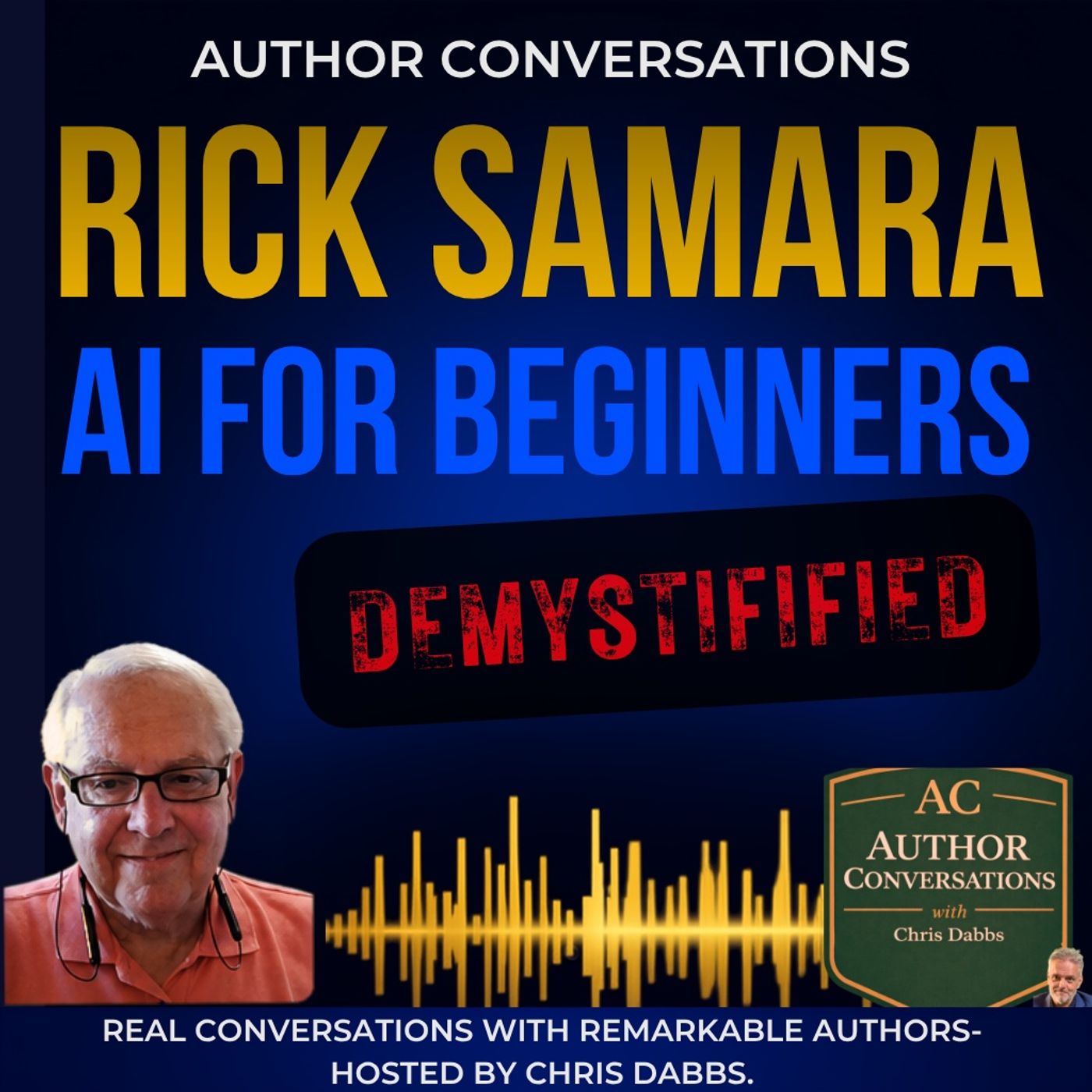
In this episode of Author Conversations, Chris Dabbs speaks with award-winning author Rick Samara about his book AI for Beginners Demystified, a practical guide designed to help everyday people understand artificial intelligence without the complicated jargon.
Rick shares how his background as a former Air Force intelligence officer helped him develop a talent for simplifying complex information into clear, understandable ideas. The conversation explores how AI is already changing business, communication, productivity and everyday life, while also tackling common fears and misconceptions surrounding the technology. Whether you are completely new to AI or simply curious about how it works, this interview offers an accessible and engaging introduction to one of the biggest technological shifts of our time.
In This Episode
- Why AI feels intimidating to many people
- How beginners can start using AI confidently
- The biggest misconceptions about artificial intelligence
- Practical uses of AI in daily life and business
- How AI may change jobs, communication and creativity
- Rick Samara’s approach to simplifying technical concepts
- The story behind AI for Beginners Demystified
Today, Rick helps businesses understand and adopt AI through his digital marketing work, focusing on practical and accessible applications of artificial intelligence.
artificial intelligence, AI for beginners, Rick Samara, AI explained, AI podcast, beginner AI guide, generative AI, machine learning, future of AI, digital marketing AI, AI interview, author conversations, Chris Dabbs, technology podcast
Become a supporter of this podcast: https://www.spreaker.com/podcast/author-conversations-with-chris-dabbs--6905413/support.
Every book has a story beyond its pages.
In Author Conversations, broadcast journalist, presenter and newsreader Chris Dabbs sits down with the writers behind some of today’s most fascinating books to uncover the research, experiences and ideas that never made it onto the printed page.
Featuring bestselling and emerging authors from around the world, each episode goes beyond the blurb to explore the real stories behind the writing.
From untold historical discoveries and groundbreaking scientific research to personal journeys, business insights, faith, true crime and the human experience, every conversation is designed to inform, challenge and inspire.
Drawing on more than two decades of professional interviewing across radio, television and digital journalism,
Chris creates thoughtful, in-depth conversations that give authors the time and space to tell the stories that matter most.
Whether you’re searching for your next great read, fascinated by the creative process or simply enjoy intelligent, long-form conversations, Author Conversations offers a unique opportunity to discover the people, ideas and experiences behind remarkable books.
Real authors. Real stories. Real conversations.
Hi and welcome to author conversations. My name is Chris Dabs and today we have got, I have to say, one of my favorite subjects actually, we're gonna be talking about AI. Yep, and you're right, we have got an author here who has looked at making a book simple for people to understand or make it easy for people to understand. AI, build confidence without techie jargon, it's fantastic. So today we're gonna be listening to Rick Samara who is an award-winning author. His book, AI for Beginners Demystified, has now won awards for on Life Fest America 2026 and the literary Titan, amazing.
Well, a former Air Force Intelligence Officer, he's known for his exceptional ability to simplify complex technical information into easy to understand concepts, which I think we all need with this subject. And throughout his military career, Rick developed a unique talent for turning detailed data into clear explanations that can be understood by a broad audience, including those without specialized knowledge most importantly, like a high school first year student, perhaps. His ability to connect advanced intelligence with everyday understanding made him a trusted figure in both professional and educational environments, leaving a lasting impression on those that he worked with.
Now today, Rick applies his expertise as the founder and co-owner of a digital marketing agency. It's called eInternet Marketing Services LLC and he uses his signature ability to simplify complex ideas, helping business owners understand and adopt artificial intelligence into their digital marketing strategies. Sounds like a plan for to me, this is where we're going nowadays, I think. So by making AI accessible and practical, Rick enables both individuals and companies to boost their productivity and efficiency, basically encouraging growth and innovation in an increasingly digital world.
His book is available on Amazon and all other great book retailers and you can also find a good book directly underneath this video as well. So Rick, welcome, it's lovely to have you here. How are you today? - I'm very asked a question, so good to be here with you. - I really appreciate to start off. - Thank you very much. - Get my message out. - And it's a really important message, I think, to get out nowadays, isn't it? Things are changing rapidly in business, as you said, and also in, well, personal lives as well with AI, isn't it?
I mean, why did you write this book? What motivated you right now to get it out there? - Well, Chris, as you mentioned, I have a digital marketing agency called eInner at Marketing Services. We saw, we saw the writing gonna wall about two and a half years ago that most digital marketing was moving to AI. Yet, I got a lot of resistance from business owners for a number of different reasons, because, it was so new that there was resistance, the restrictions, people who were scared, they didn't know what they were getting into.
So I wanted to figure out why, why, why? You know, when AI came out, personal, I loved the idea. I loved this new technology. I thought it's had so much to offer everybody. So I started doing some research, and I did more research and more research, and I kept notes and I said, you know, I'm just trying to write a book about this. I never saw myself as an author, but I said, let's brush your off to skills. Let's take everything that I've learned and kind of package that into a book, and we'll put it up on Amazon, and I'll have it available for my clients, you know, as a free gift, let them read it.
So they're not afraid of artificial intelligence. So I wrote the book. Now I will tell you that I subscribed to an agency and I had the book written in AI. I got a copy of the book. I looked at it, I read it, I crushed it. I said, this is not me. I need to speak as bricks some hour would speak. I need to tell the story the way I want to tell the story and not the way some machine is trying to tell the story for me. But it gave me somewhat of a structure to use and I was able to use the structure that I certainly had to write the book on my own.
So that's how I got into it and I'm happy I did it. I'm really happy I did it. Because I was really pleased. And if you read the reviews on the book, they pretty much say the same thing. You know, it says that my message really got across. Yeah, this is a simple version of AI. I used to fear it. I didn't know anything about it. Now's the expert is my family on AI and it, you know, the reviews are just so rewarding. That's why I did it and that's what I have right now. I'm looking on artificial intelligence.
Now, I bet you didn't think it'd be a nice, official intelligence author five years ago, did you? No, I didn't. I never envisioned. You know, everybody kind of thinks that, I'd like to write a book. I'd have friends write books, but I never really had that ambition until, you know, I crossed this path. Clients on the one hand, artificial intelligence, artificial intelligence out here and how do I simplify it? How do I bring it all together? So now I'm an author. And then I want to come forward. It's really cool.
That's incredible. Yeah, congratulations on that. That is amazing. I have to say, especially like 2026 as well, this year as well. So, you know, it's like, is it you're really motoring forward? So, yeah, congrats. I mean, you know, this is the thing though, isn't it? You know, AI, we look at it in movies, you know, obviously Terminator and all that sort of thing, you know, all sorts of things. So it's seen as the demon. But nowadays, I think that people are obviously looking at the, well, we would call the large language models, right?
But we're keeping away from techy stuff here because your approach makes complex technology like large language models feel approachable and even fun, right? So why was it important for you to avoid all this techy jargon when writing this book? Well, I'm not a data scientist. I'm not an engineer. The hurdle was to, you know, produce the, all the technology behind self-driving cars, you know, things like that. I'm not at that level. And in order why even want to understand that level? Do you mention the major chatbots, you know, chatty PT, perplexity, chord, and those?
AI, as we know it, I mean, it goes back. It goes back to 50s, you know, but it didn't come to us as consumers until 2022 when open AI developed chatty PT. So this technology is really in its empathy that it in terms of, well, you know, how we know and understand it. And it's really easy to use the, I'll call them chatbots, you know, like chatty PT, it's really easy to use and there's so many different functions that not only businesses, but basic, mom and dives and sisters and brothers and students and aunts and uncles can be using if they understand the value that it can provide to them.
And that's the fun part of the job. Bring in that message across. - Nice, true. And it helps people to be creative, I feel, as well, funnily enough, because people think that you're not. I mean, I understand completely what you're saying about the, when that first iteration of your book came out and it was like, somebody else wrote it, a machine wrote it, as far as you can say, it wasn't in your voice, was it? So you had to edit it into your voice. And so, yeah, I mean, wow, the options are so vast.
I mean, I lectured at the University of Brighton down here in England in Southern England and my students, they're all over AI, as you can imagine. It helps them, right? This is in journalism. It helps them, but we always teach them not to rely on it and to do exactly what you did. So in other words, you use it as a framework, right? So once one simple AI tool or habit that you think every beginner, like a student, should start using today then. - Well, the first thing I started doing really was, I said, as a log, a log, I went to chapter 15, and I said, develop a log for me to, so I can start putting in expenses, things that I do, I keep the schedule, but this is better, because I can go and check GPT and I'm thinking, we might log in and treat for the month of May.
And it'll take a while to think and it'll give me everything that I put in there. So that's one easy thing that people can do. All of these checkbox, all of these AI applications, they check GPT and the Google Gemini and the FOD. They all have paid programs, you know? You can upgrade and pay $20 a month for them. Most people don't have to do that. They, all they need to do is log in, I use a Google account, I use my Gmail account, and I use it for the login to the chat box. And I have an account set up for each month.
So you don't need to pay. So my place to people is to pry it out, don't get a quick paid program or a pro pro, pro pro pro, I try saying that many times, real fast. But, yeah, it's good to free version, it's tested out. Ask a thing this. Yeah. Well, one of the most popular examples initially was how to create a trip, I tend to write. You can use a prevent, you know? I am in Boyd Flames, Maryland, and I want to take a trip to kind of see what sites should I be visiting? What are those popular sites?
I'm writing for sponsored. And then he asks you for more detailed information. Well, can you give me, you know, a list of hotels in the area? Think, think, think, think, you'll get a list of hotels in the area. Yeah, so it's simple stuff that anybody can use. Let's say, you know, you're a, you're a 40 year old man, and you have been tasked by the family to create a, your annual family gets together. We think that he could use it for that. He just plug in and ask the information about it, and it'll come back to you with questions as well.
Okay, well, you know, how many people are we talking about? You know, things like that, and you engage with it, and you iterate with it, and you refine your questions with it, and it'll, it'll help you do that. So there's some simple things. I mean, if you're a, if you're a, if you're a coach for your kids, and I want to sudden that you're, you know, you're going to develop a league and a schedule and rules and things like that. Yeah, these chat pots will do it for you, and I'm supposed to worry for free.
Now, there might be things in there that you don't like, and then you respond and you tell them that you don't like this for this reason. But how about putting this in there, this rule, or something, and it'll say, thank you very much, and thanks, thanks. Now, one of the things you want, you really want to do, too, because these, these large language models want something that's called machine learning, and you don't need to know anything about that. Yeah, let the data scientists worry about machine learning.
But one of those things you want to do, if it gives you a good response, you'll, you'll see a thumbs up or thumbs down. You know, if it's a good response, click the thumbs up, because that tells the machine that tells the chat pot, this is a good response. And I'll remember the good responses, because they're all built on data, thousands and thousands and millions and millions of data points, and you keep providing thumbs up, you're telling that's a good data point, so let's say this thing. You teach them machines, and they show us from you as well.
Yeah, I really, it's amazing. I mean, you know, without getting too geeky, I'm sorry, I have to geek out a little bit. You know, it's incredible, isn't it, how the amount of power that this new industry kind of thing, new industry uses? You know, we've had issues over here in the UK, where I think, you know, like OpenAI and all these guys have decided not to come to various parts of the UK and put their silver farms, because we can't provide enough electricity to run those things. I mean, it's amazing, isn't it?
It really is. Yeah, we have those issues in the United States as well. But then, you know, the saving grace of it is, this one, we gave a lot of jobs. If in fact, you can build the infrastructure behind it, and put in the data center, you know, anyone in the country is not a great new jobs, new high-tech paying jobs, so good paying jobs. Oh, well, exactly. I mean, one of the issues that I have, you know, with my students is that they worried, because they think that AI is going to take over the jobs that they would have had, right?
The graduate jobs that they would have gone for straight out of university or college. And, you know, you can kind of see that happening already, can't you, you know, these sort of simple kind of jobs are being taken. But do you think that people should be afraid of AI? Or should they learn how to work alongside it? More so. One more company here now are putting AI in the job description. You have to know something about it. And you could do that by getting start vacations, but the best way to do it is, you know, you try to examine and expand the figure out what exactly they're asking for.
So you examine the question and by examining the question hard enough, you can try to figure out what the problem is. Because they're trying to solve a problem. So what's in business? Our business is going to be different. Every industry is going to be a little bit different to try to solve the problem. Now, I'm article that I just posted. I put a, you know, what if your employer requires you to know AI? You know, you need to develop a framework with your employer. You need to sit down. Chris, I've worked for you.
Okay, what are the parameters? How can I use this? Do you have something set up? Which shouldn't I ask, which shouldn't I incorporate? So there are parameters. And then I put together a checklist as well. You know, these are things to go over with your employer. So that's already happening. So they're starting to use AI, in US companies, in industries. I wouldn't have a fear at all about losing a job. You know, the software industry, they need humans. They don't want humans. But then in the more technical industries, in the more creative industries, like, you know, I'm most familiar with building a website, building websites to find, you know, how do I use AI there?
How do I use AI for content? And, you know, how do I structure it? The established parameters and help them produce content on their sites?
I know in my business how to use AI, what people need to figure out is how, in their future jobs, they can start using AI. And the best way to do it is just to start practicing. Start practicing. You can't use it right now because, you know, AI isn't necessarily going to replace your job, but, you know, your employer's like, "I want to hire somebody else who can do AI just a little bit better than you." So, in order to stay competitive, learn it, start practicing. Practice, practice, practice. And you can start figuring out certain things in live-duly that will help you stay ahead of competition at work.
You know, I mean, if you see a problem at work, see if you could solve that problem. When I was in the military, okay. I was a young second. We've then signed my first base. There was England, there was a first base, and I was always the AI, it's not there anymore, it's a part of the buildings. But a colonel gave a lecture to all incoming personnel. And he said two things that I'll never ever forget. And I used them, you know, they were in-brained in me. So I hadn't made a major impact. And one of the things he said was, don't bring bring your problems.
Bring your solutions to the problem. You could use AI to figure out a problem at the job, you know, some of that problem by using AI. And, you know, be the smart guy in your division or branch or whatever, that the boss will come to you and ask you to do certain things. It's always great when a boss superior comes to answer, hey Rick, I, Colonel, Colonel said, you know, I can come talk to you about this. I know you don't work for him, but he said you get things done. Can you help me with this? The other thing I'll always remember is, you know, work your bosses agenda.
And that's stuck with me too. So whoever your boss is, know what they need and work with them and trust me. If you practice, practice, practice AI now, you will figure out a way to use AI to help solve your boss's problem. That's my two cents. (laughs) That's all I can do to be a Chris. No, that's perfect. Yeah, the world had an honor, so it came up with a report a couple of years ago. And they said, yeah, jobs are gonna go away. Know that about, but by the year 2025, 2027, it's gonna be a net increase in job with AI.
So I would just advise anybody, I wouldn't worry about it. I wouldn't be scared. I wouldn't stay away from it because I feared it, I'd get involved and I'd start learning it. To my advantage. I think it's not hard. I mean, you could spend a half an hour a day doing it. Well, exactly. I mean, that's the thing, isn't it? I think, you know, I remember a while ago when you used to be when you were going for a new job or what for a new employer and everything else that they would insist that you had Microsoft experience so that you could write a word processor or you knew how to use a bit of Excel or something like that, right?
And at the time, people thought, oh my gosh, it's the same thing. People used to think, oh, we can't do this, I can't do that. I don't wanna change. Why, you know, I'm good with a calculator, I'm good with this, I'm good with that. Why do I need to use a computer? And then, you know, they were scared for their jobs also, weren't they at that time? But, you know, yes, that's change. But why, yeah. Right. And the people asked you that you're running along. Exactly. Exactly. There's a lot of apprehension to computers when they came out.
There was a lot of apprehension to cranes when they came out. People were saying, I can't write that 'cause my stomach all fall apart at 30 miles an hour. And no, it all comes as worries about technology and how people doing the stuff. We go through this, we've gone through this before. Off to the cars, why? I don't wanna give up my horse. Exactly. You have to go on the industry. So, how am I going to have it? Yeah. Yeah. And all these things became part of our lives. We just accepted them, got you right.
So, with artificial intelligence, it's pretty much the same thing. It's already here. You were already using it, whether you know it or not. If you have a smartphone, your smartphone is full with AI. From your camera to your apps, you know, it's already here. You have to learn about it and make it-- And even the predictive text, right? When you-- Yeah. Oh, amazing. Yeah. Yeah. Yeah. So, exactly. In the old days, what was it? There was a software, wasn't it, that people like lawyers or accountants or whatever used to put on their computers, they could dictate.
And I think that used to be quite expensive. But now, well, they don't really need to do that, do they? They can just talk to any one of these, AI's, and get the same job done, right? Right, right. You know, I don't use the voice AI, you know, is much, but you can do it, just look you're saying. And it's a lot easier on your phone, because all these apps, you all have a phone word. And, you know, it's easier just to cut that speaker button and ask. But I find it writing the prompt to me is more effective than speaking the prompt, because I'm-- I could be more accurate when I'm crazy, but that's just me.
But it's all good. And of course, you know, it's really amazing. So you teach? Exactly. I think-- yeah, yeah, yeah, I teach journalism and broadcast journalism, which is great stuff. And of course, we are now this year, certainly, looking at introducing AI to help with not editing or anything else, or writing, really, but to do with design, for instance. So, you know, Canva, that's one of the things, or Adobe, have got very much the AI design process that is going on. So you can create a photograph from nothing, right?
Or, you know, a photograph, an image from nothing. And so, yeah, that's the kind of thing that we're looking at. And so, you know, obviously, you can do that. You can do that when-- You can do that, if you'd like. Now, they-- oh, yeah, yeah, you can go to the young man and say, create an image, and then they'll use nano-- nano-binana. And it'll kick out your image. If you'd like it, you download it, if you don't. You iterate. You come up with something else. So I don't use TAN, but all that much anymore.
I use chatbots. Don't need to, right? I'll use-- Exactly. I'll tell you what, that you don't need to. Yeah, perfect. Listen, obviously, we're running out of time now, Rick. I said, no, shame, right? But let's say that you've got a client comes to you for, you know, at your marketing services and says, look, I need to get some graphics done. How would you go about explaining to them how to use, as you've just said, the AI tools to create graphics or create pictures, or all of that sort of thing? It's a bit of a case study.
Well, I'm a time when they wanted to-- they wanted to do it on their own, to do it on their own, using one of the chatbots. They could play with chatbots, they would take the cat, because they use Dolly Wree. That's the name of their image creator. I like Gemini for that, because Gemini uses nano-banana. And I would tell them, try it, just go in and-- when you go into something like Gemini, it'll have a little box down there, create picture, or an image, whatever-- you know what it says, but you know, it's the same thing.
So then you just prompt it, and that's a good way to start learning about AI and how to create a prompt. Try to be specific as specific as possible. Another trick you can do is have the chatbot actually write the prompt for you. Type in. Write a detail prompt. This is what I want to explain graphically. I need an image or an infographic that describes such and such, such and such, and such and such, give me a detail prompt. And it'll write the prompt for you. So then you just copy and paste the prompt, put it back in the Gemini, and go use nano-banana to create a poster, an infographic, a plain image.
And let's say you want your logo on the image and they didn't produce it for you. Well, you just go in the next time and say, put my logo on the left hand corner. Now, you may have to upload your logo, but they have a little plus sign there, and all you do is you go to your hard drive on your computer, and you hit the picture of your-- an image of your logo, and it'll know that's the logo you want on that image. So if you don't like the finished product that they deliver, just update it, just update it in your prompt.
But you could even get them the right to prompt for it. You know, it's the-- And I don't learn how to practice, Chris. Yeah, exactly, I mean, that's-- yeah. That's the point, isn't it, right? So it's-- through practice, you obviously can become very good at using AI for whatever it is that you need. I mean, my father's quite elderly, and he's in there as well now. My mother-in-law, same kind of thing. You know, they're doing like this. So anybody can do it from students through to retirees, right?
So everyone can absolutely just go ahead and really benefit. Yeah, exactly. Well, listen, thank you very much, Rick. We are out of time. But I think that this is the beginning of a fascinating subject. Are you going to be writing a second version of AI for beginners, de-mystified, do you think? I haven't been able-- I have all my notes put together, and it's going to be, you know, AI from beginner to practitioner. And I hope to put all these simple things in. Hey, if you're a softball coach, you're a vault-- you have a bowling league, you have this, you just-- and put the-- actually put the prompts in, the help people, you know, get started, and, you know, continue with my message.
So hopefully-- I will. Hopefully I'll get that done. I just have to find a time. Fantastic. That's the only thing, isn't it, right? It's just-- It's just-- Yeah, it's interesting, but, uh, uh, um, at least I have AI, it helped me, you know? So, uh, I think I have all the egg up on a lot of other people. Uh, because I practice-- Practice, practice, practice. Yeah. No. Well, it's an interesting thing to do. I appreciate it. You can have a hobby like that, really, couldn't you? So, Rick, yeah, thank you very much for joining us today.
Rick Zemara, it's been wonderful talking to you. You know, you're an award-winning author, don't forget. And listen, listeners and viewers, make sure that you check out AI for beginners, de-mystified. You know, it does not that often where a book comes out and wins awards almost immediately. So, it must be telling you something. So, check it out on Amazon and, you know, feel free to leave a comment down below, get involved in the conversation. And let's hook up and understand how AI can really help us.
It's not going to take too many jobs. It will replace or maybe augment them. Who knows? But let's see what happens, okay? But in the meantime, I think, Rick, your message probably is, enjoy it, learn it and just move forward with it. Would I be right? That's exactly where I cross. Exactly. You then, you know it. You can't have had the part. Well, I'm going to go into... There you go. I should be a coach. So, there we are. Listen, Rick Zemara, thank you very much for joining me on this edition of "Or the Conversations."
I hope to speak to you again soon with your second book. In the meantime, have fun, enjoy AI and everybody else. Also enjoy AI. Love you to meet you, Rick. Back of course. Break to meet you, too. Okay. Take care.
 Apple Podcasts
 Castbox
 Castro
 Goodpods
 Moon FM
 Overcast
 Pocket Casts
 Podbean
 Podcast Addict
 Podcast Republic
 Spotify
 YouTube