Mark Sacco on Mafia Power, Loyalty & Survival | Author Conversations with Chris Dabbs
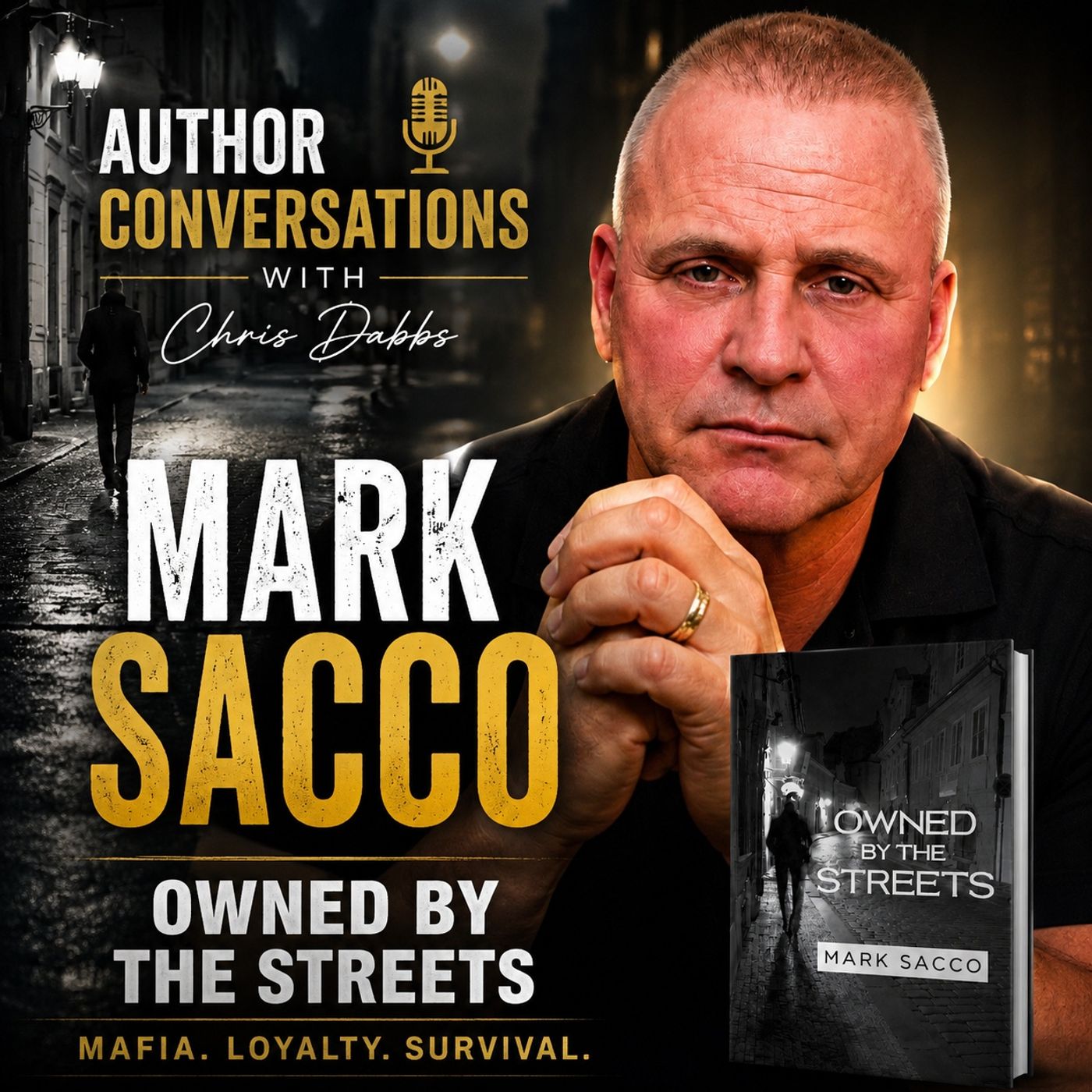
Set against the backdrop of 1950s organised crime, the story follows Frank Gevono, an ambitious young man torn between the values of family life and the dangerous pull of the streets. As betrayal, romance and violence collide, Frank is forced to survive in a world where loyalty can mean life or death.
Mark discusses the inspiration behind the book, the enduring fascination with mafia culture and the emotional depth behind organised crime storytelling.
This is a conversation about power, survival, loyalty and the cost of ambition.
Become a supporter of this podcast: https://www.spreaker.com/podcast/author-conversations-with-chris-dabbs--6905413/support.
Every book has a story beyond its pages.
In Author Conversations, broadcast journalist, presenter and newsreader Chris Dabbs sits down with the writers behind some of today’s most fascinating books to uncover the research, experiences and ideas that never made it onto the printed page.
Featuring bestselling and emerging authors from around the world, each episode goes beyond the blurb to explore the real stories behind the writing.
From untold historical discoveries and groundbreaking scientific research to personal journeys, business insights, faith, true crime and the human experience, every conversation is designed to inform, challenge and inspire.
Drawing on more than two decades of professional interviewing across radio, television and digital journalism,
Chris creates thoughtful, in-depth conversations that give authors the time and space to tell the stories that matter most.
Whether you’re searching for your next great read, fascinated by the creative process or simply enjoy intelligent, long-form conversations, Author Conversations offers a unique opportunity to discover the people, ideas and experiences behind remarkable books.
Real authors. Real stories. Real conversations.
Hi and welcome to author conversations. I'm Chris Dams and today we're joined by the author of owned by the streets Mark Sacco. Now, Mark has got some really good heritage, I think that he's brought into this whole story. And let's just get straight into it and find out about your story and inspiration Mark. What inspired you to write owned by the streets in the first place? Well, what inspired me was the way life used to be. You know, good work ethics, family, the most important thing. A handshake.
I was brought up in the 70s and the 70s had some, still had some grip on the 50s, which that's what the book is about in the 50s. And it always comes back to me and it inspired me to write a story about the way life used to be. What, so okay, so how life used to be as opposed to in the 70s or as opposed to how it is now or just sort of writing something that just kind of told the story in the 50s so that we could all reminisce with it. Does that make sense? Does that mean that that does make sense?
Yeah, I didn't want to get confused with the 70s and the 50s. I just wanted to bring up the point where the way when I was brought up in the 70s, it like I really still remember family that was so important. I'm Italian, so it was like every Sunday, it was the same thing. Family gatherings was, it was all from the heart. And I wanted to bring that, you can't bring back the past. I mean, I wish they made a time machine that you could, but you can't really, you can't go, all you could do is think about it, remember it.
And I wanted to put it on paper and it just turned out to be a good story and it inspired me the more I wrote it about those those true values, the more I wrote it, the more it became, you know, half and half where it was. It was, I mean, it is fiction, but part of it is the way life used to be. And I think as well, based in the States, right, you can tell us where it's all based and everything else in the sec, but I kind of agree, I think it looks like, I mean, I was brought up in that time period too.
And I think it's quite interesting really because I always look at that as the 50s as being like the golden era, I think, and a lot of other people think that too, don't they, of America in the 50s. So, you know, it's not, I guess it's not just about the family, even though there is a big thing, my wife's Italian, so I know all about that, right. So, you know, it's quite interesting. And I agree, I think the 50s, I'd love to have lived in the States in the 50s at the time. So tell us a bit more about where it's set and what's going on and why you chose, you know, the Italian Mafia as the setting for the novel.
It takes place in, literally, New York on Mulberry Street. I visited Mulberry Street many a times when they had this engineer face, and, you know, I was there at Burdo's Clam House, and, you know, I visited that area, not recently. But it's sort of like it was compatible to where I was brought up. I was brought up in Hoboken, New Jersey. And Hoboken was very family oriented. Everybody looked out for each other, which is part of where, you know, what inspired me. And Mulberry Street is, like I said, it's sort of like where I grew up.
So I didn't want to pick Hoboken because I think it would have brought in too much of my life. So that's why I picked New York, Mulberry Street. And like you said a few minutes ago, the 1950s were, they, I, from the research that I've done, the 1950s were great years. They were, they were years of a good life. And the mothers were happy wives were happy. There was new things happening. New technology. Men had good jobs. There was no war. It was just, it was just good to fit. So that's, I guess that's really why I picked the 50s.
Yeah. Yeah. I think I think it's right. And it's funny. Obviously where you come from now is pretty famous, isn't it? So, you know, you've got that cake guy. Whatever his name is. Oh, the guy is it's, it's a matter of fact. That's it's a funny. I don't want to get into the whole story. But when I used to pedal, I used to pedal produced with my father in Hoboken. And that was a little similarity in that was in my book. Frank Jervano, the main character. He peddled fish with his father, but his father passed away when he was very young.
But anyway, fast forward. When I used to pedal with my father in Warner to streets in Hoboken. The cake boss, he was, Barlow's was the original Carlos was right in front of where me and my father is the pedal. And I remember the cake boss. He was my age. I think it was a little bit younger than me if I'm not mistaken. And I remember him coming in and a store with his father. So it was, it was, you know, kind of ironic that you just mentioned that. Yeah, it's, it's funny. I mean, I was on holiday on the cruise, not too long ago.
We met this couple from Hoboken as well. And it's amazing. Yeah, you guys get around. I thought it's everyone from New Jersey that got around. But nope, it's you guys now. Oh, there's even New Jersey though, right? Or not. Yes. Yeah, exactly. Okay. All right. Well, let's leave that because our listeners are going. Why is this English guy going on about this? But anyway. Apart from, you know, obviously the Hoboken stories and all of these sorts of things and you're growing up and seeing, you know, I mean, peddling around to restaurants or shops, stores, whatever.
I mean, there must have been some real life experiences or historical influences or even classic mafia stories that helped you to write the book. I mean, tell us about those. Yes, that I'm glad that you brought that point up because I was, I was, I learned to be street smart at a very, very young age. And the main reason why was because I was working for my father, I started with my father at, I think it was somewhere around nine or 10 years old. He, he went back, he was in produce all his life.
He went in the army, he came back, he didn't go back into produce right away. But when he did it in 1971, that's when I started helping him out on weekends. And it was so those memories, I think, brought me to where I am today, meaning when I was with him and people used to come up to the truck. People he knew were just regular customers. The way he presented himself and the conversations that they had, I used to just stop and listen. And I learned a lot and there were the majority of the time, a lot of his friends would come up to the truck, just talk to him a little bit.
And he would say to me when they left, he would either say, that I watch Alpha that guy or that's a good guy. He stand up or that guy's honest. And I just, as the years went on, I just learned more and more and more. And I grew up very, very fast. I bet, I bet. But did you know what though, that's a great thing, isn't it? That's a, you know, if I think his parents, if we can pass that on, you know, it being a street smart. It's, yeah, that's what we want, isn't it? Oh, yeah. I mean, I wish there was a school today that you could go and enroll for street smart, but there's not.
It's all about experience. That's what it is. No, that's very true. And do you think that's one of the reasons why you wanted to go back to the 50s with this as opposed to like present day or, well, I know it's different nowadays, of course, because we haven't got the sort of main mafia sort of influence, I guess it's not as open as it. But do you think that's one of the reasons? Yes, that's one of the main reasons. Interesting. Okay, so how would you describe Frank Javano, as it Javano Javano, really?
At the beginning of the story then, how would you describe Frank? I mean, what's he about? His life at the beginning is very humdrum. It's very boring. And he feels that there's something missing that he wakes up every day. He works for his uncle. And he just feels like he does the same thing every day, every day, every day. And there's he just feels in the back of his mind that there's something missing in his life. And he struggles with that because he knows the stability part of this life, which is, you know, back then it was you would go with the neighborhood, meaning the neighborhood or the streets kind of told you what you did.
Meaning, if you had, if you had uncles or relatives that they cannot school or whatever and they worked for the city or they worked for as a clerk for one of the business owners. And it was all the same thing, but Frank didn't want that. He wanted something different, but he didn't know what it was until things started stirring in his life. If this is interesting, it's because again, that's something that happens, isn't it? Like father to son passing on jobs or passing on opportunities or recommending father son, or whatever for a role that used to happen a lot, didn't it?
And I think, yeah, especially with what teamsters and things like that, you know, and I think that's probably gone away as well now, isn't it? And everyone has to make their own way in life, which is kind of good, but you know, equally, it means that those bonds break down so I see what you mean. So talking about Frank there, I mean, he's obviously struggling with trying to find who he is, why he's there. He thinks he's bored. I think is what you're saying. And he thinks there's more to it. What makes him want to get involved with organized crime then, you know, what's that about?
Well, he starts to see his uncle store is on mobile street and across the street diagonally, like because I could picture this in my head, is the social club. And the social club has the man there and they're in and out of there every day. And it just so happened one day, he started looking and he started seeing the clothes, the cars, the way they presented themselves. He knew, he knew who they were and what they were about. But he never really looked and started visualizing himself in that life.
And I think that was the moment where it clicked in his head. And he said to himself, maybe that life is not so bad. Which is interesting in itself, isn't it? Because, you know, getting into that without being introduced in some way or other, I guess by a father or something or an uncle could be quite interesting. Okay, so Frank obviously has got to go through life now. And I think that there is this like an internal conflict, isn't it? That Frank's struggling with, I couldn't really make out from the bits that I read what that was, but there's something really driving him, isn't that?
Yes. What's driving Frank is, and it has to do with the things that he struggles with. What drives him to start this life is the main reason. And I believe this is sort of like the core of the story, it has to do with family. And he wants to, there was, there was a, there was a paragraph or a couple of pages that I wrote that he wanted, he asked his mother for something about dinner or. And she could have said it was too expensive that week. And he just, he broke down. And that was the moment where he said, I have to do something with this.
We can't live in these railroad, me, me while when I was a kid, not to jump back, but I was a kid I lived in railroad rooms in Hobo. I don't know if you know what railroad rooms are, they're, they're rooms that just, it's straight ahead and it's one room right after the other. There's no doors or anything like that. So he lived in this little apartment with his mother and his brother. And he knew that when his father passed away that he was his responsibility to take care of his mother and his brother.
And would then go back to what you were saying. He, when he, when he heard this from his mother, he was determined. He said, I got to make some money. I, there's, and I know that the fastest way to do this is if I could get my foot in the door with this type of lifestyle. And he was, that's where he started. He started where he wants to make a better life for his mother and his brother. And he comes next. He didn't put himself first. And that's another thing about Frank. He, he always has a reason for something.
He's, he's a reasonable guy. He's not naturally cold-hearted. He has a conscious. And he just, he wants to make a better life for his mother and his brother. Which is a nice thing, actually, isn't it? You know, I mean, that's, at least as you say, there's a reason for it. There's some compassion there that he wants to, that he wants to push his family forward. And I can see how, you know, if he hears his mother saying, sorry, we can't afford that son this week. It can affect you as a child, kind of, especially if you know that you're going to be taking over the family kind of thing.
So would you say that it's your, sorry, his mother, rather, Frank's mother had the greatest sort of impact on him over his life. Or is there somebody else who's really sort of like acted as a mental? Yeah, it's funny because that goes back again to his, not confusion, his, his, his struggle. It's the word I was looking for, easy word, but that's where God is back to his struggle. His, his mother and that life is his, his stability life. And then the other part of his life is where he wants to, he wants to change it.
And the love he has for his mother is unconditional. But she's not the, she's not, she has an impact on him in his stability part of his life. If you could understand that the other part of his life. I think the man he works for and his best friend has a big impact on him. Now the man he works for, the impact that that he has on him is the way he dresses and the lifestyle he has. And mostly the power, the power to do whatever he wants to do. And that takes money. And then the other impact on his life is his best friend.
And he knows that his best friend will do anything for him. And he knows that he's there for him. He'll take a bullet form. Even though he argues with him once in a while. He needs him. He needs Angelo by his side because Angelo once in a while will tell him you're wrong or you're right or. And he needs him. So I guess there's three people that impacted his life, his mother. Of course. And the best friend and the man that he starts working for. So it shows you really that you think their family loyalty as well, right?
It's best friend and trusting in friends as well are really important. It's I mean, are there any sort of tests that Frank has to go through in terms of loyalty or any that he puts his other people through, I guess, in the story. Yeah, they there's there's there's tests that he has to go through mentally and physically mentally with his struggle of deciding that this is the life that he wants physically. He has to go through a test with the man that he starts working for and it's it's a we're not was writing it.
I didn't know how Frank would get into this lifestyle. And then it it kind of like tamed together where there's a story. There's a part of the book about how Joe that's the man he works for puts Frank through this test. So he's got he's got he's got a couple of different steps that he has to take and different things that he has to think about. That's interesting. I mean, you know, we haven't talked about romance either on Frank. I mean, because how do you sort of have romance if you're living in that sort of lifestyle?
I mean, how does Frank deal with that then? Well, he it's he's got a little bit of a jump on it because the girl that he's involved with. And they've known each other since I believe it was kindergarten and they grew up right on the same street. And she works for her parents. So they kind of like have a lot of things in common, but they were always friends. They would always joke with each other and as they were growing up, they would joke with each other and then be when they started becoming a man and a woman.
Then that's where it started taking a little bit of a hold. So it's not like it's not like where he got into the life. And then he meets a woman or a girl or whatever. And he's got to start this. Okay, how am I going to do this? He already had a foundation with Maria and it just escalates from there. No, no, no. Okay. So she's she kind of obviously that if they're childhood friends and yeah, that that does help, right? Because she knows what he's up to, I guess. She she has an idea and she always kind of like in you window throws little hints out there and asked questions.
And by the middle of the story, Frank's started to get irritated by this because he doesn't want her to know exactly what he's doing. And that's another struggle that he has because Maria is is that that other part. She's that part of his of stability. So it's it's a it's a very fine line where he can't he he don't know whether he he should cross over and tell her everything or whether he should just keep it the way it is for now. That would be quite a truth bomb, wouldn't it? I guess if she doesn't really know what's going on.
But even if she did, I don't know how that would work. You know, I mean, the violence and the danger that Frank has to deal with like all the time in that, you know, doing that sort of thing. I mean, how does he deal with that like emotionally, you know, the violence that can't be simple, can it? And the danger of having that violence kind of done to him as well. How does he deal with it? He deals with it with his street smart. He deals with it with strategy. He thinks first before he acts. And it works because jumping into something without thinking which I've learned in life is very, very bad.
It knocks you off course. If you do things on a spirited moment, sometimes it's good, you know, I guess personally or maybe for fun. But as far as something that's very important in life, you have to think about it. You have to sit down and weigh out your options. And that's what he does. And as far as the violence part of it, he deals with it in a sense of justification. He tries to justify what he's going to do. And like I said, he's not a natural born cold-hearted killer. He's just a young man that's getting into this life.
And he wants, he's in it now. He can't get out of it. But he wants to, he wants to keep that other part of his life inside of him. And I think that's what, I think that's what he consciously, what he keeps in his head. He keeps that his old life in his head. And that part holds him back from doing something that is not his nature. That's interesting, isn't it? You know, that he can kind of like compartmentalize it. And he's got like a, I guess in that case, like an angel that used to see the loonichoon or something like that on your, on your shoulder.
Yeah, yeah, like a conscience, I guess, right? Yes, yes. Yeah, well, amazing. It's like, it's, you know, Chris, it's like he's, I mean, I've read my, I've read this book. I don't know how many times. And you know, there's some things I would have changed or, but I like it the way it is. But what's funny is, the more I read it, the more I feel that Frank is living two lives. And something's got to change. And it does not in this book, but it does. Right. Okay. Well, that's interesting. It's actually thinking about living two lives because I hear that might a lot actually.
You know, I think, I think that we're kind of guilty of doing that sort of thing ourselves without even realizing it, right? Work life, home life, sports life. There's, you know, all these different lives, right? That don't mix. So, I mean, try to figure out all of this because it's not just a sort of like a bank robbery kind of whatever he's, you know, thing, a book where it's just like goes in, gets the money, you know, gets caught, goes to prison, whatever else, right? It's quite challenging to think about all these things in the background, right?
So what was the most challenging part of writing this novel for you? And try to keep, I mean, it was challenging from the beginning, but then towards the end, they got easy. But at the beginning, the challenging part of this was to keep realism in the story, to keep all the characters, to keep them interacting with each other constantly. And keep the reader feeling like they're there, like they're, they're, they're, they're sitting there, or they're standing there, like every situation that Frank goes into.
The reader is there. I want them to feel that. And because writing it, I felt it. I mean, there was, there was things in the book where when I was writing, it had nothing to do with my life or my father or my mother, but just like you said, situations that he got himself into. I, I rewriting it, I felt like I was there. And the more I felt like I was there, the more I put into that certain situation and those pages. And it just, it flowed and it just, it got better and better. Brilliant. Wow. I wish I had the talent to do that.
I mean, that's, that's great to hear, I mean, just having it flow like that because you're into it. And so you know that your readers will also be into it. It's great. I mean, what do you hope that your readers then will remember most about owned by the streets after finishing the book? I would say family relationships. Self respect as for and respect for others. Maybe there's still people out there that. Shake hands with somebody and there's trust. So there's trust. There's loyalty. And the biggest thing is I would say emotional conflict.
You know, there's, we all have them. We all have them in life. And if anybody says that, no, I never had them, they're lying because. People have emotional conflicts. It could be when they're kids. It could be when they're teenagers. It could be when they're, yet when they get married, we get to whatever the case may be. So I would say all of them. And like I said, emotional conflict where you have to sit down and. Way out all your options and try to take the best road that you could. Yeah, I thought you might say something like that because you mentioned that earlier on, right?
We're talking about that actually just sitting down, weighing up your options, as you say, don't run into things. Don't make snap judgments. Think about where you're going and the outcomes, right? Of what you're going to do next. Correct. That's correct. So it does stem to what I said before. Yeah. So brilliant. Well, this is typical. We're running out of time. It's always the way. I can see the book in my head. It just sounds so great. But listen, where does Frank Javono go from here, though? Tell us more.
I think you've already hinted. Haven't you? I can't say too much, but book two is in the making. And he is, he needs to get back in the game. Because what happened at the end of book one really took a whole name. It really, I should say took a took a toll on him. He is down and out. And he he's losing his grip. He's losing his, his grit, his aggressiveness. He's, he's slowly losing it. And he's got to get that back. And he does. And it gets, it gets more interesting. I'm going to still keep the concept of family and loyalty and trust.
That's all going to still be there. But there's going to be more action in book two. Oh, wow. I can see a trilogy at least coming along there. Then I would, I would, I would like to do a three book series. I know I could do two. But I, I don't know about three, three is that's kind of pushing it. Yeah. Well, we'll see, we'll see. Let's hope so, Mark. Right. So I guess you that's fantastic. Well, listen, that's it. We're out of time now. But Mark Sakko, it has been absolutely wonderful to meet you.
And to talk to you about owned by the streets, which sounds like a great book. If you really wanted to go back in time to 1950s, New York and all the mafia scene and that, you know, just the way that people were as opposed to how they are now or how they were 10, 20 years ago, even, you know, the golden age we were talking about earlier on. So I think it's a wonderful book and you know what? I can't wait to see the movie. Well, the TV series maybe. You know what I mean? Oh, that would be great. Exactly.
Exactly. Well, listen, if you want to know about the Italian Mafia, you know, in the 1950s, someone who was in that kind of area, not necessarily in the mafia, right? Or Mark, but in the area growing up where that was happening kind of thing and have spoken, then or hope, I should say, then, yeah, then take a read of the book owned by the streets. It's available on Amazon, I guess, and all the other retailers. Yes. Yeah. Fantastic. And do you have a website that you want to tell anyone around about?
That's being in a making. So keep an eye out for that listeners and viewers. Okay, well, brilliant. Mark Sanco. It's been an absolute pleasure to meet you and been an absolute pleasure to talk about owned by the streets. So I hope that we speak of it again when book two comes out. And in the meantime, wow, good luck with it and good luck with everything else as well. It's been lovely to me. First, thank you. Thank you so much for having me and we will talk soon. Probably I think we'll talk again before book two.
Good. Sounds like a plan to me. Mark Sanco. Thank you so much Chris. I appreciate it. I'm happy to meet you and me as well. No, not me, but you. Well, thanks so much. Take care. Bye. Bye. You too.
If you enjoyed this conversation, you can watch more author conversations here. [Music] [Music]
 Apple Podcasts
 Castbox
 Castro
 Goodpods
 Moon FM
 Overcast
 Pocket Casts
 Podbean
 Podcast Addict
 Podcast Republic
 Spotify
 YouTube