Thomas Redick on Trump, Reparations, Race & Historical Justice with Chris Dabbs
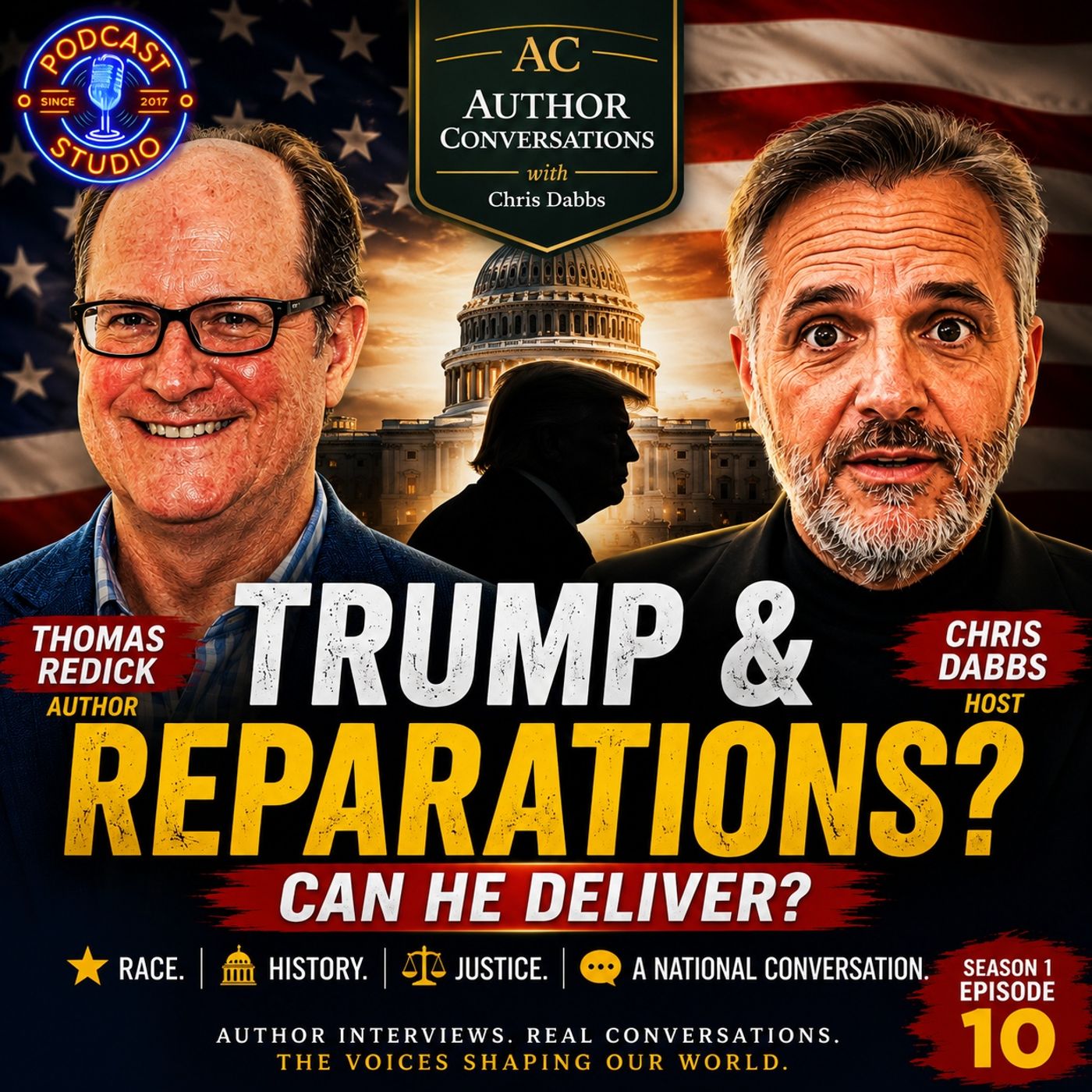
In this episode of Author Conversations, broadcaster and journalist Chris Dabbs speaks with author Thomas Redick about his controversial and provocative book Time for Trump’s Patriotic Reparations.
The discussion explores slavery, Jim Crow laws, lynching, historical injustice and whether the United States is approaching a political tipping point on reparations. Redick argues that, despite Donald Trump’s deeply divisive reputation on race, he may uniquely be positioned to force a national conversation around compensation, accountability and historical justice.
The conversation examines:
🔹 The legal challenges surrounding slavery reparations
🔹 Jim Crow, lynching and racial violence
🔹 Why California and New York are already exploring reparations
🔹 Historical precedents including Holocaust and Japanese-American reparations
🔹 The politics of memory and national identity
🔹 Whether reparations should involve money, housing, opportunity zones or systemic reform
🔹 Why Redick believes America has delayed this conversation for decades
This interview is not an endorsement of any political position.
It is a journalistic discussion designed to critically examine the arguments raised in the book.
🎙️ Hosted by Chris Dabbs
📚 Guest: Thomas Redick
📖 Book: Time for Trump’s Patriotic Reparations
Become a supporter of this podcast: https://www.spreaker.com/podcast/author-conversations-with-chris-dabbs--6905413/support.
Every book has a story beyond its pages.
In Author Conversations, broadcast journalist, presenter and newsreader Chris Dabbs sits down with the writers behind some of today’s most fascinating books to uncover the research, experiences and ideas that never made it onto the printed page.
Featuring bestselling and emerging authors from around the world, each episode goes beyond the blurb to explore the real stories behind the writing.
From untold historical discoveries and groundbreaking scientific research to personal journeys, business insights, faith, true crime and the human experience, every conversation is designed to inform, challenge and inspire.
Drawing on more than two decades of professional interviewing across radio, television and digital journalism,
Chris creates thoughtful, in-depth conversations that give authors the time and space to tell the stories that matter most.
Whether you’re searching for your next great read, fascinated by the creative process or simply enjoy intelligent, long-form conversations, Author Conversations offers a unique opportunity to discover the people, ideas and experiences behind remarkable books.
Real authors. Real stories. Real conversations.
Hello, and welcome to author conversations with Chris Dabs. Now, today we're discussing a book that steps directly into one of the most politically and emotionally charged debates in modern America, reparations, race, history, and the role of government. My guest is author Thomas Reddick, whose book Time for Trump's Patriotic Reparations, argues that the United States may be approaching a moment where reparations for black Americans move from political theory into practical policy. The book examines the legacy of slavery, reconstruction, Jim Crow laws, lynching and historical injustice, while also making the controversial argument that Donald Trump could become the political figure capable of delivering a federal reparations framework.
You know, it's a book that combines history, constitutional arguments, public policy, modern political analysis, and it raises difficult questions about accountability, legality, national identity, and how societies confront historical harm. Now this conversation is not an endorsement of any political position, by the way. The aim is to explore the ideas in the book critically, thoughtfully, and in depth. So with that said, Thomas Reddick, welcome to conversation. Well, thank you for the kind words, and I do appreciate the chance to talk about this time, Lee.
But he couldn't be more timely. Could it really? That's face it. So yeah, absolutely. As we're recording it right now, I mean, you know, I guess Donald Trump is really at the forefront of geopolitics right now, okay? At the time of recording, and I can't imagine that's changed too much, but when you're viewing it viewers, but your book, Thomas, makes the unusual argument that Donald Trump, a figure who's often criticized by opponents on racial issues, could actually become the president who delivers reparations.
I mean, why do you believe he's uniquely positioned to do that politically? Well, his unique position is that he is the most racist president, maybe since Andrew Johnson or it, God knows who else could be more racist than him. Yet he is positioned because of his relationships with California and New York governors who are working on reparations. To propose a federal solution that has his name on it, and I think it all, it plays to his strengths that he is a deal maker. He loves to put his name on things.
And if anybody ever moved fast and break things, it's Donald Trump. So he is a person who is well positioned to deliver a federal solution that polls that were doing, I'm burning it, 25% support, which was just what the support was when Ronald Reagan gave $2.5 billion to the Japanese. So it is like so teed up its bizarre. Yeah. Yeah. Having him do it is also a very bizarre proposal. But I see it. Yes, he needs a federal guy. The next federal guy could do it. The next federal guy after that could do it.
But we need a federal solution. California is working on its thing, New York's doing its things are doing different things. We need a uniform federal solution to this very problematic issue. So I think, you know, I somewhat of an outsider in the US is interesting that, you know, for me to look at the political state of the nation there and see that, as you say, California is thinking about one way of doing things. New York state is thinking of another way or New York is thinking of another way. And that kind of, it's interesting because you want it to be a federal country-wide kind of agreement.
So what would happen if those states didn't agree with whatever Trump came up with, say, and decided to overrule it or to add to it? Is that how it would work? Well, it's interesting because this has happened in other federal preemption situations. For example, with guns, New York said, we're not sitting quietly while you preempt us. And they sort of started looking for holes. But what the federal solution did was give enough pressure that it forced the states to start thinking outside the box. And I do think if you do the federal solution, it's going to be the first reparations law.
There may be 20 of these. That's what they did with the Nazis. A bunch, they went back and back and back and back. So here we have the first federal law that will tell California. You don't get to do it. You pay into the Trump Foundation that we created by this law. And California might not sit quietly, but they do have the law preventing them from giving anything to anybody anywhere until they work with the federal government. So I think it's going to be a very unique use of preemption. It's different in a lot of ways than what we did with pesticides or with guns or other preemptive laws, because this one will trigger the national dialogue that we need.
And we have been delaying this national dialogue for at least 40 years, maybe 250 years. And it is also the 250th birthday of this country. So high time we got to deal with this problem that has been with us for 250 years. So really need to work it out. Yeah, it's quite interesting. Actually, again, I think another point to look at it is from the global perspective, of course, is that there's a lot of conversations that are happening around the world about reparations for slavery and those sorts of things.
And so I guess if the states were to go for that and actually federally mandate what should happen, then there are going to be massive ripples that go across the world, right? So what's your view on that? Well, I have a second book on indigenous reparations, which takes those issues apart and tries to deal with them. It's a hard book to write. I must admit, because the world has to come to the altar of reparations and do its business well. And it's not an easy path that we're embarking upon. I do think though, if the United States can come up with at least one solution and work out the very difficult issues it has with its own reparations approach, it will teach the rest of the world, you know, what can you do here?
Just as we're learning from the Nazis and a little bit from Ronald Reagan, the history of this is something that is going to be written in America first, I think. It is just so well teed up here for Donald Trump or the next president or the next president to take this issue and work with it and make sure that we do justice in the zero. Yeah, it's interesting. You say about doing justice because, you know, one of the most striking themes I think in your book is your distinction between, say, hang on, sorry, just just think about this for a second.
Actually, thinking about this, you know, as I'm saying, one of the most striking themes in the book is your distinction really between slavery era reparations is what I'm meant to say and reparations linked to, I guess, reconstruction, Jim Crow and the lynching that used to happen as well. I mean, why do you think it was important to you to separate those historical periods sort of legally and politically? Well, when I was first researching the book and I was told by my father after he saw a speech I did on it, write a book, Tom, so I read every book.
And it's clear to me that there's a path that we are following here that was made in history because we have basically a federal system and we have a civil war that we fought years ago. We spent humongous amounts of blood, treasure and pensions that were repaying well into the 20th century for the civil war. There has to be a credit for that work that we've already done. There has to be somebody to say our constitution has an ex post facto clause, which basically says slavery was legal, therefore you can't sue for compensation for it.
I have not in all my readings seen anyone take on that ex post facto clause. That's why I wrote my book because I thought somebody needs to talk about this. And frankly, there's so much we've done to these folks. You really don't need slavery to get the job done because there is a massive 150 years of being mean to people that really needs to get paid. It's much more recent and much more recoverable under the law. The law doesn't like to look too far back. It doesn't want to go into the injustice of the world going back to when we were bacteria.
There has to be a level at which we just say, okay, we were mean to somebody there, but we don't get to pay for that now. So we have statutes limitations, though, that we routinely toll for when someone has done child molestation, someone has done something involved and they couldn't get to court because they had a gun against their head. They do not enforce the sat limitations against people who have not been allowed to sue because of the various reasons. So this is clearly something that they can do and they should do.
And it's well into the world of doing it now, I think. Again, it's another point, isn't it? Where do you draw the line? 300 years, 400 years, 500, 1000, 2000 years ago. So I think that's one of the big arguments with this side of things. And also another argument, of course, is as you just mentioned, slavery reparations are illegally and financially difficult because slavery, as you said, was lawful at the time. And of course, the Civil War, as you also discussed, you know, carried enormous human and economic costs.
So critics, I guess they may say that long term damage caused by slavery risks, but it kind of risks minimizing the problem of it if you see what I mean. I mean, how do you respond to that? Well, as I mentioned before, this is the first law that we're going to do. Okay. Every expo's facto has many exceptions and I would be the first person to say somebody should do a law review article and really dig into why the expo's facto clause does not prevent slavery. There's people working in that area and I've talked with many of them and traded emails.
So I don't think that Civil War is completely gone because of my book. My book points out at first we need to get over it and we need to do something. It's not the end of the thing, but clearly there's an easy path and a difficult path. And I think California is having its struggle with the Civil War right now, which is why they're cutting off their payments at 1910 and not even looking at a lot of Jim Crowett. I'm speculating. I wasn't involved in that and I'd be first to say they were good to try to do it.
So they're working on it and it's a tough issue. Yeah. Well, yeah. Well, of course, okay, well, let's have a look at, you mentioned earlier on the historical precedents, including payments to Japanese Americans that were interned during World War II. And of course, the German reparations or the Nazi reparations should say following the Holocaust. I mean, do you believe that those examples kind of are directly, well, I guess comparable to the black American experience or are there important differences between all those?
Well, there are very much apples and oranges differences. But they're the precedent and as an lawyer, I do work on precedent. Somebody did this before. Therefore, we should do it again. And when you look at the Japanese, they did it pro-Rata, $2.5 billion, just paid out and they didn't try to distinguish. I think with this crime, we need to distinguish. That's why we create a foundation that works through the tough issues because that is the way to deal with the differences that we have with the blacks in America.
And I think with the Nazis, they went back and paid and paid and paid and we're going to do the same thing. We're going to have to pay. This is the first time we do reparations. It opens the door to getting back to the Civil War, getting whatever, whoever we left behind. You know, and that's clearly what the precedent we left, was left behind by the Nazis, was make sure you do it right. And if you have to go back again, do it over and keep meaning until you're sure you have remedied the wrong. Yeah.
I guess I see what you mean. So you sort of advocate using that as a model kind of thing. Well, yeah. Okay. Animal. I think that this really does, as you've already mentioned, indigenous rights and indigenous reparations. I know that that's another book, but that's got to come close on the heels of anything that comes from this, though, surely. Sure. They're joined at the hip and there's just no way to do one. Just as we see that we did it for the Japanese, why are we leaving these other people out?
Right? So the Native Americans in America have a very complicated situation to deal with. The indigenous of Africa have equally complicated situations to deal with. And they will need to be addressed. The Africans are meeting now and talking about it. How are we going to do this? So they're working through it. And they will look at what America does and say, well, we've got America doing the Japanese and the blacks and the Germans have addressed Jews. We really need to figure out our path here. Yeah.
Again, a seismic shock across the globe, isn't it? Really? That's it, yeah. That's it. Yeah. Okay. So thinking about how this has worked so far in history, one of the figures that you've mentioned is Kelly House, a reparations activist. I mean, what drew you to her story? And why do you think she remains kind of relatively unknown in mainstream discussions about reparations or actually anything right now? Well, I'm wondering who's going to make the movie about Kelly because it is a story for the books and for the movies because she was an activist in the early 1900s who basically said, I'm going to collect money from the blacks and figure out how to create a nonprofit that works this issue until I am then then she was thrown in jail by the federal government for misleading blacks and thinking we'd ever be nice to them.
A white guy was working in the same parallel path, nobody touched him because he's a white guy. We don't throw white people in jail. So it is a story made for Hollywood, I think, because here's a really nice lady who is doing a nice thing and what did we do? We threw her in jail. So they offered her an old folks home at one point and she said, that's not anything close to it. I want the cotton money that's left over from the Civil War. It literally was money ready to be paid, but she couldn't get her hands on it.
Wow. Okay, yeah, that is a story. I mean, I'm not aware of her. So that'd be quite interesting to look at. Not to write the screenplay of course, but just to think about it. So the book also touches on the politics of memory. Who kind of gets recognized as victims in history and who doesn't? I think you've mentioned the kind of why the Japanese, but no one else, right? Or the inter-Japanese and no one else. I mean, do you think that America has fundamentally failed to reckon with the legacy of Jim Crowe and racial violence?
Do you think that's what it comes down to? I think, yes, because it's such a big issue. Okay. It's a really hard one to get your arms around. We gave money to the Japanese and immediately there was HR 40 proposed by John Connors to take a look at our issues. We've taken 40 years and done very little of them in a few committee hearings to look at those issues. So I do think it's time to have a reckoning about this very big problem of our injustice to this group of people based on the color of their skin.
What the hell was going on there? Well, I think we need to come to grips with it. It was a racial crime that we need to do something about. Yeah. I understand what you mean. I think it's, I think as a lawyer, I can see where you're coming from, right? Because you're kind of like that being literally black and white about it. In other words, it was a crime. So we need to sort it out, right? It's so nuanced, so surely in terms of, and because there's no particular law right now, you can't be guided by, as you know, as we were talking about earlier on, by precedent.
I mean, you've got an issue where a whole group of people were treated not as people for several hundred years or a couple of hundred years. And so the legacy and the history of that just sort of kind of moves forward. And it always seems to me that it's one of those things where, you know, asking that country, any country, if you like, who stops slavery at that stage to immediately change their whole viewpoint, generational viewpoint is always difficult. And unfortunately, that's just what's happened, isn't it?
Where it's the legacy of that is continuing, continuing, continuing, but doing the thing all the time, which is why you probably think it's just the right time for things to happen, right? Yeah, it's clearly, a lot of my friends have told me, well, that Trump, he is the most racist guy ever. And I think that makes him the perfect person. He's the least religious person and religious people love him. So I think we probably could have a similar thing go on here that we got the guy who is well positioned to bring a dialogue.
It's not going to be end of the dialogue, but it will be the dialogue that needs to happen in America. And he's already triggering it because he's doing racist things. So he will have to have say in our 250th birthday, we're going to do something really big for the people that we've been really bad to. And it's his choice. He can either take this banner that's been handed to him or he can hand it off to the next guy who's got a better Congress to work with or whatever he needs to get the thing done because it's clearly a tailor-made, Trumpian solution that is sitting there waiting to be picked up and waved around and put your name on it and do a deal and get her done, right?
Well, we do it. I can't say it's a better than 50/50 chance and I'm a very optimistic person. Yeah. Well, it's interesting to think about that, isn't it? Because you can, from one point of view, from the optics point of view, I can really see him going for it because of course that gets him the headlines, gets him, you know, not so much the votes I guess for him, but you know, it gets him his historical legacy, doesn't it? Or another one, another wrong on the historical legacy. So I can see where, you know, it would appeal.
And as you say, we like to make a deal, likes to mix things up, that makes things up a bit. So yeah. You don't want to leave it to somebody else. I'll tell you that. So if he can do something to stop Gavin Newsom and his tracks on the reparations movement that Gavin Newsom is leading, he will do that. And as you pointed out, that won't be the end of the story because these people who have been shut down and are not going to sleep long on the issue of what they could do about reparations. Yeah. So you mentioned that reparations, you know, could potentially include families affected by lynching across different ethnic groups, including, what, Hispanics, Asians, you know, was broadening the framework beyond black Americans to deliberate attempt to create a sort of wider political support for the argument, do you think?
Well, I do believe that when Trump was elected, he was elected and he thanked the blacks and Hispanics of America. And they were lynched and lynched in hundreds of people that are not included on the National Memorial for Peace and Justice, which are hanging columns, recording every lynched person. It's a wonderful tribute to the history of lynching in our country. It's based in Montgomery, Alabama. I do think they're, the lynching issues are something that is much easier for the lot of them to get its hand around because it's a wrongful death claim never made.
And the statual imitations was prevented from happening because, for example, when Tulsa was destroyed, the little city of Greenwood was bombed from the air. They did not let those people forever go to court. They said, nope, nope, you can't come to court. And only now when they've let them come into the court, now the courts are saying, well, the statual imitations is run. I'd think that's clearly an unjust legal opinion that has come out of our courts that needs to be fixed on, can only be fixed by our government.
Yeah, I suppose the statute of limitations, as you were saying earlier on, wasn't it? You know, really thinking about how far back to go as well and that sort of thing. But, you know, the question I think there is, if you're talking about generational, generational times, I mean, that's the issue, isn't it? Really, I'm thinking, okay, well, let's move on from that then. Some readers, they'll inevitably see the title alone. And just assume that the book is partisan or ideological. Do you think that this primarily is a, or do you feel that this is a political book or an historical book, maybe, or maybe even a policy proposal, is that what you're getting at?
Well, I'm certainly proposing that the government should do something. So I'd call it a policy proposal and it's something that really has the teeth that they need to deal with because I've given them the preemption issue, which no one else talked about in any of the literature. I give them the expo's factor clause, which is I pointed out as Swiss cheese, but it's a good start to get past that civil war problem. And they're well positioned now to move on it. They've got the polls that they needed.
The same polls that were running when Ronald Reagan moved 25% are tracking now, they're going to be up over a majority in my lifetime. And the time is right now to do something about this 40 years after the other two and a half billion went out, we're going to do something probably measured in the trillions, but it's going to have to get done and it's going to be done by this Congress, the next Congress, one of these Congresses here. They'll be able to give us the solution to a very difficult problem the Americans faced.
And I think it's, it'd be nice if they did it on their 250th birthday, but maybe they have to wait for the 51st of the list. He said, yeah, that's true. You know, I just thinking as soon as you mentioned trillions, it gets me a bit sort of, I just then I start thinking why you've actually suggested a foundation because how can you manage that kind of thing if that happened, right? I love this one. Pandemonium, wouldn't it? Can you imagine? I can imagine it would be a very grand thing that would attract the attention of California in New York and all the foundations that are donating to other process would say, well, this is the only game in town and they have a lot of money and they are doing good things.
It doesn't have to just be money. I mean, money is definitely a part of it. Cash payments, but opportunities zones, better laws, protecting blacks, any number of things that we are falling down on could be fixed here and give them what they need. As a fact, actually, I was sorry, I was going to say, actually, that's a really good point. I'm glad you brought that up because we've only really assumed we're talking about cash money, right? So what are what other ideas have you mentioned in the book that people can sort of chew on?
Donald Trump has been big on opportunities zones. Now, there are people who would say, that's just gentrification and it is complicated, but it's necessary. It's part of what we have to do to bring around a new world where people are justly treated. And I do think that Donald Trump, because of his deal-making side, would appreciate that there's a mix of different things we're talking about in this reparations arena. And there's opportunities that can be created under capitalist systems that could give people the opportunity to really be part of our capitalist society in a real way, not sports and entertainment and other aspects, but really bring them into the world of capitalism and see what they can do.
Yeah. Was that the town you mentioned? Greenwood? The one that was? Yeah. Historically, that that was, from what I know of that, that was a bit of a nightmare, wasn't it? And you mentioned gentrification clearly. So it could be tricky again, couldn't it? Yes, it could get very difficult, but I do see a chance to bring around a new world where people are justly treated and justly given. But just even if you look at housing in America, we have been so bad about blacks and housing because we didn't give them loans as farmers, we prevented them from getting mortgages necessary and necessary locations for houses while our wealth was building their wealth was not.
And there's a ten times difference in our wealth between white and black and America caused mostly by the way we dealt with housing. So we really need to fix this and it's not an easy thing to fix because people like to have their home equity, you know, they don't want you to go after that. Yeah, that's true, that's true. No, well Thomas, we're running out of time here. So we could talk for hours. I could talk for hours. Yeah, yeah, right. No, I find this fascinating, you know, social history, reparations and fairness, it's just something.
But anyway, before we bore or I bought to really people, finally, when readers finished the book, okay? And to you most hope that they reconsider, okay? Is it America's history, the modern political system, or the way that reparations are discussed in public debates? Well, I believe that the world is coming around this issue, that's why the polls are moving up. So someone will read my book if they join the next round of people who are saying, okay, I know I shouldn't pay for what my grandfather did, but boy, this is a real problem.
And I really think we should do something. There's going to be a lot of people who are waking up to this issue. It's at 25% now, it'll be 50% by 2040. And I do think if my book can help move that process forward a little bit, it's done its job. And I do, I praise the people around the world who are doing work on reparations. I'm not trying to be the best at it. I'm just helping them get their tail to all because it's really a big problem that America has yet to ever deal with. Yeah. Well, I can see that, you know, obviously, churches or universities, corporations, you know, that they sort of, that they do have a part to play as well.
I mean, how do you think that they could actually help, as you say, you know, to get people used to the idea, I guess, and to push it forward? Well, they've already been doing that. And they're going to keep doing it. The federal law, the pre-empts of states, doesn't touch anything going on in a search or a foundation. And those folks will have to realize there's a new world, there's a federally-primptive law. So we're not dealing with the California folks or the New York folks. We're dealing with the Trump Foundation.
And that's where they're going to have to work. And that actually might be the way that man gets a, get out of jail free card because if he can create a foundation that actually attracts the attention of good thinking, right thinking people, to get a good thing done, he will have burnished his legacy as he would like to do, I think, and given us something we could thank him for, that he's put his name on something that is getting the job done. Well, we'll see. Yeah, we'll see. I think it's going to be fantastic to think about this.
I mean, yeah, the changes across the globe would be something, as we discussed earlier on. Thomas Reddick, we're out of time, I'm so sorry. But listen, thank you for joining me in this conversation and viewers, listeners, thank you for watching or listening. It's fascinating conversation, isn't it? Let us know in the comments below what you think we could and would and should happen, okay? So really, whether people agree with the arguments in time for Trump's patriotic reparations or strongly disagree with them, your book, Thomas, is clearly a book that's intended to provoke debates about history.
So let's get people involved in that. And let's think about the accountability and the unresolved questions surrounding race and justice in America, but elsewhere too, right? So listeners, viewers, if you've enjoyed this conversation, don't forget to subscribe, leave a review and share the episode and get the discussion going. You can find details of Thomas Reddick's book in the description down below and until next time. Thanks for listening to author conversations with me, Chris Dams and Thomas Reddick.
Thank you for joining us to talk about your book. Thank you. I really enjoy this conversation as it's, it's, you know, go on for hours, but we do need to end here. It's like, we really could. Exactly right. Thomas, it's been fantastic and I hope to see you again soon. Yes, thank you, sir, and I appreciate the chance to talk about this book. Thanks. Take care. Have a good day. If you enjoyed this conversation, you can watch more author conversations here. [Music] (dramatic music)
 Apple Podcasts
 Castbox
 Castro
 Goodpods
 Moon FM
 Overcast
 Pocket Casts
 Podbean
 Podcast Addict
 Podcast Republic
 Spotify
 YouTube