Laure Stack on Once Upon a Boy & Howie the Unusual Bear with Chris Dabbs
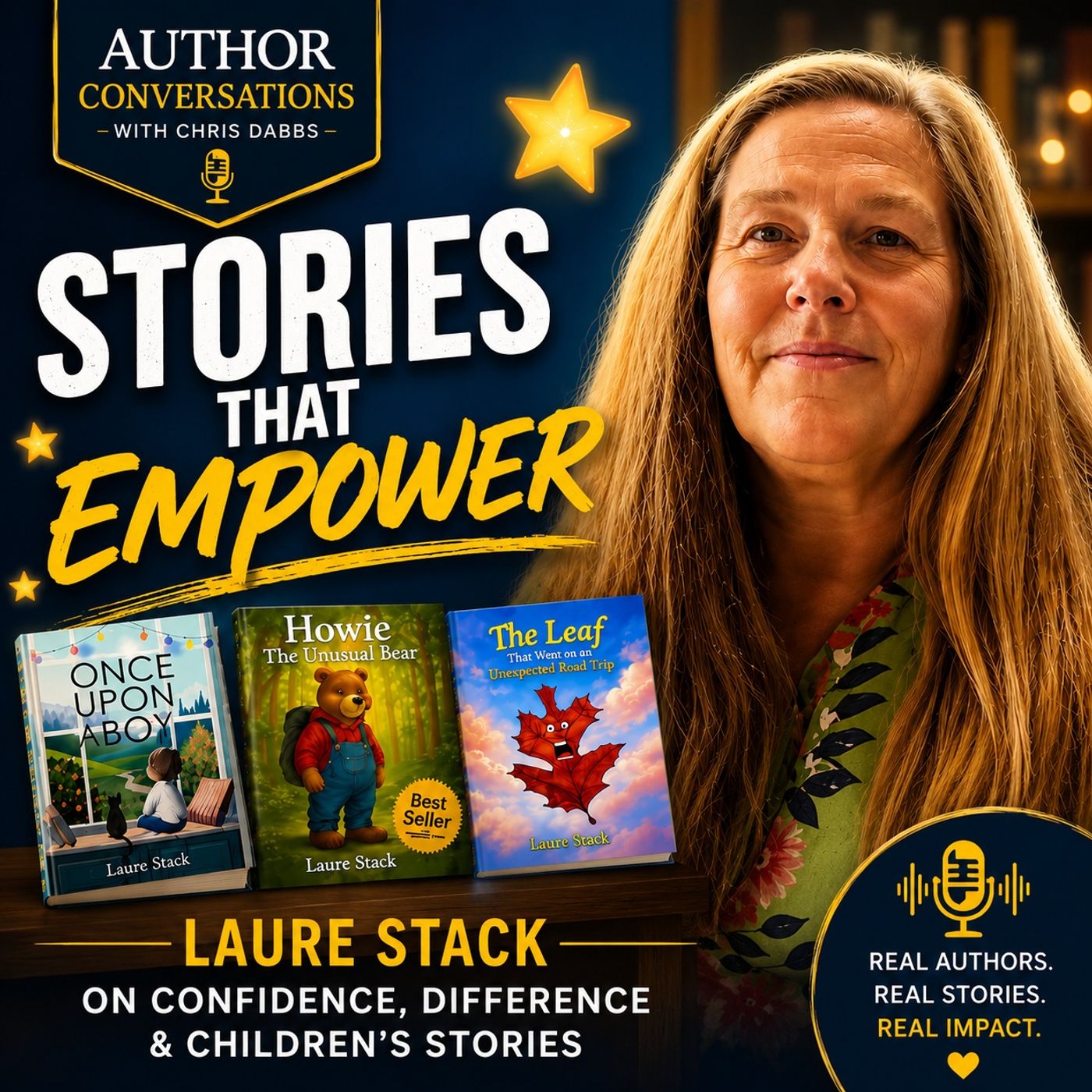
Laure discusses how her classroom experience shaped her writing, particularly the children who shut down when they believe they “can’t” do something. Her book Once Upon a Boy explores self-belief and the idea that children need encouragement to recognise their own potential.
The conversation also looks at Howie the Unusual Bear, a story about difference, individuality and accepting children who do not fit neatly into the box. Laure explains how the character was partly inspired by her own son and by the many young people she met who needed reassurance that being different can be a strength.
Chris and Laure also talk about The Leaf That Went on an Unexpected Road Trip, a story inspired by a real leaf on a car journey, which became a gentle way to explore fear, change and learning to trust new experiences.
This is a warm conversation about education, childhood, imagination, nature, confidence and the importance of stories that help children feel seen.
Episode Notes In this episode:
Laure Stack reflects on her move from education into writing
Why children often shut down when they believe they cannot do something
The real-life inspiration behind Once Upon a Boy
How Howie the Unusual Bear explores difference and acceptance
Why bullying often comes from misunderstanding
How a leaf on a car journey inspired a children’s book
The role of nature, animals and imagination in Laure’s storytelling
Why children need stories that help them feel capable, valued and understood
Youy can watch Chris' conversatiuon with author Laure Stack on YouTube here : YOUTUBE LINK
Become a supporter of this podcast: https://www.spreaker.com/podcast/author-conversations-with-chris-dabbs--6905413/support.
Every book has a story beyond its pages.
In Author Conversations, broadcast journalist, presenter and newsreader Chris Dabbs sits down with the writers behind some of today’s most fascinating books to uncover the research, experiences and ideas that never made it onto the printed page.
Featuring bestselling and emerging authors from around the world, each episode goes beyond the blurb to explore the real stories behind the writing.
From untold historical discoveries and groundbreaking scientific research to personal journeys, business insights, faith, true crime and the human experience, every conversation is designed to inform, challenge and inspire.
Drawing on more than two decades of professional interviewing across radio, television and digital journalism,
Chris creates thoughtful, in-depth conversations that give authors the time and space to tell the stories that matter most.
Whether you’re searching for your next great read, fascinated by the creative process or simply enjoy intelligent, long-form conversations, Author Conversations offers a unique opportunity to discover the people, ideas and experiences behind remarkable books.
Real authors. Real stories. Real conversations.
Hi and welcome to author conversations. I'm Chris Dabbs and today I'm delighted to say Laure Stack you know what? It has been like an educator for 20 years. Can you believe that really spending her time in her career supporting children through their struggles and dreams?" Now she's an author as well and her deep understanding of young minds leads her to her what, to write heartwarming stories. Who wants upon a boy how is the unusual bear and more future books, law hopes to inspire children to dream big and never let doubt keep them from reaching their full potential.
Well, good on you law, I've got to say, I love that. So first of all, we've got "Once upon a boy" with how is the unusual bear, the leaf that went on an unexpected road trip. I mean, you really are prolific aren't you as an author. Well, I've always wanted to write and I became a teacher instead and I didn't have time to write and so as soon as I retired it was like and I was working in the classrooms and I saw immediate needs and I saw things that were blocking kids and so I decided to write stories about them.
Right, that's interesting actually. So what were blocking kids? I mean, what age were you teaching? I actually worked with kids from kindergarten to seniors in high school. I substitute at all the schools. So you look after like, well, any child said that means you have got a lot of experience in dealing with different age children who are in a school environment, right? Yes. Wow. It's not just like being a parent, okay, where you've got your child at a certain time and they're growing up and then you have to deal with that kind of thing but for you being a teacher, I mean, you know, I can see that's quite tough really.
So was there a particular moment, say, in like your first book "Once Upon a Boy?" I mean, was there a particular moment in your life that influenced, I guess, Liam's emotional journey in the book? That really influenced the character of Liam. He was actually built on an actual child, Liam. And the Liam that I worked with was special ed. He was in a SDC class, but he was the cutest thing ever. And what I noticed is in school, the minute a child couldn't do something or they thought they couldn't read or they couldn't do the math, they didn't understand, they just shut down.
They just, I can't do that. I can't. In the minute they do that, they're creating their reality. And so this book was written to let kids know you are in charge of your reality. You create your reality. And you have to believe in yourself because the minute you stop believing you can do it, you can't do it. There's no way. So in this book, Liam discovers that he can create all kinds of things. It's a fantasy story. It's not a realistic story. But he develops all these things, children in a play set and all these things.
And as soon as he sits back and goes, how in the world did I do that? It all vanishes. And you know, he thinks, did I just make this up? And then he sees a remnant from the lunch and he realized, no, I did create that. And then he brightens up. And what was meant to convey is the minute you believe in yourself. And really know that you can do things is, you know, when you have the power to create wonderful things. Yeah, absolutely. And you know, I think that's one of the things that sort of like breaks my heart actually with children who have got no self-confidence and really don't believe that they can do these kind of things.
I mean, so you really think that it comes down to fear or doubt about a child's ability to pursue their dreams really that affects them. I mean, does that come from home? Does that come from their own psyche? Does it, what does that come from, do you think? Well, what I've seen, there's a lot of children that come from homes that aren't so great, homes that aren't encouraging, that don't build them up. And they're pretty much on their own with the TV set. So a lot of these kids, it is based on home life.
But then again, there's kids that have a wonderful home life. And they just, it's too hard. This is too hard. Math is too hard. A writing is too hard. And it's just easier to give up. But you know, I watched the Olympic, the kids in the Olympics, the last Olympics. And all of them said, I went through trials and tribulations. I faced so many roadblocks, but I didn't give up. I never gave up. And that's why they were there competing. And it's the only way they can do something that their lives is to believe that they can.
Which I mean, again, I think you feel a nail there, I haven't even on the head. As far as athletes are concerned, they've got the support system around them. Sure, of course, that helps them, you know, coaches and things like that. But they still have to believe in themselves, don't they? Yeah. And you know, children, even if they don't have a home, you know, ra ra team that's that's spurring them on, it's school luckily. Those schools have dedicated staff, whether it's teachers or other people that work there.
And every single person is dedicated to every single child on that school that they feel safe and welcome and are in a healthy environment to learn. And so, well, that's interesting. So, to learn in the book has pushed himself forward and, you know, done things now and believes, I guess, in himself. I mean, what sort of advice do you think Liam would give to people who ask him if, you know, who are discouraged, maybe, you know, children who are discouraged? What do you think he'd say to them? Don't give up.
Don't give up. Don't ever give up. You know, every dreams are what are help people through life. I mean, from very little kids, they have dreams and goals. And it is so important that they know that they are exactly where they should be and that everything will work out all right. But they have to try. They have to take on difficult things because that's life. And so, it's nice that most children, I can say, have mentors at school that are propping them up and going, you can do it. You can do it.
But they just need to believe. Yeah, it's just so sweet. Yeah, well, you know, that's down to adults as well, isn't it, to help them along? But yeah, it's a shame that sometimes a home life gets in the way of that. But okay, let's, everyone listen. I mean, you know, that's got to be a really good thing. And just quickly on that, I mean, what sort of conversations are you having with readers, you know, through reviews and things like that that have moved on and have they, you know, have you had some positive stuff as a regarding family moving on with these sort of things?
Yes. Well, I've shared these stories with children before they were ever published. And they always had a good reaction. They always understood that this book was there to help them realize that they have potential. They all have potential. No matter what their strengths and weaknesses are, every child has value and potential to do something. They just have to feel good about themselves. Because when you don't feel good about yourself, you're just kind of muddling through and so those are the kids that I kind of watch out for when I'm teaching.
Yeah, those are the kids. Well, that's, that's good to hear. Excellent. So talking about that muddling through and everything onto book two, then we've got how we the unusual bear. What can you tell us about this one? This one also originates from the idea that today kids are so unique, very, very different than when I was in school. I mean, when I was in school, no one had purple hair, you know, no one wore crazy outfits that I can remember. And the kids today, they're so different and the way they dress, the way they appear to their peers.
And it can produce a lot of bullying. And what that stems from is I don't understand you. I don't understand your look. I don't understand how you talk, how you feel, how you think. And so I'm just going to avoid you. And I think it's so important if kids embrace who they are, you know, this is who I am. This is what I love. This is what is important to me. And they just, you know, again, they don't give up. They stand by how he, he's friends with everyone in the forest, not just bears. But he doesn't live like other bears, you know, he builds his own log cabin.
He has his own garden, so he doesn't forge for food. And he, yeah, he sleeps in a bed. He has a library. He's snowboards and he keeps himself quite happy. And you know, he's looking for his bear. He's looking for his person. And in the meantime, he makes his life as happy as it could possibly be. That's what we all need to do, you know, as to just know who you are as a person and that that has value. And it coming from my own life. I mean, I was bullied as a kid. And I had to, I had to just get through that.
And actually what I did, if I had time by myself and there wasn't anybody to play with, I would write. I would write. I would research animals, plants, and I'd make my own books. So that's where the writing career started. But I totally understand the kids that are different. And the kids, they want to be accepted for exactly who they are and know that they can be successful whoever they are. You know, because everybody has strengths and weaknesses and we need to use those strengths and build up the weaknesses.
Yeah, that's so interesting. I mean, people are changing, aren't they? And school is very different from when I grew up and obviously as you were saying, when you grew up, I mean, even watch now TV shows about say school days as it were and you look back at the ones, you know, and everyone's regimented, they all fit in that they've always got the low-in-ers, the ones or two's who never fit in and they're really upset usually in a film, right? So how do you think that how a story can help children and teens as well, right?
Become kinder towards others and perhaps not so dismissive or nasty or unaccepting. How do you think how we can help with that? I wrote it for young children on purpose. So starting in kindergarten, they know that whoever they are is just okay, it's fine. And they're going to go somewhere, that they're important, their ideas, their feelings are important and they can use these things to get through school in really creative ways. Because the kids that aren't academic, they find other ways, they find theater, they find working, they find automotive or whatever in high school printing.
There's some thinking of all the classes that are available and there are so many opportunities, especially with AI, for them to do so many different kinds of things. So you know, we need all those different viewpoints. We need all those different ways of looking at the world because that's what makes the world go round is we're all different. Yeah, that's true. And I think that obviously, as you say in kindergarten, the earlier that we sort of understand that, the better for humanity, hopefully in the future, right?
So how do you hope that adults respond, you know, after reading this story to their children and with their children? Do you think it? Do you hope that that happens? And I mean, have you heard of any adults who thought, who said to you, oh wow, you know, I've heard it. I've heard it. I've heard adults say this book was important for me, as well as Liam wants upon a boy because it is a universal thing, you know, to succeed in this crazy world, you have to believe in yourself. You just, you have to, and you have to be okay with who you are as a person and accept who you are as a person.
And then others can feel free to, you know, to join you and kind of go through life together. But it's the fear of difference. It's the fear of, you don't look like me. You don't act like me. And so this causes, this will cause bullying. And so I think from the get go, we have these conversations with children. And we have these conversations with adults also. And this can help them guide their kids through school and through those difficult times. Yeah, excellent. Yeah, good. I mean, you know, great.
So we're talking about using it as a kind of handbook or some sort of manual as well, right, to help people, to help their children, which is great. You know, maybe you didn't really plan that when you first started, but it sounds like a really great thing. So, okay, so once we book three then, which is, yeah, which is the leaf that went on an unexpected road trip, hey? So tell us about this travel, movement, core of the story. What's this about? Well, it's based on a true story. We've all had that leaf on our car that, you know, and this one trip about two years ago I took with a girlfriend.
There was a big oak leaf on my car. And I thought, oh, by the time we hit the freeway, it's going to be gone. But it wasn't. The little part came up and this leaf was with us the whole trip. And so I created a persona for this, this leaf. And I told my girlfriend, I said, I'm going to write a story about a leaf that goes on an accident road trip. Now the leaf road trip was not my road trip. I made the road trip up. But basically what that book deals with is the fear of the unknown, whether kids are starting a new school, a new class, you know, new opportunities, new things happen.
They move to a different home. They're going to have. They're going to have things that frighten them and things where they're not quite sure how things are going to work out. And so the leaf is terrified because he lands on this car and is taken away from, you know, everything is ever known. But he comes to trust these girls. The girls notice the leaf and start a relationship with them in this trip. And by the end of the story, the leaf is grateful that he's had the experiences that he's had. And any trust, he has trust in these people.
And he winds up back home where he started. And so it's all about getting through, getting through your fear, you know, your fears of unknown situations. Yeah. And it all turns out good in the end, right? Yes. Yeah. But it takes him a long time. I mean, he has to go through a lot of scary, you know, scary things that happen to build that trust and to know, okay, I'm going to be okay. And kids need to know that too because it is frightening to go to a new school where you don't know anybody. A new, I mean, right now the kids from middle school, we're going to be going to high school and I've asked them all, are you ready?
Are you ready for high school? And they're all like, no. And I said, you know, you are going to have so much fun. You are going to have a blast. But it's the unknown. And same with I saw the elementary kids at the middle school the other day and they came over for their orientation. And, you know, it's scary. Elementary is kind of like a little cocoon. And then middle school is where you get to shine who you are. You know, they get to be whoever it is that they want to be. And it's interesting watching these kids on their journey.
Sometimes I've seen kids all the way around elementary, all the way through high school. And it's crazy watching them through their life and how they change and develop. No, I know what you mean. I'm a lecturer at the university as well. And I see that, you know, with the undergraduates when they come through all the way from the beginning. And that's just like three years and they're quite old, right? So, you know, it's quite interesting. I know what you mean. It is nice to see that. And of course, my own kids as well.
So what about one thing that I mean, I understand why, you know, you've had a leaf. You saw the leaf on the car, which is a very sweet story, right? To be able to think about that. But how do you use nature in shaping the story's message? Um, my mind just works that way. I love animals. I love nature. I live in the mountains. We have bears. We have raccoons. We have bobcat. We have eagles. Um, I just saw a bald eagle on our lake the other day. And that was really special. And we have deer and living up here just, it is, it's so great.
The interaction between the animals and their environment. And so my fourth book actually that is in the works is about my animals at home and how they interact with each other in funny ways, how they interact with my husband and I and the wildlife. And it's humorous. Um, it's, it's a funny book. It's got like 11 parts to it. I don't know if you'd call them chapters. But, um, yeah, I, I marvel at nature. And I watch my animals intensely. I watch other animals intensely. What do they thinking? What do they feeling?
You know, what are they experiencing right now? And that's, you know, so my whole world really is nature. I live up here in the mountains and I ski and I hike. And I'm also about the ocean and I've swam of whale sharks and real sharks and, and my next adventure is going to be swimming with whales at some point. But, um, yeah, I, I gravitate to animals in nature. Uh, that's really sweet. I mean, I think obviously, I view as I can't, I don't think saw your cat at the beginning, right? So, uh, your cat was wandering around it.
Do you have any other pets? Oh, pets. Any other pets? Oh, if I left them in, you'd see the, we actually, um, the dog that's in my story, um, actually passed away from a horrible dental accident. He, we've dropped the dog off at the vet to get a tooth removed and they gave him too much anesthesia and he passed away and he was like six years old. So we didn't have a dog for over a year and then we were convinced that the spirit of our old dog could lead us to whatever dog we were going to have. And we went to a shelter and as soon as my husband saw this one dog, he started crying and he said, that's the dog.
And I said, okay, so we brought her home named her Lexi. She was pregnant. Nobody knew. Oh my gosh. So it's like surprise. In a couple months, we had five puppies. Yeah. So we, we kept two of them. So we have a mini dog pack and I've got two cats and, um, yeah, it's quite the household. Yeah. I bet it is. Right. So I can understand where you're talking about interacting, you know, with the, the other animals interacting with the family animals, each other, but get, I guess. And then the wildlife as well, you know, for readers who don't, or listeners who, who can't get, you know, living in the mountains with bears, you know, going into town and like, we're rummaging through garbage bins and all that sort of raccoons and all that.
It sounds lovely. I've got to say, I am blessed to live here. I am truly, truly blessed to live here. Yeah. Absolutely. So, okay. I have two, I have two other books that I can tell you about that are in the least as well. Because I'm just, once I started writing, I didn't stop. Why not? Yeah, exactly. I like weird stuff. Um, I mean, my mind is just, I, it's kind of bad of a child, but have you ever heard of a cryptid? No, no, I haven't gone. Um, a cryptid is like Bigfoot. Oh, right. Okay. Okay. So, a cryptid is a creature that people have seen, a lot of people have seen, but hasn't been scientifically proven.
And so, I'm fascinated by these kinds of things. And so, I researched the United States every single state in the United States has about five cryptids. Almost every state has a lake monster, Bigfoot, and flying things, and it's crazy. Right. Yeah. So, that book is coming out and that book will have like 250 pictures in it of the weirdest stuff you've ever seen. Literally. And then I love sharks. I love being underwater. And so, I wrote a book, sharks, and it's, it goes into the eight orders of sharks and the different sharks that are in each order, the characteristics of them from teeny to large to ancient, I mean, there's an ancient shark out there right now.
And several hundred years old. And it's, it's just fascinating. So, and that will have about a hundred pictures in it as well. Well, that's a sick, wow. Honestly, no, I mean, you know, she said, I can just imagine your life. Well, can I? Yeah, I think so, just a little bit. So, you're writing, you're enjoying yourself, you've got the recons coming along and asking you for some food. I said, you know, you're doing it in Disney. You know, they come up, you know, that sort of stuff, right? So, oh my gosh, that sounds weird.
You need to tell everybody which state do you live in? California. All right. Okay, North or South? Oh, North, I guess. So, the California in the mountains, I live in Lake Arrowhead. Oh, okay, right, right. By a really pretty lake. Oh gosh, it's so. I am so blessed to live where I live. And the kids up here, I just, they're so blessed because when I taught down the hill, a lot of the kids had never seen snow. They'd never seen things. And I used to take them on personal field trips so that they could see snow, so that they could go hiking, they could do things that they had never done before.
And so I look at these kids and it's like these kids are snowboarding for PE, you know? And so it's like a different world up here. Oh, sounds great. Well, you know, it's always a way to get into a conversation and then we end up learning at a time and it's so annoying. You know, let me ask you one more question, okay? And then you can give us a recap of all your books if you don't mind. Sure. Okay, well, the three stories that we mainly talked about today, which you can obviously recap briefly on in a second, they all explore growth, right?
They all explore self-discovery, acceptance and understanding people. But one of the things that I wondered really was, you've got Liam, you've got Howie and you've got the leaf, right? Are they similar? Are they, you know, how are they connected emotionally or thematically even? I think they represent each child out there, really, because every single kid in school, you know, they all have their challenges ahead of them. They all have difficulties with things. And I think having people there to support them or having books that they can read that say they can do it, they can become something.
It's so important because this world's gotten so crazy. I mean, it's just like everything's upside down. So, you know, and how do you make sense of it? So they have to be pretty sophisticated, actually. Even the kindergartners, I find today, are pretty sophisticated. But oh, I don't want to go into this one story. But anyways, I have so many cute stories of kids doing cute things. But they just never cease to amaze me. Brilliant. Well, I tell you what, Lord, tell us about the books briefly and then I'm afraid we have to kind of shorten 'til next time, of course.
But yes, so which ones are available right now and where can they be, you know, bought or listened to or that sort of thing? Right now, once upon a boy that deals with making your dreams come true and what really stops your dreams when coming true is published. It's on Amazon. And I am developing. A website is going to be up soon where people can go to my website and buy the books. Right now, my website is a landing page. But it will direct people to the new website once it's up and running. My second book was Howie, The Initial Bear, and it's written, you know, my son was the original unusual bear.
My son did not fit into the box. He was always way outside the box. And I grew to just love that about him and just love that about other kids. So making your way through the world when you're different, that's what Howie's about. And the leaf that went on an accidental road trip is available right now. And it's about overcoming your fears, about situations or opportunities or things that happen that are out of your control. Because that's scary. Yeah. And I think you're right. Yeah. That leaf would be scared.
Yes. Absolutely. Well, then there we are. That's all the time we've got at the moment. I'm really sorry about that. But it's been great talking to you. And I love the way that we've managed to talk about things that are actually, you know, not just about a book, as it were, but a meaningful chat about why you've written the books and how they help as well, you know. So it's not just fiction. There's a real reason behind it, isn't there? Yes. And it's great to see. And you can really see that 20 years as an educator has really pushed that through you.
So there we are. Thank you so much for having me. No, no, no. Not a problem. It's been an absolute pleasure. It's been lovely to meet you. Well, thanks again. I hope we meet again soon. You too. Yeah. And yeah, well, have a great day. And I'm very jealous about where you live. So thank you. Okay. Bye. Bye. Thanks. Bye bye. If you enjoyed this conversation, you can watch more author conversations here. [MUSIC]
 Apple Podcasts
 Castbox
 Castro
 Goodpods
 Moon FM
 Overcast
 Pocket Casts
 Podbean
 Podcast Addict
 Podcast Republic
 Spotify
 YouTube