Author Conversations with Chris Dabbs - Sir Tim Melville-Ross
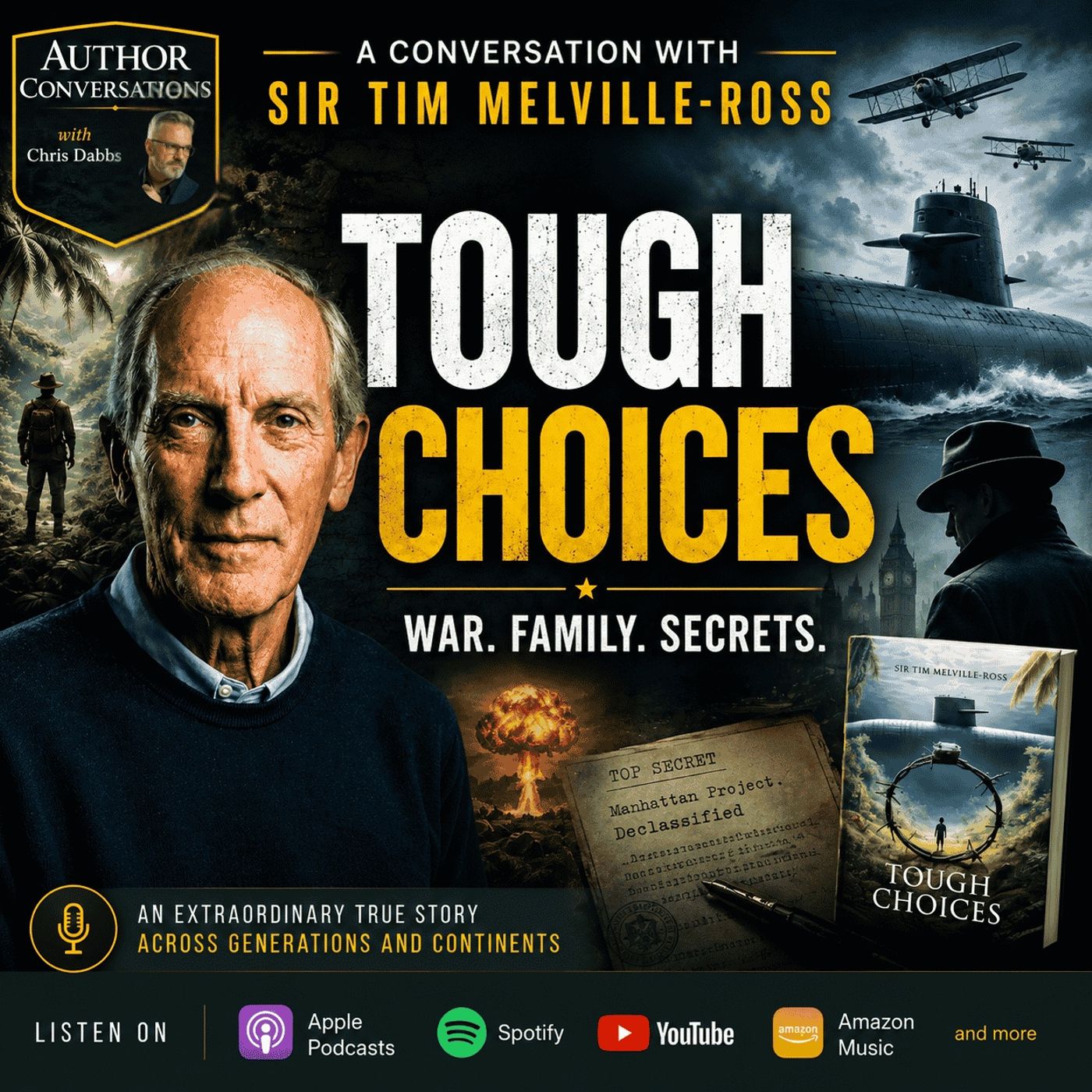
Spanning the late 19th and 20th centuries, the story moves from the Amazon jungle to early aviation, submarine warfare, espionage and the emotional aftermath of war. In this conversation, Sir Tim reflects on family history, courage, trauma, ambition and the difficult decisions that shape generations.
In this episode:
• Why Tough Choices began as a family record
• The real-life story of a 12-year-old running away to the Amazon
• Early aviation, war and survival
• Submarine command at just 23
• The psychological toll of conflict and espionage
• Why the women in the story became central to the book
• Whether family history shapes the next generation
Timestamps:
00:00 Introduction
01:43 Why Sir Tim wrote Tough Choices
03:37 Family letters and real source material
04:35 A young submariner in wartime
06:30 Fiction rooted in extraordinary truth
08:12 Running away to the Amazon at 12
12:38 Early aviation and a devastating crash
16:31 From grandfather to father
20:58 War, espionage and psychological trauma
25:42 The women who held the family together
27:11 How one generation shapes the next
32:13 Is the book hopeful?
34:24 Lessons for modern readers
38:25 Will Sir Tim write another book?
40:57 Final thoughts
Listen on your favourite podcast platform:
Apple Podcasts: https://apple.co/48XhkPq
Spotify: https://open.spotify.com/show/6oflXd2H8V0akKuPttSUfb
iHeartRadio: https://iheart.com/podcast/326179226
Amazon Music: https://music.amazon.com/podcasts/cc98bcc7-d3d9-4a55-8fba-fb23cbbd83dd
Subscribe for more in-depth author interviews and conversations.
Become a supporter of this podcast: https://www.spreaker.com/podcast/author-conversations-with-chris-dabbs--6905413/support.
Every book has a story beyond its pages.
In Author Conversations, broadcast journalist, presenter and newsreader Chris Dabbs sits down with the writers behind some of today’s most fascinating books to uncover the research, experiences and ideas that never made it onto the printed page.
Featuring bestselling and emerging authors from around the world, each episode goes beyond the blurb to explore the real stories behind the writing.
From untold historical discoveries and groundbreaking scientific research to personal journeys, business insights, faith, true crime and the human experience, every conversation is designed to inform, challenge and inspire.
Drawing on more than two decades of professional interviewing across radio, television and digital journalism,
Chris creates thoughtful, in-depth conversations that give authors the time and space to tell the stories that matter most.
Whether you’re searching for your next great read, fascinated by the creative process or simply enjoy intelligent, long-form conversations, Author Conversations offers a unique opportunity to discover the people, ideas and experiences behind remarkable books.
Real authors. Real stories. Real conversations.
Hello and welcome to author conversations. I'm Chris Stabs and today I have the pleasure of being joined by Sir Tim Melville Ross, who's a former director general of the Institute of Directors and an experienced business leader, who basically has spent many years advising organisations on leadership, strategy and decision making as well. He's now the author of Tough Choices, an extraordinary first novel inspired by the real lives of his father and grandfather, and it spans the end of the 19th century through most of the 20th century as well.
The book follows a story of adventure, conflict and resilience, and from the Amazon jungle to early aviation even, we've even got submarine warfare in there and even the world of espionage. It is a powerful exploration of family, ambition and the difficult tensions and decisions that shape our lives. This is going to be a good one so make sure you listen to everybody. So Tim, welcome and thank you for joining me. Thank you for the invitation Chris, it's very good to be talking to you. Fantastic, really looking forward to getting into not only your family history but also, well really, you know, the last 20th century and a latter half of the 19th century pivotal times.
We're talking about armed conflicts, we're talking about service to country and we're talking about all of these things so it's going to be really interesting. I mean, this is your first novel. Yet it tells this extraordinary story, this multiple generation story. It's like you could have written a television series or something along those lines, you know, multi-series, multi-everything. But let's start right at the beginning. We're inspired you then to write tough choices. Well originally it was intended not as a book but really just as a recollection of my experience with my grandfather and my father beefed up with quite a lot of materials I had.
And I was very well aware that my children knew very little of this and so my ambition was to get as far as just writing about it for their benefit. And it kind of grew from that through lockdown where I had plenty of time like so many people did and I thought, well, why don't I make a real job of this? And the more I wrote the longer the thing got and I realized that it was becoming unreadable because there was a lot of logic missing from the things I actually knew about. So my wife had the brainwave of saying, well, why don't you make up what happened between this event and that event and turn it into a novel, which is what it now is.
But it's built on the foundation of a great many very exciting events, terrifying events in many cases. And where I was ignorant of how this happened at what stage in their lives had happened, for example, I just make it up. So for that reason their names had changed and even I am Mike towards the end of the book rather than Tim just to hide my own identity. So that was the origin and then various people looked at it and said they thought, well, this is looking as though it might become a publisher book.
So I was given a lot of help by various editors and the result is what you see before you. Well, fantastic. There you are then. So that's great. So it's a fictional story that based on, you know, recollections from your family that you're passing. Very much so. We just want to example that. My father, I discovered in an attic, had written vast numbers of letters before, during and after the Second World War to his parents. And this was an absolute treasure trail of information about him and what he'd done.
Obviously limited to some extent during more time by censorship. But nevertheless, these letters have been there for years and years and years. I took my pain stakingly and read through them. Some of them pretty dull to be perfectly honest, but some of them very exciting. So that was an example of the kind of real material that I had to write the book. So your father wrote the letters or he was even involved in just to let everyone know. He was involved in this kind of military service and things like that.
But in the interwar years, I guess, right? So he could write freely at that stage. Well, before the Second World War, he was at school. He was to give you some idea of how young he was. He got his first command as a sub-mariner in 1943 at which point he was 23 years old in command of a submarine. It's terrifying. There's such young people with carrying such a burden in such difficult conditions, but others were being killed. So he was advanced really rather quickly. I think Adams didn't. Yeah, that much like the RAF, I guess.
Very much so. Yes. But of course, being a sub-mariner, there's a bigger weight and a bigger responsibility involved because of the men under their command. Absolutely. I mean, thinking back to when I was 23, I mean, no way could I have even, I don't know, run a parable, done anything, helpful to humanity. It is remarkable. And it was part of the problem that he had to cope with later in life when he went with the hell of being a sub-mariner and then the hell of having, as you've indicated, a bit of a spying career as well.
Wow, gosh, that is amazing. And that was before, sorry, in 1943, right? So that's clearly during. Wow, is all I can say. I just can't, I can't imagine. The mazes me, the pseudo-psychometric testing that must have gone through at that time rather than just putting somebody else in their shoes because you can't read it. Absolutely. And probably promotions based on really very little evidence of the ability of the individuals to cope with those sort of pressures. I think that's probably about it actually.
Very much so. You just get in there and make a break. Wow. Okay, so I mean, you know, because of these sorts of things, you know, some readers may feel that the story feels almost unbelievable, I guess, right? But because it's not though, because it's rooted in these real events, you know, I mean, okay, let's start by looking at characters who may or may not have been renamed, right? So what drew you most strongly then to Todd and Scott Peterson? How did that work? Well, the the the the the the the toad name was was was was for real.
That that was the nickname of of my grandfather. And the names, frankly, I just plucked out of the year. The Peterson name is some something I wasn't trying to imply any kind of Scandinavian link, although it sounds like it. Just literally imagination. So I'd started the process of telling things in my stories, which were not actually true. So why not just dream of an interesting sounding name, which is relatively common. Otherwise, if you come up with something very bizarre, you end up with people chasing around the same way.
I can't come across anybody else called this or that. Well, that's true. And I think that told Pete. Yes, it has got a Scandinavian ring to it, hasn't it? Yes. Yes. Well, Pete has been in particular. Yeah, you can't help but think about that. So actually, I think adds to adds to something. Well, it adds something I should say. I don't know, some some intrigue. I'm not sure. I mean, you know, but Todd's story, we're talking about it begins dramatically running away from home. Yeah, eventually traveling into the Amazon jungle as a young teenager as well, which is just something else.
I mean, why do you think that that happened with Todd? Is it what? Well, I mean, it's an illustration of the point you were making that some of what's in the book is almost unbelievable, but I have the evidence that he did indeed run away from home at the age of 12. And the reason for that was because, first of all, his mother had died in a swimming accident when he was three. And his father, my grandfather, was no, my great grandfather, a bigger button was away for the entire virtually the entire year.
He'd spent 10 or 11 months in the in the Amazon jungle. He was an anthropologist. And so he was just not around at home. So my grandfather was looked after by an aunt together with some of her slightly older children. He absolutely hated it and didn't like school, didn't like restrictions, the absence of his father. And so over several years, he cooked up this plan through, you know, before his teens for goodness sake. And carefully worked out how to get himself unbelievably from where he was to where his father was, which led to these extraordinary train journeys, just jumping on trains and hiding on them, working out how to get from one part of the United Southern United States to the next, with New Orleans being his target.
Why New Orleans? Because he knew that from there he could get, he could get on to whether he would be able to, because he didn't have the money, get on to a ship from New Orleans to Manaus on the Amazon. So sure enough, after many adventures which were in the book, he got himself to New Orleans, got himself a job as a cabin boy on this ship and was duly delivered to Manaus. And the very sensible, simple ingenuity that got him to the next stage was that he'd taken with him a photograph of his father.
So once he'd left Manaus and was heading in the direction of the first Indian or the other Indian, or the other Indian, some kind or a village or just people wandering around, he started showing people this photograph and it was often recognized because his father had been around these people. And slowly but surely a kind of respect grew around the boy. I mean, he didn't know this himself. He just found that people were being friendly and taking him by the hand and putting him in a canoe and people were taking him in the canoe to the next village and so on.
And sure enough, he gets to the village where his father is working at that stage. And when his father saw him, he was horrified. Where on earth did you come from to which one word answer was home? Wow. He was very worried about this and wanted to send him straight back for educating and all the rest of it. He simply wouldn't have it. So they stayed together for six years. Six years? In Junkal, yeah. Well, that must have been obviously nice for Todd. I can imagine the shock if my son had turned up at 12 years old and most of them would have spent other times there.
Well, actually, I can't imagine it. It must have been quite amazing. Do you know what? I think that your father probably said that on the selection board for his submariner position. And always passed on. He's definitely got that gene. I'm sure that was one of the stories he told. That would make sense. It would absolutely. Oh gosh. Well, well, that's what they were. There's a film in itself. So we need to sort the right answer to. Yeah. Okay. So his life then moves through exploration and early aviation as well.
Yes. Of course, your family was involved in all of these ground breaking times, right? So early aviation, eventually a devastating air crash. That's right. That's right. Tell us about that. Right. Well, he, after his father died, or I should say more directly, it was killed. They were two of them were together in Columbia by then. And confronted a set of hostile indigenous people. And his father was killed in front of his eyes. And he managed to get away from them. So he then had to, he returned to San Francisco and lived through the San Francisco earthquake, for example.
But went to university, studied anthropology, surprised, surprised, and found himself giving lectures. But also engineering and mathematics, which he was very strong. And he became intrigued by what he'd heard about the Wright brothers, who, as you know, flew the first part of the airplane. So he got in touch with them and with their very, very considerable help, made his way through the process of producing his own airplane. Lots of details of how exactly how he did that. And in those days, as the second decade of the 20th century, loomed with everlasting prospect of war, the expertise in aviation developed most in France, rather than the United States or all this country.
So he got himself two France. And just before the war started, he'd started manufacturing his own plane and got to the point where it was made and flyable. And he decided, as the war was literally on the point of breaking. There was talk of an invasion from Germany and France. So he thought, well, I think I'm better off out of France. So he flew across the channel in his airplane and landed. And there's quite a lot of story associated with how he managed to get himself involved with the British forces, because he was an American and therefore not eligible to join the Royal Air Force or the Royal Flying Corps.
It was there. So he became a test pilot for the nascent air force. And it was one of these aircraft that he was testing, that he misjudged and crashed and piled the thing into the top of a tree, fell from it with bits of the plane, engine, the whole bit crashing down beside him. It was very, very severely injured and spent most of the rest of the war as it was only just begun. In a hospital very close to the Salisbury plane, where all his flying was taking place, and was almost literally nursed back to life by this amazing nurse who became his wife.
And who is one of the key characters in this. As is my father's subsequent second wife, my stepmother, who also put him back to life for reasons we might go on to. And from then on, my grandfather's career was purely as too strong, largely academic, because of his disability. You know, he was certainly not fit for active service in any country. And towards the, as the second world war was looming, he became involved, I think, not to any very great degree, but in the early days of the development of the Manhattan Project, the development of the Atom Bonn.
And it was around that time clearly that the relationship between him and my father, who was reaching adulthood and wondering what the hell to do with himself, as war was about to break. And then the story moves on from that really quite interesting end to my grandfather's life, as well as the earlier parts. And my father takes over all the while desperate to persuade his father that he's got the sort of guts that his father reckoned he did not have. There was this real hostility between them having got gone on very well when he was a boy.
When he became a man, I think my grandfather thought he was just wasn't up to doing anything very brave. So my father said, well, to hell with that, I'll do something bloody brave and I'll go and not only join the Navy, but get into submarines. The thought of actually being in a submarine itself, let alone a wartime, just horrifies me. I do not know. So that was the transition. I'm sorry, go ahead continue. No, no, that was the transition from the story being about my grandfather to being about my father.
I'm amazed at your father. So I laugh because I'm so amazed. You know, it's like, I'm going to prove you wrong kind of thing. He doesn't do something as mad as that. But then again, if his father had gone and done, you know, to the Amazon at 12, you can, yeah, well, you know, if I did this son, how come you're not right? I kind of see that. You could see it. So Todd basically, physically disabled, but it's nurse back to life, as you say, and ends up marrying the nurse. Oh, doc, the nurse, I presume.
Yes, absolutely. Yeah, yeah, lovely Navy. Wow. So that's your grand mother. Yeah, yeah. That's my grandmother. Yeah. So, okay, the Manhattan Project as well, I mean. They, you know, say, you're your family. How did he be, I need to know about this because if he's an anthropologist and then a test pilot, how did he become, or do you know what his connection was to the Manhattan Project? I don't. I don't. And I thought it was sufficiently complicated not to try and make it up to any great degree. But I do know that he, the evident, the sort of evidence I have, our stories of motorcyclists turning up at his house at dead of night and handing over briefcases and exchanging obviously papers.
And so I have some of those papers still, which he'd obviously been working on, but not sent off with the weekly introduction to his participation in the Manhattan Project. That the reason he was part of one of the reasons is because he was still an American citizen, or had been an American citizen living in the United Kingdom by now. And I think the, the intellects in the United States were searching around as, brought as widely as they could. And he was a man who wasn't, had been an American citizen.
He changed his nationality, but also had a very considerable academic reputation, which was built up during that period of his, his disability, because he was able to write and corresponded endlessly, with various, various academic organizations that were looped into the kind of science that led to the Manhattan Project. So he pivoted as well in academia, so not just for an anthropologist. Yeah, oh yeah, very much so. Yes, yes, it's that. Okay, I understand it's incredible. Absolutely amazing. I can see why, you know, you wanted to write about this, to pass this sort of information on, you know, down the lines and to leave a legacy of the Manhattan Center.
Yeah, absolutely. Especially with Scott growing up in that shadow of his brother as well. I'm hoping that he could somehow shine by comparison with it, which I think he did. Well, totally, totally. So let's talk about then the psychological toll that your book talks about really, you know, the war and the espionage as well. You know, you could say that obviously your grandfather was well respected by the Americans, because I was going to say, surely they would have kept that very, very much American as it were.
I think quite famously it was pretty American. Yes, yes, and so he was regarded for this purpose as an American. Yeah, yeah, amazing. Okay, so the psychological toll then of war and espionage, I mean, how important was it for you to sort of show the emotional consequences of those experiences on your family? Well, I guess especially Todd. Yes, well, sorry, Scott. Scott, yes, no, Scott that I was most anxious to think about in my own mind, because I saw very little of my father. He was partly because of the Navy to begin with, but then being a bit of a wandering individual looking for employment in the in the in the corporate sector, he was a way a great deal.
And he found it very difficult to cope with his demons having, I think, probably rather unwisely married my mother before the end of the Second World War. So, you know, he was married to her roughly the same time he became a commander of a submarine, so 23. And I mean, bluntly, they just didn't get on. My mother, who I loved dearly because she was the only parent I had around for most of my childhood, just couldn't kind of get the tension that was inside his mind and the complexity of what he was going through, which of course is where my stepmother came in because she met up with my father, I describe how in the book, and they've clearly gone on extremely well.
She was an American citizen herself and she essentially held him together for the rest of his life. He became very very withdrawn. He was an author later in life and published several books which were based on his spying experience and his submarine experiences. But I had quite a lot of time, you were talking about my being involved with the Institute of Directors, which involved a great deal of communication on my part. And so at that time, I was trying to persuade my father to let me make use of my connections in the media to get him on radio or on television.
And he simply wouldn't do it. His, his, his, his symbols, very succinct statement was, I wrote the bloody thing, someone else can write, can, can sell it. Which says a little bit of something about, you know, he wanted to get this down, but then other people can make what they want to make of it. But so he was under huge, huge pressure all the time from this. I haven't said very much about his time as a spy, a very short period of time as a spy, but where he's so nearly got himself killed. I'm very lucky to come out of that alive.
And so the demons were with him throughout his life. There was one rare occasion when I was staying with him because I didn't see very much of him, but this was when I was an adult. And in the middle of the night, I, I got out, walked across the landing to the bathroom. And my father's bedroom door exploded and he came crashing out of it, looking all set for some contest or fight with whoever it was who was creeping around on the landing. And he stopped and looked at me very cross the ends of it.
God's sake, if you have to get up in the middle of the night, make more noise because the fact that I had crept around made him think that it was that by definition to him was danger if there was someone creeping around in the house. So anyway, very sadly my stepmother died before he did and the result of that was very shortly afterwards. He took his own life which underlines dramatically just how central she was to his survival and you know his reasonable success or certainly success as an author, for example, never mind his corporate success.
Quite a story. Yeah, that, you know, amazing, amazing. I keep I'm going to count how many times I've said amazing to you because I just think it is. I mean, and it's true though, you know, our spouses really make a difference to our lives, don't they? Well, they do. They do and my wife was very anxious that I had said so little about either of the either of the wives in earlier drafts and she was so right because the depths of the psychology that was at work and I was trying to describe very much depended in both cases what those lovely women did and I hope it comes through interestingly in the book.
No, exactly, I'm pretty sure that it does. Okay, this is the whole point though of a strong theme in your book. Okay, you know, it's that influence of relationships as there's we've just been discussing, you know, play by Maria and Marcelo, which is quite, which is interesting. I'm glad that we've been able to look at that. I mean, so if you think about the the way that you've tackled the trauma, the ambition, and the way that this is multi-generational, do you think that the experiences of one generation inevitably shape the next?
Then now I think so because if you worked, you went to the Institute of Directors, I don't know obviously much about your career, but if your father went into a corporate life, which I imagine was working for. So not a corporation, so I guess around. An all company, yeah, BP, yeah. BP, right. And then you followed kind of the same sort of part and yet he followed the same sort of part, there's no, what do you think about that? Do you think it's inevitable that we do that? I suppose it is. I wouldn't for one moment claim that I have done anything remotely corresponding to what my father and grandfather managed to achieve in terms of their courage more than anything.
And I've probably had the most successful career of the three of us, but then I had peacetime and I had lots of opportunity. But there's no doubt that my father's personality drove me on. For all that I saw, so little of him, I respected hugely what he'd achieved. And so there was always that sense, but I think my father would be quite pleased if he knew that I had become the chief executive of this or that or whatever it might be. So yes, one thing that's a little bit sad though is that having written the book and thought a great deal about what must have been in the minds of my mother, my stepmother, my father.
It's made me examine in more detail what my childhood was like. And at the time it was just, it was very tedious, but I had nothing to compare it with. I had a brother who was killed when we were in Poland. My father was a naval attache in Warsaw at the time. And so as a family we were over there. To this is interesting as an aside in relation to my father's state of mind. I was born, my little brother Richard was two and a half, and we were playing in an upstairs room. And he clamoured onto a window, cell and fell onto a concrete floor underneath.
My mother was in the kitchen, so didn't see it happen. My father was away. And I think there was a reinforcing of the tension between my parents that my mother hadn't taken enough care and so on. But also this ghastly sense of guilt that added to the tension on my father, because for years he believed that his youngest son, my little brother, had been killed by the Polish secret police because of the position that he held. And so 30 years later at some family event where one talks about my step sister had had a child who died at a very young age.
So we were talking about this kind of thing. And I was telling her what I had seen when my little brother died. And my father was sitting just behind me and I hadn't realized he was listening and he spun around and he grabbed my elbow and he said, "What did you say?" I said, "Well, I've just described how Richard died." And he had had no ideas. So all those years he had carried this guilt unnecessarily. Oh my gosh. That looks extraordinary. Oh, that is... Yes, I'm very sad. Oh, it's so sad. How?
How? Oh, no. Oh, that is awful. That's a terrible thing. But it happens, I guess. It does. What a thought. Oh gosh. But if I can just say just one more thing, this is going to sound very selfish, but I might as well be honest. I had no means of comparing my childhood with many of what else is. But I suppose over the years, and particularly when I got around a writing all of this, it dawned on me that I had a pretty crap bloody upbringing. And I began to resent that, which is ridiculous, because it was a long time ago.
And B, I had had more success than most people could possibly wish for. But nevertheless, it kind of came back and nought away at me. I suppose more than anything because of Richard's death and my feeling, could I have done something about it? Answer at that age? No, but nevertheless, it was still in my mind. I suppose we were massively over-sensitive family. That's the problem. Wow. Okay. But I don't think you could say that, but I understand what you mean. I think that your family has had all of these experiences and all of these occurrences, if you like.
And it's interesting. And I should be thinking of your father for a long time after this after the power chat finishes, because that is a sad thing to hear. And I think this is it, isn't it? You know, readers are often describing the book as both sort of a venture story and a cautionary tale. But really, considering all of these things that happened, that would basically true, true stories. Do you see the book as being ultimately hopeful or not? Oh gosh. Well, one of the reasons for writing it was to try and draw attention to the horrors of all, essentially.
So in that sense, I suppose it was useful, but I didn't seem to have had much success in influencing the way humanity behaves in that context, nor have many other authors trying to do the same thing. So it's been very difficult defining, apart from the rationale of wanting to produce something to get this off my chest to make quite sure my children who know where I've made things up and where I haven't. That was all fine. But to say that I had a clear target in mind, is illustrated, is the fact that I did not, is illustrated by the difficulty I had in describing which or the book should settle in, settle in.
Is it historical? Is it drama? Is it war? Is it this? It's a whole lot of things. So maybe there's almost too much in the book that I didn't. Well, I think considering that some of your readers are saying that the book's difficult to put down, you know, I think that you've got some good momentum going in there really. I don't think you've written too much. I understand what you mean about the genre. That can be difficult, but you know, I still think that it's, I won't use amazing war. No, no, no, exactly.
And I love the way that you are doing this in terms of really opening up your family history to future generations as well. And I think that makes a big difference too. But listen to Tim, we are running out of time, unfortunately, which is really, really upsetting. It's always a way. I've talked to fascinating authors often. And we just keep running out of time. But, you know, I've really enjoyed our time talking, but there's a couple of other questions I need to ask. Please do. Okay. So you want to, you say that you'd like to influence the way that people behave nowadays or modern readers, you know, I mean, how in what ways, just by pointing, well, I say just, by pointing out, you know, the follies of war and how that can actually affect somebody psychologically, or what other ways would you like this to be able to be a lesson, I guess?
I think quite apart from the gender side of it, the importance of keeping women very much in mind through all of these dramas and just as much today as in the past. But I suppose it's as much as anything to focus on what it was that drove these two men forward. And I suppose in a different way, drove me forward. And there's one word which did that and does that. And that's confidence. And, you know, my father went through a period certainly towards the end of the time he was going through all of this of losing confidence.
But then I think every drop of confidence he ever had had been used up if there is such a thing that's likely to happen. But I suppose it's a, it's a call to people to realise that they may run into real problems that go going to be difficult to, to solve. So, A, have the confidence to cope with them and B, have the imagination to find ways of getting out of them. Example, my father working out the way in which he could, he was the navigating officer in this instance, how he could navigate the submarine that was underwater in Kofu Harbour, being depth charged from all sides and mines here, there and everywhere.
And father at the age of 21, and before he was a commander, was simply having to underwater with all his going on around him, work out how the hell to get out of there rather than just throwing up his hands and saying, I don't know what we're going to do, we're all going to die. So, as well as having confidence to have the nose to find ways of using that confidence, to get out of some of the fixes that you may find yourself in, that initially seem insoluble. Absolutely. Can you imagine with charts at that time as well?
Absolutely. It's nascent technology still. I know we had some, some are in sort of rudimentary ones. Even in the first world war, before anything else happened, I think that's what everything started. That's what you're going to say, yes. Yeah, exactly. So, it's about confidence, it's about thinking perhaps that, or not really seeing the pitfalls, but knowing that there is something that needs to be solved, a problem needs to be solved. And just sort of happening. I think that also with your grandfather perhaps, it was a time, wasn't it, there was a certain time there where Britain was really up, that going for it, there were lots and lots of movement across the globe.
And the Habsett was just, I keep saying just as well. Perhaps it was just something that one would do at that time, even though not many people would do it. But clearly it felt like that to your grandfather. And again, with your father, the same kind of thing, your success is differently. You've got commercial success and all of that. But as you say, in peacetime, because you haven't had to, I haven't had to, my children, your children, we haven't had to deal with that from our point of view. Right.
In terms of really finding out what you're made of, I think is what it's about. That's right. Yes, we are. They're like your generation. I am certainly, I mean, I'm a generation. I heard of you. Exactly. Okay. So my final question, unfortunately, is, is after completing this book, do you feel that there are more stories that you'd like to tell? Well, certain amount of pressure has been put on me to write a book about myself, which I'm resisting because, as you've already gathered by comparison with my father and grandfather, I don't think it's anywhere near that interesting other than for some of the quite complex issues I've had to deal with major corporate episodes and adventures.
So it's going to take, it's probably taken another lockdown, God forbid, to encourage me to devote enough time to do that. Sorry, this is very personal not really to do with the book, but in a sense, perhaps it makes a point that's interesting. I am very fortunate at my age, which is 81 incidentally, to be fit and therefore able still to make a contribution. So I do quite a lot of charitable work, you know, I volunteer in a hospital, I'm chairman of an organization that looks after people with brain damage.
And that gives me some sort of satisfaction. And I feel that I should just keep going in the way that really both my father and my grandfather did. They didn't settle down and put their feet up. Even my grandfather so disabled, just kept going until the end as did my father, although the end came somewhat prematurely understandably at his own wish. Of course, but I think that's exactly what I'd like to do as well. Just continue, and so you're helping people at the same time as helping yourself, they're benefiting from your experience.
Absolutely, no, it's fantastic. He keeps me up the streets. Which I think you need at 81 years old, because you're on the streets at 81. So exactly right. No, well, you wouldn't know your 81, I've got to say, but cheap compliments are easy to give. It's nice, it's nice even so. Well, there we are. Well, so Tim, Melville, Ross, thank you very much for joining us and talking to us about tough choices. The book that actually really does fascinate me and charts generations of your family history and the daring do that they got up to.
Which good work you, you know, I think that's it, isn't it? Absolutely. Well, it's been a pleasure. So everybody, make sure that you search out tough choices on Amazon and other book groups that are retailers as well. And let's say Tim know about the questions or comments you've got in the comments down below. Get in touch via those comments and we'll go from there and I'm sure Tim will be quite happy to answer those. So yeah, brilliant. Well, I hope that I meet you again soon. You too. Thank you very much for making all this so easy.
Thank you. Thank you. Thank you for being interesting. Until next time, thanks very much. This is Chris Dabs, Satim Melville, Ross and author conversations about tough choices. Take care. Bye-bye. Bye-bye. Bye-bye.
 Apple Podcasts
 Castbox
 Castro
 Goodpods
 Moon FM
 Overcast
 Pocket Casts
 Podbean
 Podcast Addict
 Podcast Republic
 Spotify
 YouTube