Steven Cole Interview | NASA Engineer Explains the Holy Spirit | Author Conversations with Chris Dabbs
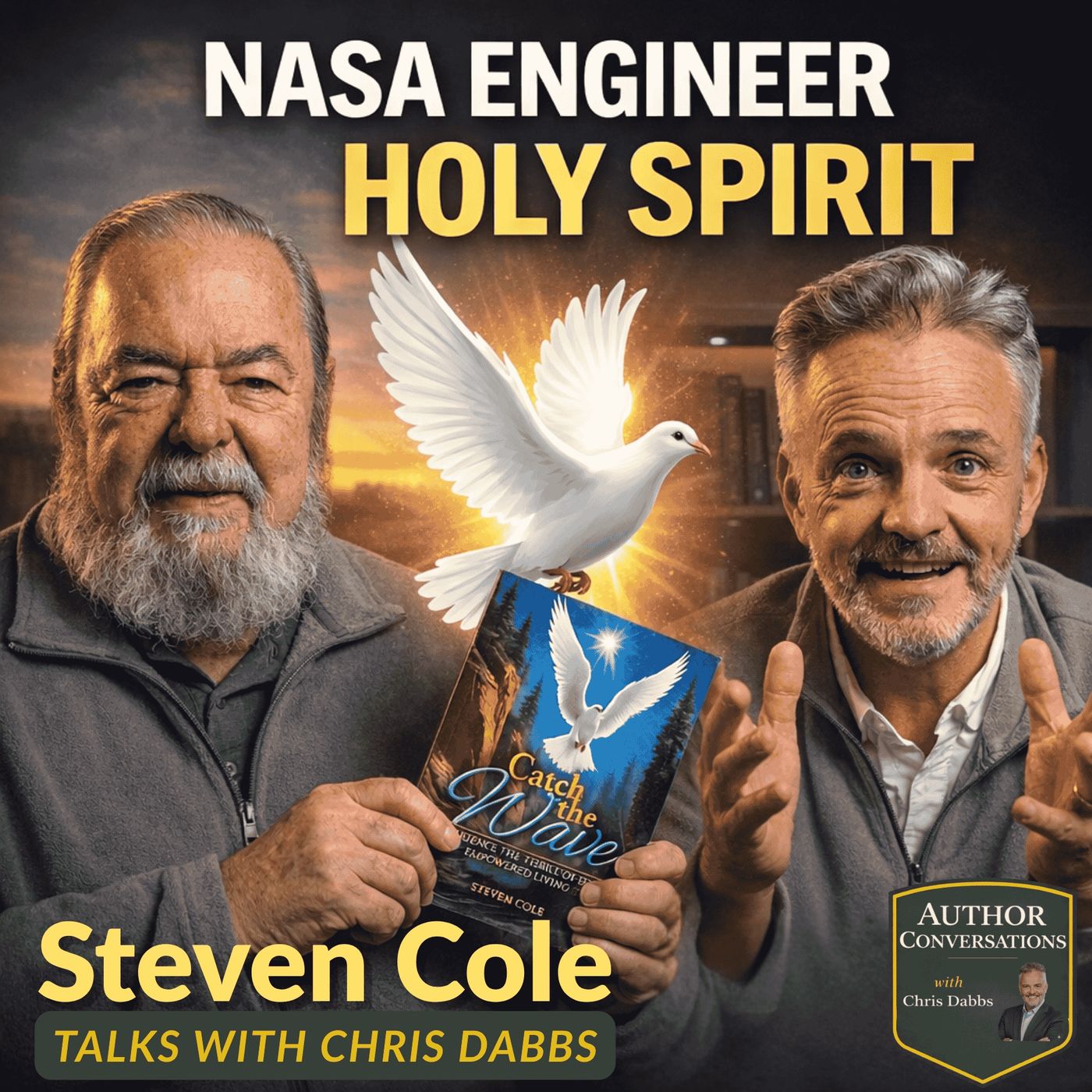
In this episode of Author Conversations with Chris Dabbs, former NASA engineer Steven Cole Chris speaks to former NASA engineer Steven Cole about faith, science and his interpretation of the Holy Spirit.
He shares the thinking behind his book Catch the Wave — and explores one of the most profound and debated topics: the Holy Spirit.
Drawing on his background in engineering and problem-solving, Steven offers a unique perspective on belief, spirituality and how faith can be understood through a different lens.
This is not a typical conversation. It’s thoughtful, reflective and grounded in real experience.
In this episode:
• How an engineering mindset shapes faith
• The meaning of the Holy Spirit in everyday life
• The story behind Catch the Wave
• Bridging science and spirituality
Work with Chris Dabbs and bring your or your clients' books to life:
www.chrisdabbs.online
Become a supporter of this podcast: https://www.spreaker.com/podcast/author-conversations-with-chris-dabbs--6905413/support.
Every book has a story beyond its pages.
In Author Conversations, broadcast journalist, presenter and newsreader Chris Dabbs sits down with the writers behind some of today’s most fascinating books to uncover the research, experiences and ideas that never made it onto the printed page.
Featuring bestselling and emerging authors from around the world, each episode goes beyond the blurb to explore the real stories behind the writing.
From untold historical discoveries and groundbreaking scientific research to personal journeys, business insights, faith, true crime and the human experience, every conversation is designed to inform, challenge and inspire.
Drawing on more than two decades of professional interviewing across radio, television and digital journalism,
Chris creates thoughtful, in-depth conversations that give authors the time and space to tell the stories that matter most.
Whether you’re searching for your next great read, fascinated by the creative process or simply enjoy intelligent, long-form conversations, Author Conversations offers a unique opportunity to discover the people, ideas and experiences behind remarkable books.
Real authors. Real stories. Real conversations.
Hello, I'm Chris Stabs and welcome to author conversations. Today we're focusing on one particular title from a highly prolific Christian author, Stephen W. Cole. Catch the Wave, Experience the Thrill of Spirit-empowered Living is the book that we're going to be talking about today. Drawing on a career that began in engineering, including 25 years at NASA's Jet Propulsion Laboratory, Stephen brings the structured and practical approach to a topic, which is often seen as deeply spiritual and experiential, the ministry and the gifts of the Holy Spirit.
To catch the wave, I should say, he sets out to make the subject accessible and personal, helping readers understand who the Holy Spirit is, why the Holy Spirit is given to the church, and how spiritual gifts may operate in everyday life. Although Stephen has written many books exploring Christian growth and discipleship, today we're concentrating on this particular work and the insights behind it. Let's begin our conversation about catch the wave. So, I, Stephen, lovely to meet you. Yeah, it's great to meet you.
Do you know what? I'm actually really looking forward to this because I've forgotten all my religious education from when I was a young age. And so the Holy Spirit, we're recording this post-easter, so there is some stuff going on there, if that's part of that, the religion or whatever it is that you may follow as a listener. But tell us, tell us. I mean, how basically did you come up with the idea for this one? How did you get inspired to write catch the wave? Well, I was saved shortly before the Jesus people revolution won a lot of drugies and street people and just a lot of college kids came to the Lord and there was a lot of conversation about the Holy Spirit, the baptism in the Holy Spirit and how to cooperate with the Holy Spirit and doing miracles.
And later on in my Christian life, I felt that that had been lost to a great extent, even though I'd been attending charismatic churches for a long time. Churches have believed in the movement of the Holy Spirit among the congregation. It wasn't, didn't seem to be taught a lot, so I approached a pastor and requested permission to a seminar of the Holy Spirit once a month, about a two hour seminar, talking about who the Holy Spirit is, what the baptism in the Holy Spirit is, an immersion in the Holy Spirit and what the gifts of the Spirit are and how they function.
And after doing that seminar for two years, once a month, I decided to put it into a book and everything that I had been teaching in that seminar fell neatly into the book with the exception of the first chapter, which is my testimony, and it's basically an introduction to the reader of who I am and what I'm all about. Now it's interesting you mentioned Easter and God taking credit for the resurrection of Jesus. Each member of the Godhead, Father, Son and Holy Spirit, took independent credit for the resurrection of Jesus as they took independent credit for the creation of the universe and the creation of man on the earth.
I find that interesting. Yeah, so do I actually. How does that work then? Because obviously that doesn't mean that we've got three universes, right? And etc. Correct. But each member of the Godhead operated not independent of the rest of the Godhead, but they were effectively showing their role in each of those events. Now the book as opposed to a lot of books on the Holy Spirit and his work with church, instead of being based on personal experience, it's primarily based on the Bible itself. In fact, in the second chapter, I talk about how Jesus did miracles and I use his own words to describe what the experience was like in Jesus healing a layman at the pool of Bethesda in Jerusalem.
So tell us about that then. Well, you know, people think Jesus is God, God does miracles, Jesus does miracles. What's the big deal? But Jesus didn't do miracles as God. He did miracles as a human being because he was filling the role of a perfect human being so that he could die for us and take God's penalty for our sin. He had to become a fully enabled human being to go through that experience of taking our penalty on himself and dying for our sins, which is what we celebrate in good Friday, followed by Easter his resurrection.
So Jesus performed the miracle, healing the man at the pool of Bethesda and the Pharisees, the opponents of Jesus instantly dragged him into a concave saying, you know, this is the Sabbath. How can you do this miracle on the Sabbath? This is wrong. And Jesus says, I can only do what I see the Father doing. In other words, it wasn't his idea. It was the Father's idea and he was acting in response to the Father's command, the Father's will in healing the man. And you think about what would happen if one man at this pool of Bethesda got healed?
Well, there were a whole bunch of people around this pool and there was a legend that when the water was troubled, when it bubbled up. The first one to step into the water is it would be healed. Now we don't know if there was an Old Testament miracle because they were still under the Old Testament at the time or if this was just a fable, but one person is healed. Everyone else is looking for healing. So what's going to be the instant response? Hey, heal me. Get me. You know, talk to me. I want to be healed too.
And Jesus turned and walked away because it wasn't the Father's will to heal anyone else. Elsewhere Jesus says, I can only say what I hear the Father saying. So Jesus was functioning not as God was skin on but as a human being. And He promises the works I've done, you'll do. And greater works than these. Will you do? Why? Because I go to my Father. Well, what happened when He went to His Father? 120 people meeting in the upper room waiting for this gift that God was going to bestow on them become, became filled with a Holy Spirit and started doing the miracles that Jesus did, functioning as Jesus did, fulfilling His promise.
And that's what the entire book is based upon. Well, that's interesting. Okay. So they underplayed a layman here. And so like thinking, that's fine. Yeah, I think that that kind of makes sense. So you're saying that Jesus was more of a conduit for exactly. Exactly. Exactly. In fact, I say it takes three things for a miracle to happen. First, there has to be a need. God does to do fireworks demonstrations. He only responds to needs. Secondly, it has to be God's will. If God doesn't want to do it, there is no special prayer.
There's no fast. You can go on. There's no... Anything... There's nothing you can do to talk God into doing what He doesn't want to do. If it's not God's idea, ain't going to happen. And then third, it requires the participation of a human being. In the first chapter of Genesis, when the Godhead is discussing the creation of man, he says that man is going to be in charge of every living thing on the earth that moves. So if God wanted to heal somebody or raise somebody from the dead, He had to cooperate with a human being because He's given the human being on earth that authority.
So if God were to do it independently of a human being, He would be violating His own word. And God doesn't do that. So I can see the logic there, actually. So exactly right. So that makes a lot of sense to me now. So talking of logic, by the way, how did you being an engineer, highly logical, I guess, and slightly creative as well, right? Or slightly, you know what I mean? And a teacher, quite creative also. How did those two kind of, well, careers, I guess? And obviously if you'll make it if you're running those seminars, how did that influence your approach to this topic?
I suppose really, one trying to say is, sometimes people say that science, for instance, and religion can't mix, but then everyone says, or everyone who is a scientist says, "Ah, no, that's all right. Don't worry, it does kind of thing." But how did that affect you in your approach? Well, I wasn't actually a scientist, I was an engineer. So I was dealing with things that human beings had thought about, created, and put together. And I was developing computerized instrumentation for NASA. I worked on everything from sub-ocean bottom penetration sonar to a four-year-sped cometer to look at planet-haryatmasters.
And everything, every project I did was something different. And it was exciting, and I loved my job. I really, really did. If I had worked for the flight power supply section, and there actually was one, I would have been born to tears, and gone crazy. But everything that I did since I was in the instrumentation section was different. It was some other kind of instrumentation. And I loved my job. I really did. That's wonderful to hear now. But I also read the Bible, and I understood the truth of what's in the Bible, because people say, "Well, if there's a God, why didn't he tell us about it?"
He did. He wrote a book. In fact, he wrote 66 of them. The number of books in the Bible. And that describes who God is and how he functions. So I was very careful to use Jesus as an example of how to work in the gifts of the Spirit, rather than human examples, because people can exaggerate, they can amplify what's going on. But if it's in the Word of God, and I can see how Jesus did the gifts of the Spirit, it becomes more grounded in the truth of the Bible than in human experience. Amazing. OK.
So again, another question I've got then is, how did you realize and sort of land on specifically dealing with, I'm guessing, the communication of the Holy Spirit, explaining the Holy Spirit's people or giving, you know, acting as a God? I mean, how did you do this? I mean, is that how it works? Is that how the book works as a communication tool? Yes, basically, yes. In fact, the final chapter deals with how to hear God's voice, right? What it sounds like, what to do if you blow it, and God was speaking to you and you didn't realize it was him, and you didn't respond in obedience.
If you fail to respond to God's voice three or four times, then God will stop talking to you unless you repent, unless you turn and say, "Boy, did I blow it? I'm sorry. Please speak to me again." Then God will resume talking to you. But if you just refuse to do it, you'll stop talking to you. And I think most believers are at that point where they may have, at one point, heard the voice of God. They didn't know what it was. They weren't sure that it was God. They didn't want to embarrass themselves for getting up and saying something that sounded crazy or sounded strange in the hopes that it was God's voice within them.
So they stopped doing it and God stopped talking to them. But if we repent, if we ask for forgiveness, he'll start speaking to us again. And one thing I say in the book, and also I said it in a seminar repeatedly, is that if we're not sure that it's God, ask Him, if it really is God speaking to us, and we're honestly not sure, He'll tell us in some way I heard of one woman who if she thinks she heard the voice of God, she said, "God is this you?" And the hair on her left arm would stand out if it was.
Just the left arm. Okay. With me, one of my main gifts, my most prominent gift is prophecy, saying God's words to a congregation or to an individual. And God would tell me something, and I'd wonder, is this you? And I'd ask Him. And if it was God, my teeth would tingle. Now I don't know physiologically how teeth could possibly tingle. But my teeth would tingle and I'd know, "Oh, that's God. Okay, I'll do it." And I did. Wow. That's incredible. Oh gosh. I'm going to have to start thinking about all my aches and pains in a different way.
No, I'm sorry. I'm not. But anyway, yeah, I understand. Yeah. Wow. Okay. So the Holy Spirit, let's move back to that because that is just another book there, by the way, Stephen, isn't it? Really? How to recognize what you're being spoken to, I think. But unless you've already written one, that deals with that subject. Well, actually, I only wrote one book. Believe it or not, I'm dyslexic. So writing one book was enough of a challenge for me. But fortunately, I had all the information from the seminar that I could just fit in the book and it fit it so automatically and nicely.
Oh, that's okay then. That's okay. Wow. Okay, so you're dealing with dyslexia as well. I mean, that's amazing. Okay. So how would you then explain to somebody who doesn't understand or just is just coming to I don't know, feeling something? How would you explain how the Holy, or sorry, who the Holy Spirit is? You know, so someone who doesn't have any idea whatsoever of the concept? Well, I've been using the term Godhead and that's really who we're talking about. The Father who is the grand architect of all that is.
The Son who is our Redeemer and the Holy Spirit who is the power, the motivator, the action of God. When God created the earth, Jesus spoke it into existence and the Spirit of God brooded like a hand brooding over his eggs, her eggs over the earth to make it habitable for human beings. It's three functioning as one. I believe it was, it doesn't matter who it is, but it's been said that a committee is great, it's only one person in the committee. Well the Godhead is a committee of three, but they all perfectly agree with one another.
There's never infighting inside the Godhead. They function as one person. That's how I define the Godhead. That's how the scripture basically defines the Godhead. My logical part of my brain, the one that gets me into trouble. It says, okay, but why does there need to be three? I understand. I could get what you're saying about Jesus having to become a man in order to absorb our sins as it were. Redeemers. Redeem, the exactly. Thank you. The other side of it, the Holy Spirit, I'm not sure how that or he or he being disassociated from the other two, how does that help?
Is that something that the Holy Spirit is when it moves amongst us? Is that what happens? Is that the mobile part of it? If you see what I mean? I guess you could define it as that, but we're dealing with a being who is transcendent of time. God wasn't created. He has always existed. And that'll blow your mind by itself. That there's this being who has always been there. And that created man told Adam and Eve the one sin that would throw them out of God's grace, out of God's goodness. And Eve was deceived by the serpent, but then Adam came home and Eve says, "I've taken the fruit that we're not supposed to have, but it tastes good."
And the serpent says, "It's to help us be wise and know the difference between good and evil." Isn't that a good thing? And Adam chose to sin. His choice to sin. He created the sin environment that we all live in, no matter how good you're trying to be, no matter how sinlessly perfect you're trying to live out your life. There's an element within you that makes you want to violate God's principles, that makes you want to do raw. Through it stealing a cookie when you're five years old or committing adultery later in life.
Now, a lot of people don't do the big evil things, but they lie, they cheat, they steal, at least in part, they violate God's law in a number of ways. So everyone on earth needs a redeemer. They need for their sins to be dealt with because the only other way for God to deal with that sin is to put them in a place where God isn't. That place is called hell. For than anything else, it is a place where God isn't. And the absence of a loving, caring, redeeming God makes it such a horrible place. That's an interesting thought, isn't it?
If we all live our lives, whether or not we're a true believer or not or an ethnic or atheist, whatever, it's quite interesting to think of somewhere where there is no God. I think it is like thinking that there is no afterlife. If you knew for certain that there wasn't an afterlife, for instance, would we all be different? Sure, we would be, wouldn't we? But obviously, through religion and all these other things, it's communicated to us. So, that's quite something to say, actually. Okay, so let's move on then.
I need to know an example of how you've seen the Holy Spirit working through a believer. You've come across this, right, in your seminars and also in your worship too, I guess. Well, the doctor said my oldest son was born with epilepsy. And it didn't, it wasn't apparent until he started through puberty. When he started going through puberty, he started having convulsions. He would have five different epileptic seizures, from petty mall to riving on the floor, up to five or six times a day. They tried them on all the good medications, the best medications that they had, and he was allergic to all of them.
What they finally had him on basically made him into a zombie, but it wasn't affecting the epilepsy. He was still having seizures. So my wife and I prayed for him almost literally every day for a solid year. Now, my oldest son tends to have a rebellious spirit. Okay, see, yes, even more. I say this guy is blue, he would say it's green. Okay. So, that's kind of thing. Well, we lost the connection there, by the way. So can we just go back a bit, and tell me about your son who was allergic to the drugs?
That's all we lost the connection, so there. Okay, he was allergic to all of the good drugs, the ones that they were normally used to control epilepsy. The drugs they finally had him on didn't control epilepsy, but they made him kind of a zombie. And my wife and I were praying almost literally every single day together for him to be healed of epilepsy. And I mentioned that my son had a rebellious attitude in his heart. And he was rebelling against God in his authority over his life. Well, one Wednesday night, he went to a youth meeting in the evening.
And he heard God say, "Okay, I want you to go up and kneel at the front of the church, at the front of the sanctuary." And he did. And he got up. He was instantly, perfectly healed of epilepsy. He was healed so much that he went home and threw his pills in the toilet because he knew that he was healed. Now this medication would actually cause epileptic fits if you stopped it too suddenly, but he has never had another epileptic seizure since that day. He chose to cooperate with God, to submit to his authority and God instantly healed him.
Well, that's great, isn't it? I mean, you know, I think that's the thing. Wow, there's some story. I'm so happy for you all. I can only imagine, really, luckily my children have been okay, but, you know, wow, thank goodness for that then. So I think the people will want to know, I'm sure you do cover this in the book, but how can people sort of begin to develop their relationship with the Holy Spirit so that they can hear when God is talking to them, I guess? And also hear or understand when the Holy Spirit is communicating as well, because I take the Holy Spirit doesn't have his own voice.
Well, the voice of the Lord is like the, a lot like the voice of your own thoughts, but there is a unique tamer to it that once you learn to recognize it, you can recognize it as the voice of God. But it takes some practice, it takes some learning, which is why I say, if you're not sure if it's the voice of God, ask. And if it is God's voice, he'll let you know in some way specific to you that it's his voice. But this whole thing starts with accepting Jesus as your Savior. That's the starting point.
That's one of the reasons I put my testimony as the first chapter of the book so that I could show my progression, first accepting Jesus as my Savior, then a few months later being filled or baptized immersed in the Holy Spirit and being able to hear God's voice and cooperate with Him in working the gifts of the Holy Spirit. Does that answer the question? Yeah, I guess so. I think it's just one of those things, isn't it? Like you said, we need to understand when this is happening. We need to be able to recognize when this is happening.
So, hopefully, we're running out of time, by the way, Stephen, unfortunately, it's always the way I'm so sorry. But the last sort of question that hopefully we'll kind of bring all this together is is is that the key takeaway that you hope that readers will carry away with them after reading catch the wave? I mean, was there something else that you'd rather that they looked at that you think see more important than that? I wrote the book for one reason because this is God's intention for every believer to be able to be baptized in the Holy Spirit to be immersed in the Holy Spirit.
To do the gifts of the Holy Spirit, there are nine of them. I arbitrarily divide them into three categories, gifts of speaking, gifts of knowing and gifts of doing. And being able to hear God's voice. It's a process, but it must be begun at some point for a believer. And a lot of churches don't teach it. Even charismatic churches that believe in the moving of the Holy Spirit in the congregation don't necessarily teach what the baptism in the Holy Spirit is or how to be baptized in the Holy Spirit because the pastors are afraid of unleashing the power of the Holy power of God in their congregations.
They're afraid of losing control. And to some extent, I sympathize with that. But this is the purpose of God for believers to connect not just with Jesus' Savior, but with the Holy Spirit as a power so that we can do the works that Jesus did and greater works than Jesus did. Can I share the website? Yes, please do. It's called HolyspiritWave.net. That's Holy Spirit Wave all lowercase, no commas or periods, all one word. HolyspiritWave.net. And there are a number of unsolicited comments by people who've read the book and found it very helpful to them.
And I'd like to encourage your listeners to connect to that website and see what it says about the book. I didn't write the book to get rich. I didn't write the book to get famous. I wrote the book so that the ability to connect with God can be shared with the majority of believers. There's a revival that's coming directly before Jesus returns to the earth. And what he wants is for the absolute maximum number of human beings to accept Jesus' Savior and go to heaven with him as part of his family.
And one of the greatest ways that can happen is when ordinary believers who are filled with the Holy Spirit do the works that Jesus did, touching them in a very special way, praying for them, relieving pain, healing, delivering the gifts of the Spirit, words of knowledge, words of wisdom, words of prophecy, directly God's voice speaking through a human being to them. That can turn people around. That can make them realize that there really is a loving God who died for them, who died so that they can go to heaven.
They can be part of God's family. They don't have to be exiled to a place where God isn't called hell. Everyone has eternal life. The question is where they're going to spend it. I want people to spend it in heaven with God. Exactly. Well, I think that most people would probably want that anyway, wouldn't they? But they need to know, as you say, it's not kind of what to do, but I guess it is kind of what to do, isn't it? In order to map. How to get there? Yeah, exactly. So like, a road map kind of thing, really.
Well, listen, Stephen, this is being fascinating. Really, you have. Hopefully listeners, you guys have listened to what Stevens had to say. And it's caught you somewhere where you actually do now want to catch the wave. So if you remember, Stephen's website, Stephen, can you just say that again, please? Holy spirit wave.net. Holy spirit wave.net. Perfect. We'll try and put that on the screen as well for people to see. Thank you. So that can be done as well. So listen, Stephen, it's been wonderful talking to you.
Stephen Colt, thank you very much for taking the time to talk to us today. God bless. Yeah, God bless to you too. And I tell you what, I wish you all the luck with your book. And your future writings as well. And hopefully we'll speak again soon. Thanks very much. Well, I'm 77 years old. I think I've done writing. Well, you don't look it. So that's all I can say. That's that's good. Okay, fair enough. Done writing. But here it is nice and white. Yeah, but so is mine. And I'm not 77. But there you have.
Lovely to meet you. And, well, okay, hopefully we'll meet again in the future somehow. Take care. Take care and have a great rest of the day. [BLANK_AUDIO]
 Apple Podcasts
 Castbox
 Castro
 Goodpods
 Moon FM
 Overcast
 Pocket Casts
 Podbean
 Podcast Addict
 Podcast Republic
 Spotify
 YouTube