Subject to Change: What We’ve Lost in the Digital Age | Tom Potosnak
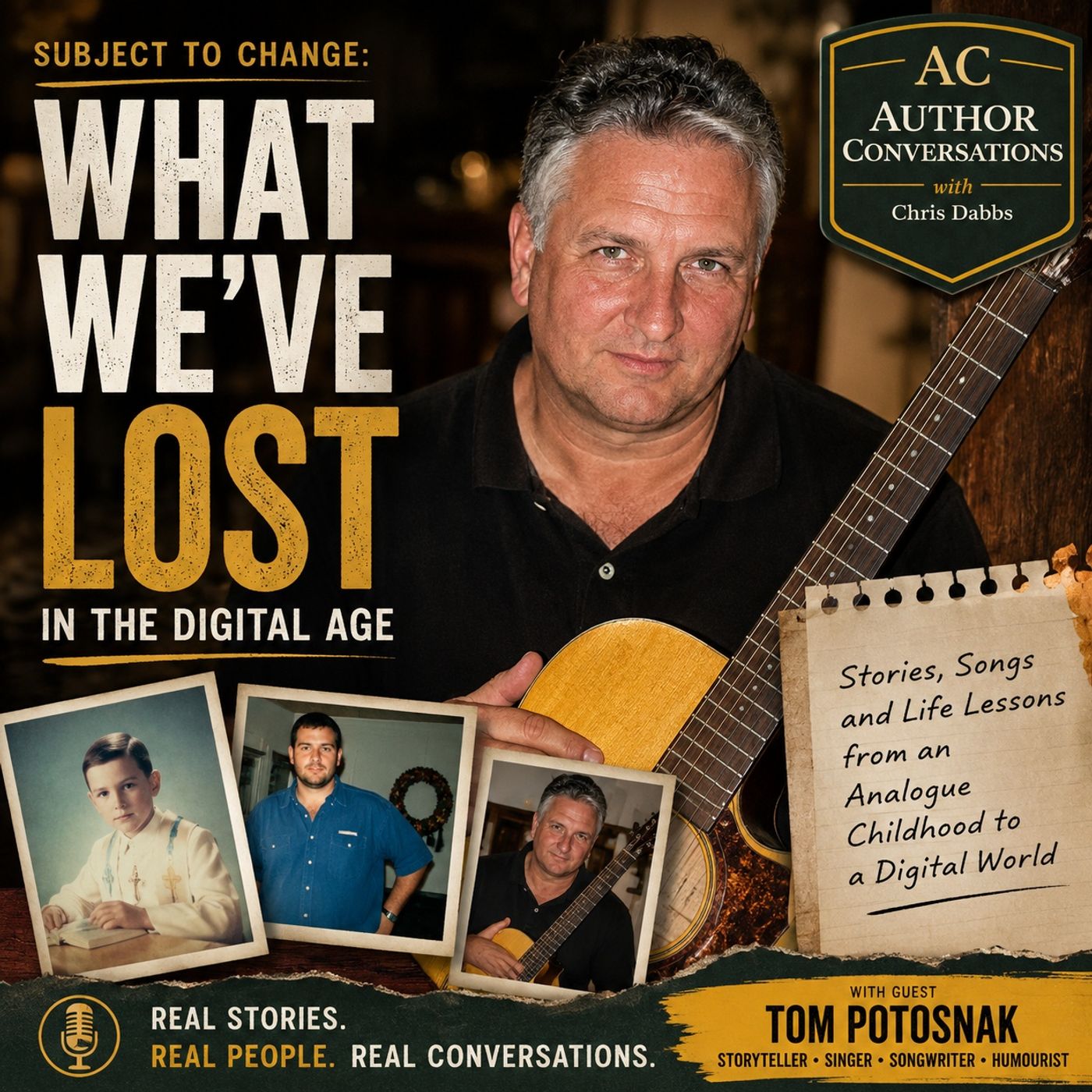
📱 What have we gained from technology… and what have we lost? In this episode of Author Conversations, Chris Dabbs speaks with storyteller, singer-songwriter and humourist Tom Potosnak, author of Subject to Change.
Part memoir, part collection of stories and songs, Tom’s book explores the journey from an analogue childhood to today’s hyper-connected digital world.
Through humour, nostalgia and heartfelt storytelling, he reflects on family, friendship, ageing, community and the simple moments that often matter most.
🎸 Featuring original songs accessed through QR codes within the book, Subject to Change offers readers a unique blend of music and memoir while asking one timeless question: “What does it all mean?”
During the conversation, Tom shares stories from his childhood, military service, family life and career, while discussing the importance of genuine human connection in an age dominated by screens and social media.
🔎 In this episode:
📚 Why Subject to Change is more than a traditional memoir
🎸 How music and storytelling work together throughout the book
👨👩👧👦 The lessons Tom learned from family, friends and everyday encounters
📱 What we’ve gained and lost in the shift from analogue to digital life
😂 Why humour is often the best way to tell the truth
❤️ The importance of connection, community and meaningful relationships
🌎 What younger generations can learn from life before smartphones
💡 Why “ordinary” people often have the most extraordinary stories
🎙️ About Tom Potosnak Tom Potosnak is a storyteller, singer-songwriter and humourist whose work blends personal experience with larger reflections on life, culture and community. Through live performances, songs and writing, he explores the humour, wisdom and humanity found in everyday experiences.
📖 Featured Book Subject to Change
By Tom Potosnak
www.tompotosnak.com
Buy Tom's book here🎧 Available in audiobook format, narrated by Tom himself.
00:00 Introduction
01:01 Why Tom Wrote Subject to Change
05:35 What Does It All Mean?
09:14 Life Before Social Media
13:17 Why Humour Matters
16:21 Growing Up Then vs Now
19:15 The Power of Everyday Stories
21:56 Lessons for Younger Generations
24:10 Why Everything Is Subject to Change
27:21 Reader Reactions
28:41 The Book's Core Message
29:53 Final Thoughts
Become a supporter of this podcast: https://www.spreaker.com/podcast/author-conversations-with-chris-dabbs--6905413/support.
Every book has a story beyond its pages.
In Author Conversations, broadcast journalist, presenter and newsreader Chris Dabbs sits down with the writers behind some of today’s most fascinating books to uncover the research, experiences and ideas that never made it onto the printed page.
Featuring bestselling and emerging authors from around the world, each episode goes beyond the blurb to explore the real stories behind the writing.
From untold historical discoveries and groundbreaking scientific research to personal journeys, business insights, faith, true crime and the human experience, every conversation is designed to inform, challenge and inspire.
Drawing on more than two decades of...
Hi and welcome to author conversations. As usual, I'm Chris Dabbs and you know what, I've got a question for you. Can you remember what life was like before smartphones, social media and constant notifications? I could just about do that myself, I gotta say, but well, okay, I can do it a lot, right? But last year's Toronto's day just about. But anyhow, yet I do remember life like that and a man is really interesting seeing the world today. And my guest today is storyteller singer, songwriter, anti-humourist Tom Potosnak, whose author of subject to change.
Now subject to change is part memoir, part collection of stories and songs and the book reflects on growing up in a very different world while exploring experiences that remain universal even now. So Tom, welcome to author conversations. I mean, I could go on for ages about how bad it was in the olden days without phones and things, but I guess you don't agree with that. So what inspired you to write subject to change? And how come you describe it as I thought this was quite funny? Sort of a biography.
Well, first of all, yeah, I remember obviously those days I grew up in those days and they weren't all bad. I mean, it was okay. In fact, some many ways it was very good, but what really inspired me to write this was I'd been a storyteller for many many years, a singer, a songwriter, I've done in many shows and I tend to lean towards trying to find kind of the bigger picture in regards to whatever topic it is that I'm singing about or talking about. And having grown up in those days and seeing the kind of the analog era if you ever are in the and now we'll be at the digital page and seeing all of their differences.
When I would write some of my songs or tell some of our stories, it would you would see Mizzip. Those were the sorts of things I would gravitate to GSU from true or different then. And this was how they were different. This is the way they are now. That necessarily make a bad, but there is certainly a difference. And I wanted to communicate that because that's kind of what I've done over the years with my stories and songs and shows. So you're saying that it's a bill. Well, but the world is different, right?
And I think the way that you've written your books different as well because you've built it around your story songs and shows and your musings and things. So how can we chose to do that format instead of writing like a traditional memoir? Because obviously most people were just going about, "Oh yeah, I remember when I was 14, I couldn't do this, I couldn't do that." But now they can, but I think you've chosen quite an interesting way to do it. Well, you know, first of all, when I call this book a sort of biography, what I mean is it's not my life story.
That would be boring. I invented nothing, I haven't solved any international crisis, I haven't learned any super bowls. Oh come on, song crack on. Honestly. It would be interesting to talk to those names, a story doesn't work. To me, that would be a tradition of memoir, I think. What a sort of biography is, it is stories from my life, about life as opposed to the story of my life. And I've been, as I said earlier, storyteller and musician and I do these one-man shows that we're doing for the last 16, 17 years, where what I did was, it's got a funny actually, I remember telling my daughter in that line, "You know, I'm going to write a one-man show and it's going to be part-cure, part-sauve stories."
And they said, "Yes, sure you are." And I used to take the dog for a walk and the morning and out of up a stuck and I could hold him it, write it out or type it out and lo and behold, I put together a show of midlife chronicles because I was a midlife there. And it went pretty well. People enjoyed it. They enjoyed stories. They enjoyed the song. Since then, I put together three different one-man shows that, and variations on the theme are three years. And I do it when I can because I was running a business for a lot of years, so I had to weave it in between life and work and what-have-you.
But as I say, people enjoyed him. And what they would say to me is, "Well, honey, you turn this into a book or something, because you can only do so many songs and so many stories at a 90-minute show." So I said, "You know, that would be a good thing to try to do to be able to expand me and add more stories, more songs. But I wanted to make it a theme as opposed to just a collection of stories and songs that were one-offs. So I made it into, guess it's a memoir, but it also has sort of a theme that runs through it about kind of the search for meaning and likes and significance and those sorts of things.
So the reason I did it that way was because that's the way I've done it over the years with the audience or its stage. It just lent itself to that. There is also a very unique way to do it. People say, "Wow, listen to kind of crew. You get songs that you get stored to it. So let's work it out." No, no, no, no. Okay, that's an interesting way to look at it. I mean, I love the way to take the dog out and then you know, you're writing at the same time, right? So multitasking. But I mean, so what is the theme then that, you know, sort of like puts the connection through to people of a certain age, as we would say, the hey, who are readers and the audience of the book?
What theme connects them, do you think? Well, when the book starts out, I'd honk about a seer year in high school. First day, when, and this literature teacher, who I did not know, comes in, shuffles in and says, "What does it all mean?" and he plops down in the chair. And he did this every day for a few days and finally some kid from back from the last year, old out his act was, "What's going to be on a test?" And he stopped he stopped saying, "What is it all mean?" But we all kind of figured out that, you know, obviously we'd have any answers for this guy.
And we figured, "Well, he's probably in the middle of his, you know, midlife crisis somewhere and he's either going to get it together or, you know, hop on a Harley and get a leather jacket and ride off into the Jersey Sunside. It was similarly frustrated, taffic, cheery lady, but he didn't. He made it. But my bend is that it's just some reason. That question always kind of stuck with me. What is it all mean?" And then, when I was in the, the arm, four days into the arm, the first day report for duty.
And nothing for me to do by course didn't start for six weeks. They say, "Hey, go to your bachelor officer, brooders. Come back Monday." So, okay, I'm walking down the street, a big class, a uniform, feeling on spiffy. And all of a sudden this, uh, green sedan screech to a halt, when the guy jumps out, runs screaming towards me. I'm a tenant. Do you know who's in that vehicle? I'm like, "Well, no, I mean, I know who wasn't at the Captain Ork, because his name tagged right in front of me." He said, "That's the commanding general of Ford Benjamin Harris, a Udor-Brendered, Crop or Military Currency, and the former of the salute of the general's vehicle past its buy."
Well, I must have missed that class, where I was, you see, because I didn't know what I was doing. He sent me on my way, and I honest to God, the rest of the way to my quarters, I must have saluted every green vehicle I saw just to take no chances. I'm sure there were a lot of, you know, privates and sergeants running around, "Hey, look at the goofy lieutenant saluting me, you know?" But anyway, I know this is a long story, but it kind of sets up how this book sort of came to be. I get into my quarters there, and I clot my stuff down, and I sit down on a cigar, and I said, "Cut, is it all means?"
Basically, what have I got myself into? And I laughed, and I thought of my teacher. Next day, I snuck off to the rec center, I rode a guitar from the rec center, made sure, keep an eye out for Captain Ork or Ever Protector with the Generous Vehicle, made it back, and wrote the lyrics, and I wrote it this song, "The Search Cut Us All." So, that kind of got these going, and the theme of the book, it starts out with, "What does it all mean?" And as I went through the book and the stories, the stories, they're some that are just playing funny, but there are others that have a larger meaning, and it's about personal connections, it's about relationships, it's my, it's my opus, who maybe feel like I was somebody special growing up, in a generation where parents certainly were her friends, and it's about friendships, these stories, they're all supposed to have that theme that runs through up.
And as I roll through all this, I get towards the end of the book and I ask again, "What does it all mean?" And I, basically, they were clues as you go along through the book, it's about personal relationships, fulfilling relationships, loving relationships, it's about connection, I think that connection was a lot easier to have in the pre-digital age, and that's part of when I talk about this book, if you've heard about cell phone, I think those people can understand that, and recognize that that's something that's kind of lacking in our culture today.
Because of it, I hope that there is. Yeah, yeah, totally. Yeah, I mean, without getting for all sort of like political and all that sort of jazz, I mean, I think that the social media thing and digital communications and things has changed the world like completely, I mean, don't forget me wrong, I use internet for business and what have you, but I'm from the UK and we're following Australia, who has banned social media for under 16-year-olds, yeah, so we've recently announced that, and this art pror, absolutely, art pror, from the youngsters, as you can imagine, because they think they've been missing out of something, you know, and of course, they will, right, because they've grown up, as you say, where where parents are friends, and they're helping them to use their devices to do whatever it is that they want, right?
So no, I can see what you'll say, and I can definitely see that the audience would be on board with what you're saying as well, yeah, I think unless you have gone through this, you just don't realise, do you know, what it was like before, and it wasn't bad, that's the point to make, isn't it, right? My wife and I were talking about this yesterday, actually, you know, we got on with stuff, right? I'm not saying they don't, but you know what I mean, it's different. So talking of getting on with stuff as well, right?
You mentioned that you had to make sure that Captain Orden catch you, of course, but you got yourself a guitar from the rec center, which is great, right? Because, is that when you started playing? Because, you know, you've woven music, quite interestingly, through your book, right? Through all those QR codes that are in there. So I love the idea of that, and you're song lyrics. So how did you decide which stories kind of deserve the song, or did it work the other way around? Well, I, but I first wrote this, it ended up being 40 chapters, right?
Sounds like 40 chapters makes for a long book, a drumbery sure, which by the way is a quick thing because I also think with a limited tension span, the treatment seemed to have pushed the stories being short, or what it is that sawdust is to work, it seemed to appreciate it. But I started out with 53 chapters, and I, you know, at 13 more than an hour and a half. So I had to edit because I wanted to stay tight with the theme, and again, you know, the stories that either had some cure in them that were, they weren't all heavy stories, but they were, they had, they were funny, and then there are other stories that had little, little gaps to them.
But I didn't want to be read enough because I realized I'm a piece of that, got a couple of songs here first, it's about my college years. A song, you know, when I went off to school, I was from New Jersey, I ended up in Pennsylvania, and it was a very different sort of world. I was at a small farm town in a Cumberland Valley at Pennsylvania, it was beautiful. So I had written a few songs around that, but then I had another song about the steel mills in Allentown, Pennsylvania, and guys that went to schools, his fathers were laid off, and they had to be schooled.
But you know, I didn't want to go to the well one too many times with the college years, pets of A-Mistories, so I asked them out, I've got to come down. So I wanted to keep it, I didn't want to start wandering off, it's your wilderness with this thing. So I really just went through and sent up to which songs are essential, which stories are essential, and also what songs do I really like that I think people would enjoy. So there's a combination of sorts. I don't know, yeah, great, well again, that makes sense.
I think a lot of us, we write books or whatever, and you end up with something at home, you know, the answer. Sorry about that, just a bit of a technical thing there, no, it's all good, don't worry. Yeah, people end up with massive tomes, don't they? You know, with hundreds of pages, and then the editing is a nightmare. But yeah, I think that looking down at it and making sure that you've got exactly what you want in the book makes sense, right? So I mean, humour for instance is something that runs throughout the book, and I could see, obviously, you're a humorous guy, and that's why you're a humorist.
But why do you think that laughter is, I guess, one of the ways to talk about, you know, aging and life changes and how things change all the time? Well, I, first of all, I was two things I seriously enjoy, very much, one is to laugh, my love calaf, and two, I enjoy making people laugh, and humor is, it's the left turn, it's the thing you don't see coming, and it just, when they call it a sense of humor, that's what it is. It's up, it hits you, and it's funny, and you enjoy it, and that's a great feel.
So I've always enjoyed humor. I, I come from a family of people who are fairly witty, especially my uncle, my mom as well. They just would come out with things, you'd say something of "and", you would hit you, and it made you laugh, but oftentimes there was a point there, and it's all times easier to receive something, when it comes in a funny way, or in a humorous way, in a light-hearted way, and I think that in this book, when I talk about growing up, and you know, there were some, we all have our struggles or challenges, we grow up, and in the book, I talk a lot about the way my parents were, my parents were tough, you know, I tell a story about when I was a kid in the second grade, whatever, I used to cry when I get to school sometimes, and I make the joke, no nowadays it calls separation at the time, you know, a backpack thing would call it a "baby", and they call, they call them as the ace of semi-todd the nurse, so I could get it together, or one day I go to the nurse and they say, Tommy go to the principal's office, and they go there, who's there, my mother, and my mother worked, she'd rare, that was those days that she had two or your parents, and my mother said to the principal, where she said, "hey could you talk to Tommy, you be crying in school, let's see what's up?"
so she said, "can I have a word alone with him?" he says, "sharp" and she sits me down, looks in the eye and says, "tommy, I don't know what you're crying about, but you gotta cut it out, because if you don't and they make you leap work one more time, I'm gonna get fired, if I get fired, I'm not gonna have any money, and if we don't have any money, we're gonna start." I haven't cried since, and that's this February I tell in the show, and the point is, there have been people that have said, "qua humo was tough on you," or just other stories of the book that I tell, and I said, "well, yes, but no, um, and I kind of tell it with a bit of humor, because it's kind of softens the edges a little bit, it makes it more palatable and more fun, and you can make before you, I think, very effective even, keep."
Well, and also, yeah, at the end of the day, it's the truth, right? So, you know, your mum's being blunt with you, but equally, you know, I mean, yeah, well, this is it, okay, so looking back at that and looking at now, what do you think the biggest differences between growing up before the internet and growing up today for these people, oh these people, you know what I mean, people. I think it's personal connection, it's, you know, when I was growing out, you, if you had a problem with solo, you'd talk to that, you were face to face, you could whatever what you'd have done it, or you didn't sit down on your basin that we've two angered little phones and start, you know, putting something on, you know, the Facebook or Instagram or Twitter or X, as it is now called, which we're always repudding up, but you were, it was only one way, you don't look people what tomorrow, you had personal relationships, and that was just the way it was, and the biggest change is now we have so many more opportunities to sit back, take pot shots, do whatever it is we feel like going without ever having a face of them, on a fact in the book, I make mention of this, I saw a mean that I thought was great, and I used this to the show, and he can get a ticket out, I say that, as a great American philosopher Mike Tyson, then I said, the problem with the end of the, like, paraphrase is that, you know, people get away with saying those about you without getting conscious of the face for it, you know, a little bit blunt, but, you know, that's kind of the difference is the separation, you know, I went out to dinner now, already though, and honestly,
good, this me and my wife were sitting there, and I pointed to the table, a couple of tables, oh, family of five, parents, three kids, every one of them are, it felts, they weren't talking, they weren't interacting whatsoever, they were all doing whatever it is they were doing, that wrong thing. Now, at first of all, as a kid, we didn't go out for dinner very much, that's a big difference too, but I sure did, we put on these clothes, and we interact kid, you know, so that was a difference, that was, Neff Serra was having this better, Miss Warris, or it's different, but you would really do have to watch, I think, and be vigil that to not fall into this, you know, you just, you're into yourself, selfie obsessed culture had bought, could do a death, you couldn't, well, no, exactly, it's funny, because when I was growing up, I always used to say, if I went to, well, when I say growing up, when I was a bit older, say, in my, when he's whatever, if I was in a restaurant and I saw like an older couple who was sat there at their table, not talking to each other, for instance, I would think that that was very sad, and things like that, whereas now it's changed, or we, you know, my age, I agree with you, I look over and I see that no one's talking to each other and they're just doing this, and then when I pick up my phone to kind of do the same thing, I'm thinking, ah, I've got to stop it, but then I can't sit there with my wife not talking, right?
So it's just, it is a bit of a minefield, but this is the whole point though, isn't it? Encounters, with everyday people is what we're talking about. So being able to talk to your wife, being able to go to the store and talk to somebody in the store, being able to walk down the street with your dog, and interact with people, who you might come across, right? So many of your stories, they're focusing on these kind of encounters, right? So what would attract you to those kind of normal situations, I guess?
I, I, that's my nature, I think, and I've always been, you know, I, I had a lot of, I had two brothers, and, but I had a good number of, of awesome objects, and in fact, I was the 28 for 30 walk first cousins, about one, 10, here, one at five, and my mother's side or family, care, I could read four, but we spent a lot of time with those people, and me being on the younger end, I was always fascinated by these people, they were like my heroes, you know, and my uncles, Charlie, tell these stories about this, about it, you know, my cousin, this, or that, and I always just gravitated towards kind of the, what does it all mean?
Wow, that story, I'll go Charlie, he was talking about her, you know, here's a guy that was, you know, he grew up on our, working in coal mines, you know, he came to New York City and King of bus driver, you know, and just, I was always fascinated. So ordinary people, ordinary fainters, ordinary stories, it's a gold mine, it's just, there's so much there, and it was so interesting in what's out there that we ignore what's right here, and that's the stuff that's most important because these are the people that you interact with, these are the people you come from, so that was very fortunate, I think, in that regard to have all these people, and to be in the observer, hey, because we're the young one, they don't want to hear from, you know, and I get it, what do I have to say about some family people?
You know, I was happy about this there for a laugh, you know, but I always just, each of you, I, joy be here actually, people, who's this great? Yeah, yeah, I'm always jealous actually when I see that, you know, I think in America it happens more often, where you have great family reunions, right, or family meet-elves every year or something, you know, like that, it's not something that we really do here, but, you know, I always think that big family is great, right, I'm very jealous when I hear that.
So talking of interacting them, we're talking about interacting with family, we're talking about interacting with people in different age brackets as well, as you said, who wants to hear from the young one, right? But, so, so what do you hope that younger readers or that somebody can tell a younger person, what about them learning from the experiences that you share? What do you hope that they learn from that? Well, you know, in the book, what I hold in this, this, and very thankful in this way, when I'll do my shows, my daughter is 33.
Notice I had to think for a second, okay, she said, and her generation of friends, they they grew up in the beginning, because the iPhone didn't come out to host that and she bore a lot of you too. So really, she kind of made it cruel without the heavy inference of that. But she, she will have people that she invites to these shows that enjoy the shows, enjoy the skills. I think they enjoy the differences, they find it kind of funny, that they also make some think that people have since many times, they enjoy your show because it makes me laugh, because it makes me think, and there's some poignant stuff in there.
And I also do address, like phenomena, the differences. I have a song, I'll say, hey, which is about current, the way things are now, touching on cancel culture, in a lighthearted sort of way, but it kind of makes a point. I also talk about, you know, in the chapter do something, you know, do something, meaning be a positive influence. I say, you know, you, everybody's so focused on changing the word to be an influence or doing something so grand. Well, you know, something you could sit down in the cafe and have yourself a cup of coffee, a berry or something before, or you could look up onto the while, perhaps just spot an old friend, maybe you could smile at somebody and that just, you know, was what they needed with that boat.
So these kind of little little bit of lessons, a little bit of things, I don't beat them over the head with it, but I like to think that some people do walk away with, you know, he's right. You know, maybe a little less on the knee and a little more on us is a good thing. And again, it's not going to change the role. Really getting the smile, a world. It's just changed somebody's day. And make you feel better as well, right? Absolutely. Where you do for others, you do for yourself. I mean, that's essentially true, true.
And I think that's the thing. So, okay, the title of the book is subject to change, right? That seems to carry a lot of meaning because it's quite sort of ambiguous, isn't it? Really? But what does that phrase represent in your life and in the book then? Well, okay, my father, my parents used to rent a place when they were retired, down to the good church, you do Jerseyshire, a little bottom of a little, a few blocks on each. And I was down to this. My father was living with the Froucester Cancer 26 years.
And he seemed to be doing okay. So summer, we're sitting out on the course just here and up. He wasn't a guy to talk about feelings and things. All the bad generation of heat repulsed on his thing. But just out of the blue, he said to me, "You know Tommy, I know I'm not going to look for it, but I do plan on hanging around and death, and in the meantime, I'm going to enjoy the time I have to have other boys and kids." And then he paused and he looked up. I get chills just telling it. He said, "But this isn't all there and I didn't say anything.
Six months later, he was done. And after his funeral and going down to his and my mother and my hometown a few times, I took a ride around. I went by the places that meant something to be boy guy. And I realized, you know, how much it changed and the open the light of that saw. If these times I rely on the street sides, when I find myself around, the things I always remembered and he faces some places I always remembered any mortar that were so clear. And I kind of take it from the scruyard memories and they're all subject to change.
Then I take it to the family to the backyard, family memories and I say, "Well, they're all subject to change. Then I go into getting older and health and so on. But the things throughout the song, and of course, is pretty sweet. Some things don't change. You're your old dear friends, true love, hope and faith and so on and glitter like you're sorry. Those are the rocks you cling to when the times get tough on the storms are raging. There are things that you hold on to. But most things for certain, if it left and stays the same, so you walk these core things into life.
And that's the thing I feel tough about. The people don't have that foundation made that they used to. So the subject to change, they'd kind of wrap that up. Yeah, it was about going back to our home tab, seeing how things had changed and just thinking about that on a larger scale. But then also coming back to, okay, what remains? And that's some truth in the last light of the song. Old friends, true love, hope and faith always remain, never to change. That's very wise time. Everything is subject to change.
You're quite right. Oh, no, second again. Sorry. Don't worry. Don't it's okay. Yeah, I mean, always, you know, this is the whole point, isn't it? I think once you realize and accept that things do change, then you can't actually get on with your own life, can't you? So Tom, we're running out of time, unfortunately, which is a real problem here. But it's such a shame. Because it sounds great, you know, and your life story is sounds fantastic from what you've said so far as well. And the book sounds great too.
I can't wait to listen to more of the music. But what really gets me is when readers listen and read your book as well. What sort of feedback have you had from people? You know, I mean, obviously, I guess if they're feeding back to you, they like it, right? But what is it that they're looking at? A couple things. One, the humor, two, the poignancy, you know, I was storing in there about my, but I hope we're dying. We're two. My other awkward didn't die in what we're two. But is you pass tape for if his life?
That's a very poignant sad story. We carry a lot of meaning. So there's heavy stuff. There's lighthearted stuff. People like the fact that have QR codes on the book. You can scan it, listen to the song and read the lyrics below. Fishing, they're not familiar. It's song. Even if they are, they said, "She's liking it off. I've heard the song. I'll read them." Well, there it's helped. The audio book people really enjoy because it's me telling the stories of person unless it's a fun stage. So people enjoy the humor.
They enjoy the big picture meaning. Which is, you know, to me, a home run. That's what I was hoping for. So it's been us. Yeah, that's it. Okay. Well, that's great. You know, my final question is really, what do you hope that people get out of this book? What's the, you know, the takeaway, I guess, for the free readers? Take away, kind of having the last chapter. Get it's a meaningful and fulfilling, when riching life is based on meaningful, fulfilling and rich relationships of love, service, and, you know, to love is to act, you know, a harry-chapen-mouse-all-warty-curve would say, "I want to end out, do something."
So take your gifts. Take the best of who you are. Never let it slip away and share it with others. Because that's all you got in this life, really. All the other stuff, the likes on the support, the money in your pocket, all go to life. But that little moment you can spend with people that's meaningful, that to me is stuff of life. And that's what I hope people get from it. So pass yourself around, paint forward, all that sort of stuff, right? So, you know, actually make sure that you make a difference as well.
Don't keep it all to yourself. Well, that's another wise point there, Tom. Yeah, brilliant. Well, listen, my thanks to you, Tom Potosnack, for coming to talk to me today. You're the author of Subject to Change, as we know. And I guess we could buy the book and audio book up through Amazon and stuff. Yes, you can on my website, Tom, so it's neck.com. Brilliant. Okay. Yeah, I bet there is. Yeah, exactly. Okay. Well, listen everyone. Thank you very much for listening, listening and/or watching. Make sure to leave a comment down below so that Tom can, you know, sort of answer any questions that you've got and so that we can get a conversation started about this.
But if you've enjoyed this conversation, then please subscribe, leave a review and share the episode with fellow readers and writers and old folks like me. I'm not saying anything about you, Tom, but old folks like me. Well, until next time, thanks for listening to author conversations. I've been Chris Dabbs and Tom Potosnak. Thank you once again for meeting up with me. It has been fantastic talking to you. If you enjoyed this conversation, you can watch more author conversations here. [Music] [Music]
 Apple Podcasts
 Castbox
 Castro
 Goodpods
 Moon FM
 Overcast
 Pocket Casts
 Podbean
 Podcast Addict
 Podcast Republic
 Spotify
 YouTube