Does God Mean Exactly What He Says? | Dr Cliff Loriot | Author Conversations
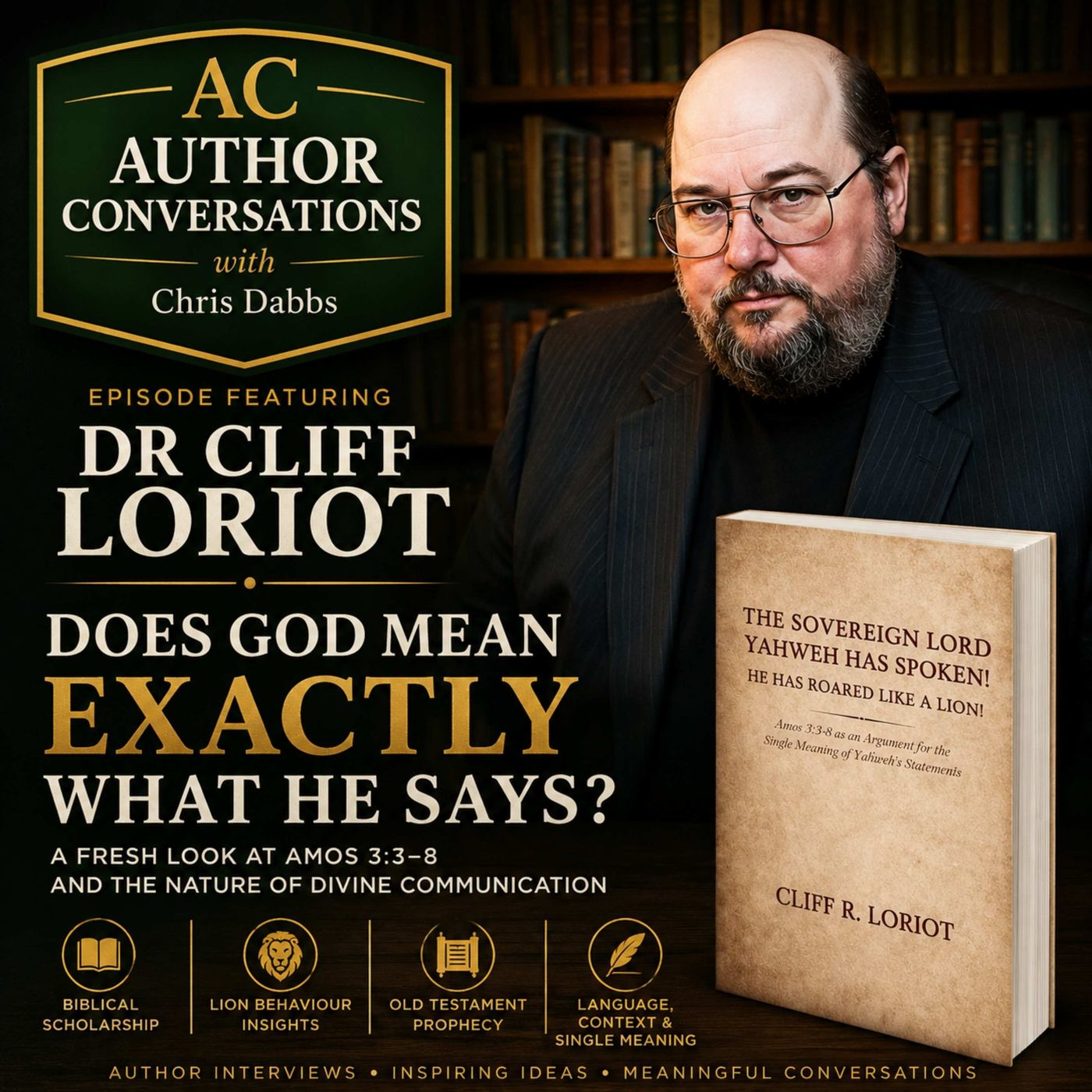
📖 What if one of the Bible’s most debated prophetic passages has been misunderstood for generations?
In this fascinating episode of Author Conversations, Chris Dabbs speaks with biblical scholar Dr Cliff Loriot, author of The Sovereign Lord Yahweh Has Spoken: He Has Roared Like a Lion.
Drawing on decades of research, advanced biblical languages, textual criticism and even the behaviour of lions, Dr Loriot challenges long-held scholarly assumptions surrounding Amos 3:3–8 and presents a compelling case for a single, clear meaning behind God’s communication.
Whether you’re a pastor, theology student, Bible teacher or simply curious about biblical interpretation, this conversation explores how language, context and careful scholarship can transform our understanding of Scripture.
🔥 In This Episode
📚 Why Amos 3:3–8 became the focus of Dr Loriot’s lifelong research
🦁 How lion behaviour helped unlock a fresh interpretation of a famous biblical passage
✍️ The importance of language, context and single meaning interpretation
📜 How textual criticism helps scholars determine the original biblical text
⛪ The debate between literal and allegorical interpretation of Old Testament prophecy
🔎 Why Dr Loriot challenges the majority scholarly view of Amos
🌍 The relationship between prophecy, revelation and God’s communication
📖 What modern readers can learn from one of the Bible’s most debated passages
Dr Cliff Loriot is a biblical scholar specialising in Old Testament studies, prophetic literature and biblical interpretation. His latest book, The Sovereign Lord Yahweh Has Spoken: He Has Roared Like a Lion, examines Amos 3:3–8 and argues that God’s communication possesses a singular, intended meaning that can be understood through careful linguistic and contextual analysis.
Author website: Cliff's website - click here
Buy the book - click here: The Sovereign Lord Yahweh Has Spoken: He Has Roared Like a Lion
00:00 Introduction to Dr Cliff Loriot and the book
01:18 Why Amos 3:3–8 became his life’s research
06:29 Can we trust ancient biblical translations?
12:25 Challenging the majority scholarly view
16:01 The surprising role of lion behaviour
20:10 Why God’s words have one meaning
25:01 What pastors and Bible students can learn
28:04 The significance of the seven examples in Amos
31:58 Solving the lion imagery puzzle
34:59 The central message of Amos
38:05 Where to find Dr Cliff Loriot’s work
39:07 Final thoughts and farewell
Become a supporter of this podcast: https://www.spreaker.com/podcast/author-conversations-with-chris-dabbs--6905413/support.
Every book has a story beyond its pages.
In Author Conversations, broadcast journalist, presenter and newsreader Chris Dabbs sits down with the writers behind some of today’s most fascinating books to uncover the research, experiences and ideas that never made it onto the printed page.
Featuring bestselling and emerging authors from around the world, each episode goes beyond the blurb to explore the real stories behind the...
Hi and welcome to author conversations. As usual, I'm Chris Dabbs and today, I'm joined by Dr. Cliff R. Loirot, a biblical scholar whose academic work focuses on old testament studies, prophetic literature and biblical interpretation. His latest book, The Sovereign Lord Yahweh, has spoken, he has ruled like a lion, takes a fresh look at one of the most discussed passages in the book of Amos. In it, Dr. Loirot explains and challenges long-held assumptions about the text, and argues that Amos was making a powerful case for the clarity and singular meaning of God's communication.
So drawing on decades of study, advanced biblical languages and extensive research, including an intriguing investigation into the behavior of lions, Loirot offers readers a new perspective on prophecy, interpretation and the nature of divine revelation. So Dr. Loirot, welcome to author conversations. It's great to meet you. Thank you for my pleasure. I'm looking forward to this because you know, I think you're going to get into some really good detail and listeners are really going to learn something from this, but we'll go through everything that we need to, I guess, but your book focuses on Amos Psalm 3 verses 3 to 8, right?
That's correct. Yeah, so why did this specific package, sorry, passage even, become well so important to you? Because it's quite small, right? Well, everyone comes to the scriptures with preconceived notions. These are mine. My father was a linguistic genius. He graduated five beta-capoe in linguistics from the University of Pennsylvania. He was a critical scholar and taught me to think critically. I also learned a lot about linguistics, especially the relationship between form and content in communication.
In high school, I took a course on how to study the Bible. It seemed to be a logical way to understand the scriptures. I later found out it was an introduction to dispensationalism. So I became a dispensationalist. Dispensationalists claim to interpret the Bible literally, but that's a confusing term. It's better to say we interpret the scriptures according to the normal laws of language. These rules apply to both literal and figurative statements and yields a single literal meaning for both when they are used correctly.
In seminary, I was taught the univocal nature of language, which means that statements can have only one meaning within a given grammatical and historical contact. So context is everything when determining meaning. Most of Christendom applies old testament prophecies to the church because they believe that God replaced Israel with the church when the Jews rejected Jesus as their Messiah. They claim that God meant one thing for the Old Testament audience, but that it means something different for us.
So they interpret Old Testament prophecies allegorically rather than literally. Finally, most biblical scholars consider Amos 3, 3 through 8 to be a prophetic defense. They say this is the right view because it is the majority view, but this is a logical fallacy. Their view of Amos 3, 3 through 8 contradicts both Amos's intent and their approach to prophecy in general. So I viewed Amos 3, 3 through 8 linguistically as the communication of messages in various forms, literally and figuratively in accordance with the normal laws of language, and univocally as having only one meaning in his grammatical and historical contact.
Wow, that's a lot to unpack there, I think, for lay people. Okay, let's have a think about this. Okay, so what you're saying is that some people look at the Old Testament and they take it allegorically. So in other words, it's not necessarily meant to be true, it's kind of like a lessons kind of thing, I guess, right? That's correct. Yeah. And so what you're saying as well, obviously with everything the New Testament is that we are supposed to be taking that literally, and that's this kind of thing that you have been studying in terms of making sure that the linguistics are understood as they are written.
Is that right? That's correct. Focusing on single meaning, the normal laws, using the normal laws of language, and recognizing the univocal nature of language, which means that a term or statement can only have one meaning in a given context. So the most of Christian and Dome not only interprets these Old Testament prophecies allegorically, but they do so in applying it to the church. They say that the Old Testament prophecies to Israel are now applied to the church in a spiritual kingdom, not a literal messianic kingdom here on this earth.
Okay, yeah, again, I mean, I think our conversation is really interesting here, but it would kind of be as a journalist, it would be wrong with me to not ask you one glaring question to me as a layperson in this respect, right? Is it, and I'm sure you've come across this before, this is meant with no disrespect, or whatsoever, because, well, you'll see. I mean, basically, if we're talking about text that is X amount of years old, okay, whichever you want it to be, you know, for the Old Testament being for very, very, very old, ancient, even more, to the New Testament being, you know, necessarily younger.
How do we know that the translations are correct? Are we, are we relying on the fact that it's supposed to be God's, oh, sorry, when I say supposed to be, is that it's God's word, as some people would say, that therefore is correct. Right. Okay, to answer that question, we have to say that in the original manuscripts, you, what are called autographs, that were self-written by the prophets and other authors, that they're the Holy Spirit made sure that they, everything was true and correct. However, in the thousands of years since the original manuscript were written, errors have been introduced into the text.
Now, determining the original meaning involves a process called exegesis, that is, bringing out the meaning of the original meaning of the text. And Douglas Stewart has a book on Old Testament exegesis that goes through it step by step, and Gordon Fee has a book on New Testament exegesis, where he goes through it step by step. And one of the steps is to confirm the wording of the text, and the process you use there is textual criticism. For the New Testament, you rely on the number of manuscripts, which have a particular reading.
The more manuscripts have a particular reading or a way of statement, the more likely that reading is correct. Okay. The majority rules when it comes to New Testament textual criticism. The Old Testament is more subjective. You look at the context and you say, "This doesn't sound right." And so you have to look at the context and you can rely on some sources. There's Jerome, there's the Kumaran, Dead Sea Scrolls, which are probably the most reliable sources, because they come from 250 BC. They are the oldest manuscripts that we have.
And I could go into more detail on that. You know, there was this theory that there were three different authors of Isaiah. Versa Isaiah, second Isaiah, third Isaiah. Okay. In the Kumaran Scrolls, the Dead Sea Scrolls, they found a single copper scroll rolled up that had all three sections in it. And that completely wiped out the theory, debunked the theory that there were three different authors to the book of Isaiah. So that's a part of textual criticism. And like I said, there are two different approaches.
Because we don't, the earliest, before the Kumaran manuscripts were discovered, the earliest manuscript Hebrew manuscript we had was from 800 AD, 800 years after Christ. That was the earliest. Okay. The one that we use now, the Landgrade Codex, comes from about 1000 AD. Okay. But it's it's the most complete. So that's what they use. That is that answer your question. Yeah, absolutely. Absolutely. I mean, very well. Thank you. But I think that's what we need, right? So we need to know the context of that.
Well, basically, the saying is that for the New Testament, you can, the number of errors in the New Testament and the goal of textual critics is to try to establish the original
reading. But the num, based on the number of manuscripts they have and all the research that they've done, only 1% of the New Testament is questionable. And no, no major teaching is questioned. They're all just spelling differences and things like that. Okay. So 99% of it is accepted as being correct. Thank you for that excellent answer. In your research, you challenge the Common Scholar Review that Amos some three deaths, sorry, some three versus three to eight is mainly a, what, a prophetic defense, right?
So what led you to question that interpretation? Well, to begin with, I was told that I couldn't prove my thesis because the majority view was that Amos 3, 3, 3, 3, 8 was a prophetic defense. But the majority isn't always right. In fact, the conviction that my thesis was correct grew stronger as I got deeper into my research. Writing my dissertation forced me to consider every view of the passage. I read everything that I could find that had been written about Amos 3, 3, 3, 8 from as early as the late 1880s.
I found so much material that I grouped the views into categories rather than discuss each one. I created four standalone categories and three other main categories with eight subcategories distributed under the three remaining categories for a total of 12 views. Meaning held to the prophetic defense view, but also interpreted the statements in other ways such as Israel's obligation to obey the law in view of their privileged status, the cause and effect relationship between sin and judgment and prophecy as God's way of warning about judgment.
Others held that it explained how the prophets predicted the future by observing current events. In my opinion, this weakened the support for the prophetic defense view. Too many interpretations had nothing to do with it. Finally, it was a matter of the emperor's new close. I didn't intend to be the little boy who saw what others didn't see. I concluded that they were taught that Amos 3, 3, 3, 8 was a defense of prophetic authority and believed what they were taught without looking into it for themselves.
I don't want to go into detail because I want people to buy the book, but I will say this. The scholars did not look at the textual evidence that is there. They assumed that certain events occurred without any evidence that they did occur. They ignored the fact that an oral or written defense of prophetic authority is useless and they did not consult the scriptures that state the true criteria for a prophetic defense. Wow. Yeah, I can see how you can defend that actually. I mean, your research sounds absolutely fascinating.
One fascinating part is the research that involves the behavior of lions. I mean, when I read this, I just thought, wow, lions, how did that change your understanding of Amos? I mean, can you explain that discovery? Well, okay. Amos 3, 3, 3, 3, 8 consists of 10 paired messages based on their form of communication. Each conveys a single meaning. For example, verses three and seven both use interpersonal communication, which involves every form in which personal beings communicate. The content depends on the context, but the individuals have to agree on the specific.
In verse four, the two lions use vocal nonverbal forms. In verse five, the trapped messages are visual. The messages in verse six are in the form of events. The question in Amos 3 verse four, a does a lion roar on the forest when he has no prey? Refers to the mature lion with a dark mane that can roar and is a skilled hunter. Scholars have debated for centuries whether it roars before or after it attaches prey, but since Amos is dealing with the form and content of communication, the question is why the lion roars?
No scholar had tried to determine this. So I googled world's expert online behavior. He said that neither was the case and explained why this lion roars in this situation. So I focused on the lion's forms of communication and the messages they convey. The experts answer explained why the mature lion roared in Amos 3 verse eight a. Most scholars believe that this is Yahweh, but they don't recognize that it explains Amos chapter one verses two a through b which revealed that Yahweh roared from Zion and from Jerusalem he growled.
Amos then confirms the exact event when he says in verse two c through d and the the shepherd's pasture grounds mourn and the summit of caramel dries up. Scholars missed the connection between Amos 1, 2 chapter three verse four and eight a and the event on Mount Carmel. The lightning bolt is Yahweh's roar as the mature lion in verse three chapter three verses four a and eight a and the rumbling of thunder is him growling like a young lion that is captured pray is described in chapter three verse four b the prophets of bale are the captured pray.
The contest that Mount Carmel in Amos 3, 8, a was an event. So verse eight b must be an event to maintain the pattern. It refers to Amos 3 verses one through two which recall the giving of the law at Mount Sinai in these two historical events Yahweh communicated the single meaning of messages. Well if God's name is going to have more than one meaning we couldn't obey him. Trust his promises be accountable for our actions or know when a prophecy is fulfilled. In Deuteronomy 4 2 Moses says do not add to or subtract from these commands I'm giving you just obey the commands of the Lord your God that I am giving you.
He repeats this command in Deuteronomy 12 32. Disobedience brought the covenant curses. The phrase do not add to means that whatever dilutes contradicts or makes God's commands ineffective is not allowed and this command is the same even if it's wording is not. The author of Proverbs 30 verses 5 through 6 writes every word of God proves true. He is a shield to all who come to him for protection do not add to his words or he may rebuke you and expose you as a liar. Verse 5 means that we can trust him because his words only mean one thing if he promises protection he provides it.
Verse 6 says he holds accountable those who change the meaning of his words because they set themselves above him as the authority regarding the meaning of his words. In Revelation 22 18 through 90 John writes if anyone adds anything to what is written here God will add to that person the plagues described in this book and if anyone removes any of the words from this book of prophecy God will remove that person's share in the tree of life and in the holy city that are described in this book. The changes could be textual, moral, or theological.
The book of Revelation is about establishing God's kingdom on earth. These curses are like the ones Moses pronounced on those who disobey the laws that governed Israel's kingdom. Those who say that God's promises of an earthly messianic kingdom in the Old Testament now refer to a spiritual kingdom in nor the sixfold phrase 1000 years in Revelation 20 verses 1 through 6. That means the criteria of Revelation 22 18 through 19. Now I'd like to add something to that okay. In Proverbs 3 36 he says do not add to his words or he may rebuke you and expose you as a liar.
When a person adds to God's words they are changing the meaning. This is what the serpent did in the garden of Eden when he was talking to Eve. He says you shall not surely die but you shall be as God's. God knows this and he doesn't want you to be like this. So he's keeping you from eating the very fruit that could make you as knowledgeable as him and Jesus says that the serpent was a liar from the beginning. So people who add to the interpretation or the meaning of God's word put themselves in a very very dangerous position.
Well that goes back to the question I asked the while back doesn't it? So I suppose that people who were translating the books made sure because of that to be as accurate as possible as well. So that's another point. But yeah I mean you know otherwise I suppose you're right you know how would people know what to follow what to obey and what to and you know and yeah I know that makes it from a simplistic point of view that makes complete sense now. So I mean thinking about that, thinking about people, thinking about say more professional people like pastors or Bible teachers or seminary students or serious Bible readers.
What are you hoping that they can get from this book? What can they then what can they add to their knowledge? Well mostly I hope the readers will believe that God's words only have one meaning and will be motivated to determine it to the best of their ability. We all have our own level. Here's what I mean. At the beach some people sit in deck chairs under umbrella sipping ice tea. Some walk along the shore picking up sea shells and bottles with notes in them. Others wait into the water and play volleyball.
Some snorkels looking at the coral and fish. Others scuba dive and explore the sea creatures on the ocean floor. And some go out far from the shore and dive down deep and pressurize suits looking for treasure. I also want the readers to know the difference between vagueness and ambiguity. Vagueness means you don't know to whom or what the statement refers. Take this for example. He won the 2020 election. Who the "he" is depends on the speaker's political persuasion, which is part of the sociological context.
God's word is often vague, but this provides the basis for progressive revelation. Ambiguity means the statement phrase or word can refer to more than one thing and be true of all of them, but only when the contexts are different. For instance, on his birthday a man took off work early. Call this wife at her workplace and said he was going to the house. He went home, showered and got dressed. Then he went to the house of a friend. They went to a restaurant called the house, ate a meal and had dessert.
Both forgot their cell phones. Then they returned to the house of his friend and the man went back to the house where he and his wife lived. When he walked through the door he wound up wearing his favorite meal. Was the wife right to assume that he was only referring to the house where they lived? Yes. You could only say no if she knew all the contexts in which he would use that term. So to be fair, God would have to reveal all that it means by his initial statements, but then they would not be ambiguous.
That is the case. That makes sense. That helps me a bit here. One of the things that I do that I have to ask is the discussion of seven examples in Amos 3 through six is particularly interesting. What does the number seven contribute to Amos's argument? Usually completeness. He presents a complete set of examples. This is inductive research. You provide samples which is indicated by the lowercase italic N. Then you provide a generalization from those samples. That is in verse seven which is that since God created the universe to reveal himself what he is like, then he abides by the rules and principles that he reveals in nature.
So in verse seven which is one statement, he reveals to his servants the prophets the clear meaning of his plans before he carries them out. Then in verse eight we get to two other examples which in research is the uppercase N italicize which is applying that principle to other examples and those are the two events. The giving of the law, a Mount Sinai which was the meaning of that was never questioned. Then the message given at Mount Carmel which the people when Yahweh answered with lightning it was a bolt out of the blue.
It came from nowhere. Actually that's not true. It came from a storm brewing out in the Mediterranean Sea. You will travel lightning can travel 125 miles horizontally before striking. That happened. Recently it traveled a horizontal bolt of lightning. It traveled from Kansas to Dallas Fort Worth. Five states okay but they got the message all the people prostrated themselves to the ground and said twice Yahweh he is God Yahweh he is God that was the single simple message that they got from that one act.
This is amazing amazing that the you know that science comes into it. Right it's funny excuse me for interrupting you but it's funny that in the eighth century BC we have an example of the modern scientific method of inductive research but Aristotle says every man does this every man defences position either through the inductive logic or inductive logic. They use it all time. Yeah it's kind of natural right? Yeah and he lived in the fourth century BC. So wow okay well Dottaloria we're coming nearly to the end here but there's one question I need to ask you because if it was me I'd be very happy about this right.
The lion imagery right it's puzzled scholars as you mentioned like for centuries okay so how satisfying was it for you to discover evidence from an expert right that helps unlock the well the fresh understanding of that text. How satisfying it it just it explained the first four chapters and even the fifth chapter there's reference to a lion chapter five verse 19 where it says he he says the day of the Lord is like a man who meets a lion it runs out runs away and runs into a bear and runs into his house and puts his hand up against the wall of the house and is bitten by a snake you can't get away from it okay but this this is the lion that attacks sheep and shepherds is the Arie okay the mature lion is the Arie yeah and the young lion is the Kadeef okay different words for lions and how they communicate what they do how they behave and how they communicate but it it just it unlocked Amos see Amos was he lived out in the world he was a sheep herder and he grew fig trees okay so he observed nature but he but one of the most important things about him is that he was from Tekoa a town in Judah and it was known for its wisdom as a matter of fact when Absalom ran away from David to his father's kingdom to to his grandfather's kingdom and David refused to let him come back though he was his most beloved son Joe Ab went to a woman in Tekoa and convinced her to trick David through her wisdom she was the wise woman from Tekoa the point I'm making here is that Amos is a literary genius
to well yeah it sounds it so if a listener then we'll have to I think we'll have to make this our our kind of last question here but if a listener picks up your book right before I'm reading it and thinks well I've never heard of Amos before wow I mean what do you hope that they take away after reading that that final page after this if they're new to Amos well as I said before that God means what he says a God says what he means and he means what he says see the book of Amos ends with the promise that Israel which went into captivity about 40 years after Amos prophesied that it would he prophesied in 760 and they went into captivity in 722 okay whatever was okay I turned 70 and in a couple days so I yeah um he promised in chapter 9 that these two nations would be reunited and they would experience untold blessing so the the point of the book is yes God is going to destroy the nation and he's going to take people into exile but one of these days he's going to reunite these all the Israelites bring them back to their land and carry out his promise because he made a promise to the Israelites ancestors that that he would bless all nations through Abraham's and descendants and the point of the book is the last statement of the book God says what he means and
he means what he said there's that's something to finish on isn't that that really is especially what's uh uh our current times and things that are happening at the moment right uh well many thanks to you Dr Clifford oh thank you I love talking about this I mean they say that when when you write a PhD dissertation that it takes over your life that I can I can understand and I believe obviously I really do but I it's been great to talk to you Dr Loria today and thank you for joining me to to discuss the sovereign Lord Yahweh has spoken he has ruled like a lion we've learned some really interesting things from a lay person's perspective and I think from a scholarly perspective as well um that your colleagues across all of your um academia will will find fascinating as it's the fascinating exploration right of one of the bible's most debated prophetic passages oh yes yes and also I think a reminder of how careful scholarships such as yours can share kind of new light on familiar texts I think uh and you know I think you worked hard on this and well done well you'd like to learn if you'd like to learn more listeners and viewers then you know and find out more about Dr Loria's work you'll find links to the book and his author page in the description but have you
got a website that you can tell everybody about right now yes um there's various ways to get to it but basically the address is all over case all one word a uth or clylf hello r-o-t dot com or just search for clifflorio and you'll find me all over the place exactly I've got no perfects in that case so it's author cliffloriot dot com right that is correct brilliant okay well listen thank you again for joining me uh I really found it fascinating and I'm going to go and try and find something out I think about the lion and the communication and all of that if yeah and I feel like such a layperson here obviously I really do but I think you've helped me to understand something at least so I hope that people who are listening and viewing who who come to this in a much more educated fashion or actually go to a way get much more out of it I'm sure they will so if you've enjoyed this conversation listeners and viewers then please subscribe of course leave a review and share the episode with fellow readers and students of scripture and make sure that you leave a comment because Dr Loirot would love to be able to see those and go on to you yeah exactly so until next time thanks for listening to author conversations with me christavs and well there we are Dr Loirot, thanks again and I
hope we meet again soon yes thank you i'm looking forward to it thanks bye bye if you enjoyed this conversation you can watch more author conversations here [MUSIC]
 Apple Podcasts
 Castbox
 Castro
 Goodpods
 Moon FM
 Overcast
 Pocket Casts
 Podbean
 Podcast Addict
 Podcast Republic
 Spotify
 YouTube