Medicine Creek Claim: Frontier Women, Homesteading & the Dakota Frontier | CK Van Dam
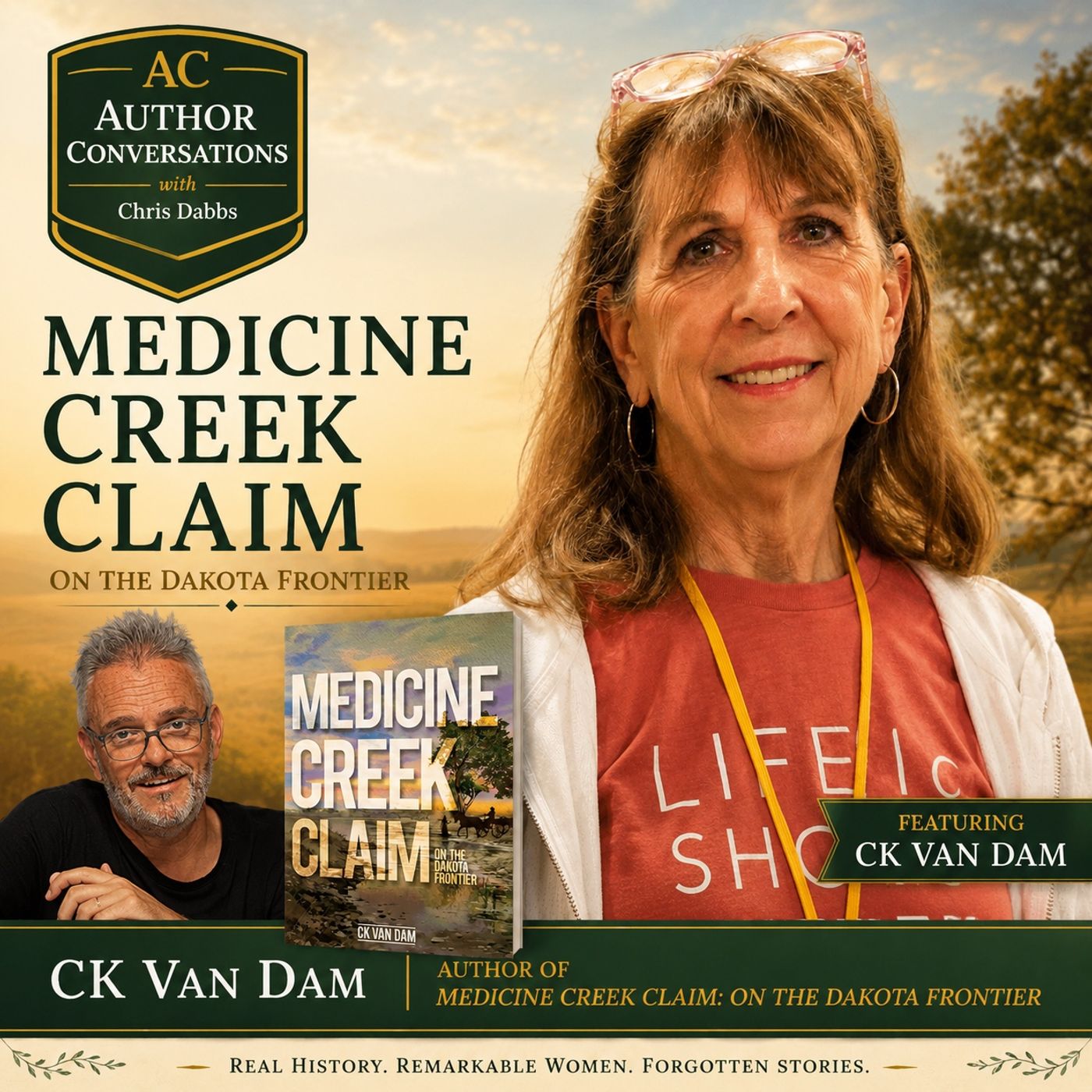
— CK Van Dam
📚 What did it take for a woman to survive and thrive on the Dakota frontier?
In this episode of Author Conversations, Chris Dabbs is joined by historical fiction author CK Van Dam to discuss her latest novel, Medicine Creek Claim.
Inspired by real historical records and the remarkable women who shaped the American frontier, CK explores the challenges, resilience and determination of female homesteaders in the Dakota Territory.
The conversation delves into the research behind the novel, the realities of frontier life and the stories history often overlooks.
🎙️ In this episode:
🌾 The real women who inspired Medicine Creek Claim
📖 How historical records shaped the novel
🏡 What life was really like for female homesteaders
💪 The strength and determination required to survive on the frontier
🔎 Surprising discoveries made during research
✍️ Turning history into compelling fiction
📚 Why forgotten stories still matter today
Whether you’re a fan of historical fiction, American history or powerful stories about pioneering women, this is a fascinating conversation that brings the Dakota frontier vividly to life.
“History often remembers the men who settled the frontier. CK Van Dam reminds us of the women who made it possible.”
🎙️ Podcast Chapters
00:00 Introduction to CK Van Dam and Medicine Creek Claim
01:18 The surprising statistic that inspired the Dakota Frontier series
02:22 Real women homesteaders and the origins of the story
03:45 Charlotte Ward: creating a woman who disguises herself as a man
05:31 Women in the Civil War and challenging historical assumptions
07:08 The realities of homesteading on the Dakota frontier
08:24 What it took to prove a homestead claim
10:02 Frontier survival and the hardships faced by settlers
11:29 The role of women in building the American frontier
13:02 Researching Civil War medicine and battlefield conditions
14:22 Medicine, hospitals and healthcare during wartime
16:05 Historical accuracy versus storytelling
17:20 Research challenges and uncovering forgotten history
18:48 Was there anything that genuinely shocked CK during research?
20:01 Divided loyalties in Missouri during the Civil War
21:32 Creating memorable characters from historical inspiration
22:54 Strong women throughout the Dakota Frontier series
24:08 Why these stories still resonate with readers today
25:30 The importance of preserving overlooked histories
27:12 What’s next for CK Van Dam?
28:27 Final thoughts and closing remarks
You can now watch CK's interview on YouTube: https://youtu.be/Qra80fQg4UM
Become a supporter of this podcast: https://www.spreaker.com/podcast/author-conversations-with-chris-dabbs--6905413/support.
Every book has a story beyond its pages.
In Author Conversations, broadcast journalist, presenter and newsreader Chris Dabbs sits down with the writers behind some of today’s most fascinating books to uncover the research, experiences and ideas that never made it onto the printed page.
Featuring bestselling and emerging authors from around the world, each episode goes beyond the blurb to explore the real stories behind the writing.
From untold historical discoveries and groundbreaking scientific research to personal...
Hello and welcome to author conversations. Today, undrained by historical fiction author, C.K. Van Dam, whose latest novel is medicine pre-clave on the Dakota Frontier. C.K. Van Dam writes stories inspired by the strong women who help shape America's frontier history. Her novels explore the realities of homesteading, survival, war and resilience, doing some of the most turbulent periods in American history. It's fascinating still. Now medicine pre-claim follows sisters Charlotte and Lizzie Ward during the civil war era as they attempt to build new lives with the Dakota Frontier.
At the heart of the story is Charlotte, a remarkable young woman who disguises herself as a man joins the Union Army and develing medical skills or trying to protect her younger brother during the chaos of the war. The novel combines family, drama, frontier life and real historical events including the divided loyalties inside Missouri during the civil war and the brutal realities of bad or fluid medicine. So after that intro C.K. welcome to author conversations. It's great to have you. Thank you very much.
It's good to be here. Oh no no problem at all. Excellent. Well, let me ask you like a really obvious question, Festival. What inspired you to write medicine pre-claim? Medicine pre-claim is the third book in my on the Dakota Frontier series and the first book was inspired by a statistic that kind of roused through this whole series that while 12% of homesteaders were women 42% of women homesteaders proved their claims. They had to be on single, widowed or divorced. They had to be head of household according to the homestead after 1862.
History made sure here. So 42% of women homesteaders proved their claims. 37% of male homesteaders proved their claims. They could be married. That to me said, ah, there's a story there. So far I have written four stories based on that inspiration. Medicine pre-claim was inspired by but not based on Land of the Burt Thigh by Edith Amits. She and her sister came from they homesteaded in
South Central South Dakota in the early 1900s and they came from Illinois and they homesteaded by the lower brule reservation. And I thought, well, two sisters, that's a great, that's a great angle. I can, I was sister. I can write this. So I wrote medicine pre-claim about Charlotte and Lizzy Ward from Missouri and they just followed the Missouri River up to Yankton and out to their, what was eventually their homesteads. Incredible. Yeah, because in the book you used this like, have the chat to buy chat today.
So I apologize to you, Ms. As they bang up the river. Well, a good portion of the book, as you alluded to, is while they're in Missouri and about asserted the book they're in Missouri. And at that time, as you said, Charlotte disguises herself as a man. They are, for lack of a better term, orphans. Both of their parents have died. Their younger brother, who was only 17, I think, in the book, in Listen the Army without permission. So Charlotte, being the oldest sister, the bossy sister, as I understand that, says, well, that's not going to happen.
He's going to come back here. So she dresses as a woman. She cuts her hair off and dresses as a man and goes off to war. And she buys it, spoiler. But that's part of the, that's part of this, that was part of the plot. And as you said, while she is in the army, in the Union Army, she becomes connected with a army doctor who kind of teaches her some of the basics. And that was when she decided that medicine was her calling. Now, while she's out in the war, her sister Lizzie is still back on the farm by St. Joseph Missouri in that upper, upper Northwest area of Missouri.
And she's on the farm. And she is running that farm by herself at this point. And she encounters Quantil's Raiders, who was a, that was a historical reference. And she also meets Frank James from James Brothers, Frank and Jesse James. Because they're from that same area as well. So Lizzie is off, maintaining and managing the farm while Lizzie Lizzie is on the farm and Charlotte is in the war. That was a long time. Yeah, yeah, blah, blah. I mean, it's quite complicated though, is that because she's got Charlotte hanging her sort of like, not really gender, but I mean, you know, dressing as a man.
And you've got them homesitting as well. I mean, this is way back. It's incredible that on one hand, you can't do this on the other hand, though, you're now at home standing. How did that kind of work? Well, so the Homestead Act, is that the answer you want me to talk about the, okay, so the Homestead Act was literally and figuratively landmark legislation. It was the first time that through U.S. law women could own land on their own. It took 20 years for Congress to pass that law because they did not want to include women in it.
Finally, after the Southern representatives and senators had left Congress for the war, the 37th Congress was able to pass that legislation. They thought it was really funny that they were including women in this act because women were never been able to make a go of it on the prairie, on the frontier. And so they said, sure, we'll set, well, let them do this. And they'll just go out there and they'll get married and make babies of the pre-apim salt. So, but that's not what happened. Lots of women went west and for different reasons.
But most, a lot of them went west, especially if they were head of household, which they had to be, they were spinsters. 600,000 men died during the Civil War on both sides. Kind of hits the marriage pool a little bit there. So there weren't a lot of method, there weren't a lot of marriageable men. Also, a lot of women lost their husbands during the war, so that made a lot of widows. And there were some divorces who went west as well. So that was that impetus for sending women west. I think that's the thing though.
That's what I was trying to say really is that it's quite unusual, I guess, for that to happen, right? So for women to be head of households and then reading around and having a legal face like that, I like you said, 20 years past the the legislation is incredible. Now for those of us who don't know, I thought you just went along home studying, right? And you got to speak some meat like, just coming down, and we went down to the other town, or something and said hello, this is my claim. But you said that law women proved that claim?
Yes. Then then ratio is it is, is it towards women? Yes, how come? I mean, can you just quickly explain what the what that means? Well, the process was that you had to file your intent to stay for this clinic. And according to the Homestead Act, you had to live on the land for five years. You had to build a dwelling of some sort. And in South Dakota, a lot of them were dunk outs or soddies because we don't have much, we did not at that time have many trees on prairie. It's flat. And so they would have a sotty and they would literally dig up a sod from the prairie and build their house that way.
So they had to live on it for five years on a build a dwelling and they had to improve the land. And out into Codator that net farming or ranching. So that was what was involved in proving a claim. After five years, you file more paperwork with the government, had witnesses that said, yes, this woman or this man was on the land for five years. I've seen them on the land. I know they improved the land. I know they're working the land. This is how many acres they've broken and planted or whatever.
So it was a process. And that process was one that a lot of women were able to complete and then they were able to 160 acres. Which is fabulous, isn't it? Because if you think about it, whether you've had to write it because of that historical context is interesting, where you've got Charlotte who's not romanticized at all really. Yeah, she's practical, determined, capable, clearly. I mean, was it important for you to avoid turning your insides like a modern action hero where she fends off the bad guys?
Oh gosh, no. I think that these are real people. In my head, they're real people. And Charlotte, once I had to find who she was. And I do that before I start writing. Once I had to find what her her mission was, what her goal was. And then I was able to write her as a person that seemed real to me. And I think to a lot of my readers. And then Lizzie, oh my gosh, I love Lizzie. And she was the younger sister, but she was the decision maker. She was the one with the vision. And she is the one who said when she saw, oh, my favorite quote in the book, Lizzie is in town getting windows and shopping and getting things for the farm.
And she comes across this newspaper that says that Lincoln has signed the Homestead Act of 1862. And he signed it in May of '62. It would go into effect January 1863. But she reads this and she's reading this article. And her response was, it's about time. So I love that about Lizzie. And exactly. She's focused as well. Very. Well, yeah. Yeah. Yeah. And I mean, that's the other point that you get. I think the one choice, one trying to say is I'm trying to keep away from the historical side of things.
Because you were a history major. Right. So we could really quite a minute go down this side of it. There's a lot of rabbit hole there. Yeah. Yeah. So, okay, well, there's something I think about this historical fiction, I think, it's primarily usually leads heavily into romance, things like this. But this one, you know, it feels really rooted in family and survival, really, because you've got Lizzie, you've got Charlotte, you've got the umbrella. I mean, was that always the attention? I mean, the pattern that got inside of things.
Yeah. I think it was. I was trying to show what it would, what it would be like for these two sisters to strike out on their own. They were done with Missouri. Missouri had the third highest number of battles and skirmishes during the Civil War. It was, they call it bloody Kansas, but Missouri was bloody too. And what the Bush Wackers and the J. Hawkers and the Union Army and this Confederate Army, there was a lot of conflict and just violence in Missouri during that time. And that was something that they wanted to get away from.
There is romance in the book. And the book has won some romance awards because I introduced a Confederate officer that Lizzie meets in a medic tent or that Charlotte meets when she's in a medic tent. And he, he realizes that he is interested in her and follows her west. But, so there is romance, but not for Lizzie. And I must say in medicine creak claim, I got about three quarters of the way through the book. And I realized I hadn't told Lizzie's story. Because as you taught it, it really is about Charlotte and about what she did and how she did it and her life.
And Lizzie is there as a supporting character. But I loved Lizzie. And I thought she deserves her own book. Shameless plug. So I wrote, I reinforced claim about Lizzie's story seven years later while they're both out in the in the Codate territory. So I was able to tell both of those sister's stories. Well, that sounds like a really good way to do that. Because if you think about Charlotte and do you think about the way that I'm really just being myself from asking her spoiler here because she's getting involved as a doctor.
No, it was a Confederate officer. Confederate officer. So all in the medic tent. Yeah, he was a patient patient. Okay, oh great. Sorry, thank you. That's okay. Actually cleaning it up. Okay, so at this time, is she still serving as a man? Yeah. And that's what can be use as him because he thinks I'm interested in this medic. And so there's some confusion up front and Charlotte has no interest in him. She thinks he ends. Well, she knows he's lying because she knows he must be a Confederate and he's not saying that.
And she really, they they they had that this was a enemies to lovers relationship that develops during the book. So they weren't really she really didn't have any interest to him at the beginning. So kind of new job. Well, she's interesting, isn't it? Yeah. So I guess he kind of felt something but didn't and as you say, it was very produced by it. Yes. They did a new job. So you mentioned Charlotte finding her calling in federal world, right? And so we're not seeing the picture. The medical scenes, they're showing credibility.
Oh, yeah. I yeah, I had to do research on that and I read a book called Blood Something and purge blood. I don't remember. It's a thick book like this and it's the whole topic is about medicine during the 1800s and the the instruments that they used and how they treated things and during the Civil War, the biggest killer was gangrene and infection. It wasn't it wasn't getting shot on the battlefield. It was getting shot on the battlefield and then going to a a medic tent or a hospital and dying from infection.
It's incredible how the Pascows and I think what's meant who introduced the antibiotics. Yeah. I don't really did change. Well, I didn't know it's that it's another issue at the moment, isn't it? But why you were doing this research? Did any of this research actually genuinely shock you as in how could we post it? No, because I have read those things in the past and so I knew that I needed to I had a slight knowledge of it and I knew I needed to dig deeper to make sure it was um, accurate. I have had readers call me out on there wouldn't be a corn on the cob at this time of a year.
So I needed to make sure that what I wrote was historically accurate. Yeah, definitely because I think historical, historical fiction fans wanted it. They wanted to be accurate. Absolutely. By stuttering fans, right? Oh yeah. They read it for your faculty. They read it and they'll call me out on it. So I don't want to I want to make sure that everything I write is historically accurate. And I do a lot of research before I read a book. Which is great because then you're writing the book which is fantastic.
You're freshing out all the world and the people and you're also doing what you like doing, which is researching history. Right. I love history. So that's great. Okay, Slope, does she you said that she finds her brother? Yes. So how does that unfolds? And is that my major part of the book? Is it like, go on together during? No, it was a vehicle to move the plot forward to get her out on the battlefield. And she finds her brother. He's been wounded. She hauls them into a medic tent. And um, nobody and they're so busy there.
And the, the they were just they were organized chaos or disorganized chaos, maybe even. And so nobody was going to be able to treat him. So she starts treating him. And that's when this surgeon, this union army surgeon looks at watches her and says, this soldier knows what he's doing. And so he recruits Charlotte to be his assistant in the medic tents. But yeah, she finds her brother and that's that's just a way to move the story forward. It's part of the plot. Okay, so she gets recruited to be the medic.
Yes, still as a as a man. Yes, yeah. Because they didn't have nurses. Then I know they did not. It's pretty good. It's amazing. Okay, let's have a look. I mean, we're up, we're supposed to get close to the end here. But I've got some questions. I still need to ask you. I was thinking that your Missouri, I know, I guess in every civil war, but there's some in Missouri, Missouri, it feels like there's like, deeply fractured. Like families are fighting trivits. Civil war's, you know, inside their homes or, you know, between families.
I mean, I know that happens quite often within civil war. But was that an intentional sort of parallel to wider America at the moment? So not really, but you just really just know, no, no, it was just a fat to that that happened in Missouri and neighbors were fighting neighbors and my hero in the book, who is a union or is a Confederate officer from Missouri. And Charlotte asks him, why are you fighting? Your family has a horse ranch and you don't have any enslaved people on your land. And he said, no, but all of our neighbors do.
And I could not join the Union Army and keep them safe. So no, it was a, it was just, it was a fact of life in Missouri. And I think in a, in a number of southern quasi-southern states, but Missouri especially, the Bushwackers and Jay Hawkers were a good example of that. Well, amazing. So I mean, as you say, you know, your books have been written quite of free now. And they kind of look at claiming land by women, building farms, upgrading independence, which is, which seems to be quite rare at the time, clearly, because of legislation and what have it.
But what fascists you really about the particular homestead era?
That women finally had a choice. They had a choice to um, strike out on their own, start a new life on whether it's in Dakota territory or someplace farther west or or wherever. And um, make a life for themselves and not be dependent on another person, especially a father, a husband, a brother, whatever. That was, it was the first time, right? Yeah, it was really the first time that we, it was the first time in America that women could own land on the rule. They couldn't vote. I don't think so. They couldn't vote yet, but they could own land.
Exactly. And I was going to say that in the UK, I think that it was a case that you could vote if you were a landowner. Yeah. Or you could only vote if you were a landowner. I think I was right. And at the end of the day, women could go land. Then there you go. Then you can't vote. Obviously, it's slightly different in America, which is great. You know, it's incredible. So what do you think then that modern audiences, you know, what can they take away from, from this kind of book or from your stories?
And at least really. Oh boy, that's a, that's a hard question. I think, well, historical fiction is really escapism at its best in my opinion. And I think that by making it historically accurate fiction, I am giving them a glimpse at maybe what their great-grandmas or their great-great-ans did, maybe, or what women had the ability to do. And the women I write about are all strong. They've come from different parts of the country. They settle in the co-deterritory. And they start farms and ranches.
They build lives for themselves. And they contribute to their communities. And I think that that was integral in every plot that I wrote. I think that makes sense, doesn't it? I think modern audiences are very, very likely, you know, at the moment, before reading your book or anything based on this era, I mean, to underestimate exactly how physically difficult survival was during then, right? Because I mean, audiences have already, they've forgotten, not his name. It was, it was very hard. And so earlier you asked, so why the difference in the 42% and the 37%?
While my sons have not read my books, one of them was, we were talking about it. And in the intro, and in the intro of the book, I had written that and he said, I get it, Mom, these women didn't have a plan B. So they came out West without a plan B. They didn't want to stay back in New England and take care of Mom and Dad and their golden years. They don't want to be a caretaker. They wanted a life of their own. And that was it. They weren't going to go to them, the Gold Fields in California or Colorado or Wyoming or wherever.
They had, this was their do or die moment. And so there you are. I mean, we don't have any parallels to that nowadays. They reign now we don't. Oh, no, right now. But can you see something coming? Sure. Will it explain? Well, I think that I hope that women are going to have a bigger say in what happens in our culture in the future. Now that's fair. No, exactly. So is that the sort of hope and feeling that you read is a left with? I'm just finishing the novel. I think so. And you know, when I wrote Lizzie's story in Ironmer's claim, I really made her a community leader.
And people looked at Lizzie Ward as somebody with a vision. And I loved that about her. I think that's something that America has. Those other countries don't have to be honest. It is the civil or civic pride and pushing things forward, you know, from the community level, which is great. And that sounds like what Lizzie's going to be doing in the next book. So we're running out of time now. And let's have a look at the books. Tell us about where you can get them. Have a website. How can people contact you?
Sure. There are for sale on my website, which is www.ckdn.com. Pretty easy. Just my name.com. And if you order them on my website, I'll sign up for you and I'll ship it off to you for free. Easy. And all four of my books are available on my web. I'll six of my books actually are available on my website to order and I'll ship them off to you with any signature you want on. I also have the audio books and I have ebooks and those are all available on my website as well. I also am on Amazon under my author name, CKVandam.
And I am on IngramSpark and bookshop and all my gosh lots of different platforms. My audio books are on Audible and they're on about 40 different platforms. So if you're on the trip books or bookbub or any of those other you can get my audio books there. And I have new libraries and I love having them in libraries. So ask your library to carry it. Exactly. Now that's great. Well, let's see. Hey, you've got everybody's covered. I hope so. Exactly. Well, it's C.K. Van Dam. Thank you very, very much for joining me on author conversation stage.
It's been a pleasure to talk about this. I'm only an amateur and it comes to history. But you know obviously you're a good book professional, you're lying. But medicine pre-clean sounds excellent. And it's available now. It's just from here this is everybody. And there we are. There's the book as well. And don't forget that Nisi has a follow on book. Yeah. So yeah, so thanks for watching or listening. I don't think it's a like, subscribe and follow the world conversations with authors and like it's short.
By the books. By the books. By the books. Yeah. Thank you. See now I've got to say I like them. I'm listening. It's very good. We've been trying to put it up in a free stream on that for years or a while. Thank you. So I was hopefully we'll speak again in the future about other books of yours. But for viewers or listeners, I'll see you or until next time. And don't forget to like and subscribe. And C.K. Van Dam It's been an absolute pleasure. Thank you. And this was very fun. Thank you very much.
I'll go ahead. If you enjoyed this conversation, you can watch more author conversations here. [MUSIC]
 Apple Podcasts
 Castbox
 Castro
 Goodpods
 Moon FM
 Overcast
 Pocket Casts
 Podbean
 Podcast Addict
 Podcast Republic
 Spotify
 YouTube