Treasure's Location | Joel A. Robinson on Publishing His Debut Novel at 92
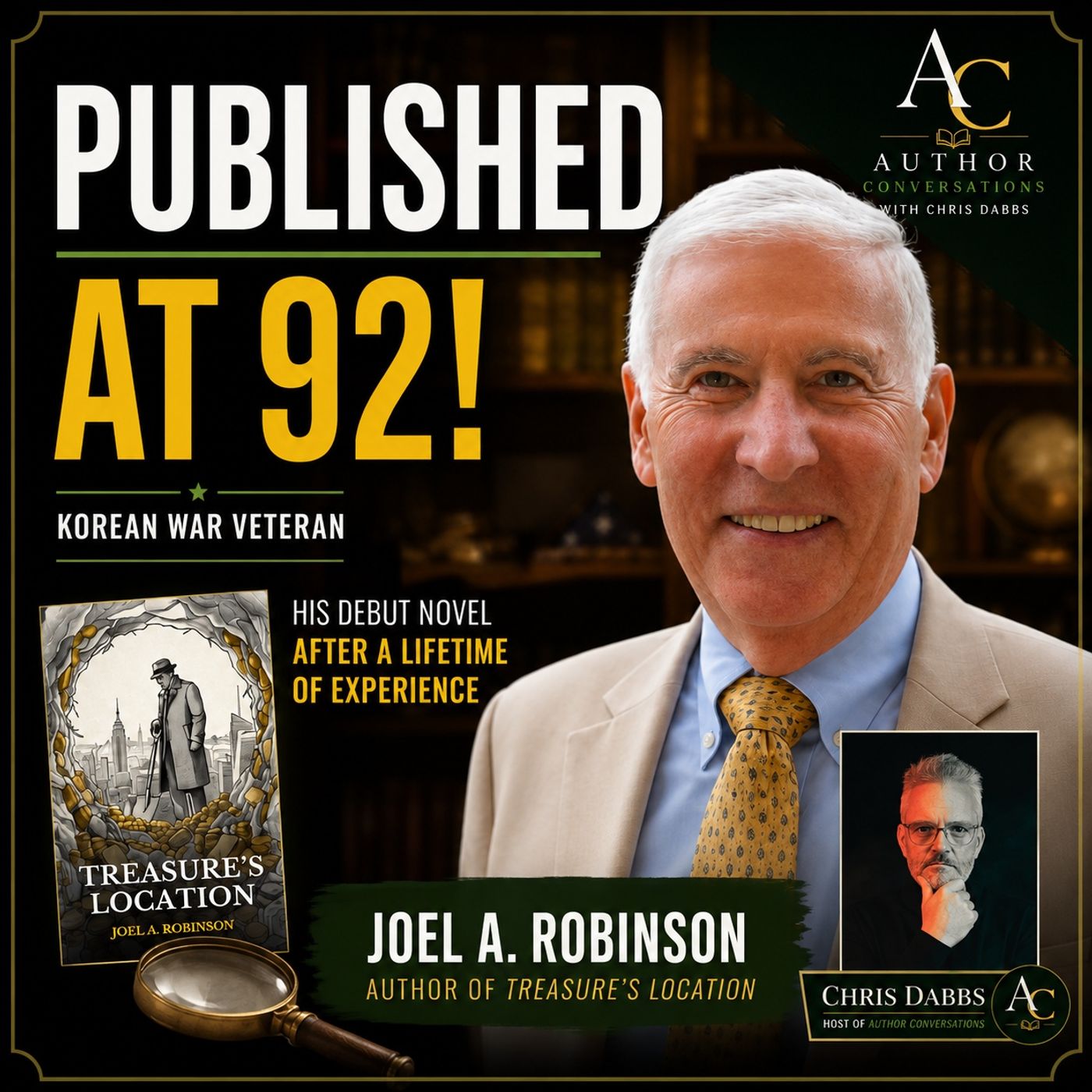
What begins as a discussion about an international historical thriller becomes a thoughtful conversation about perseverance, curiosity and the enduring power of storytelling.
Joel reflects on the real-life treasure story that inspired his novel, the historical research behind it and why he believes it's never too late to write the book you've always wanted to tell.
In this conversation
- Publishing a first novel at 92
- Life after the Korean War
- The real treasure story behind the novel
- History, mystery and writing fiction
- Building suspense and believable characters
- Advice for aspiring writers
- Why it's never too late to follow a dream
www.author-conversations.com/joel-robinson
Become a supporter of this podcast: https://www.spreaker.com/podcast/author-conversations-with-chris-dabbs--6905413/support.
Every book has a story beyond its pages.
In Author Conversations, broadcast journalist, presenter and newsreader Chris Dabbs sits down with the writers behind some of today’s most fascinating books to uncover the research, experiences and ideas that never made it onto the printed page.
Featuring bestselling and emerging authors from around the world, each episode goes beyond the blurb to explore the real stories behind the writing.
From untold historical discoveries and groundbreaking scientific research to personal journeys, business insights, faith, true crime and the human experience, every conversation is designed to inform, challenge and inspire.
Drawing on more than two decades of professional interviewing across radio, television and digital journalism,
Chris creates thoughtful, in-depth conversations that give authors the time and space to tell the stories that matter most.
Whether you’re searching for your next great read, fascinated by the creative process or simply enjoy intelligent, long-form conversations, Author Conversations offers a unique opportunity to discover the people, ideas and experiences behind remarkable books.
Real authors. Real stories. Real conversations.
Hello and welcome to author conversations again and as usual I'm Chris Dabbs. Today I'm delighted to welcome an author whose publishing journey proves that well it's never too late to fulfill a lifelong ambition. Joel A. Robinson is a Korean War veteran and the author of Treasure's location, his debut novel, published at the remarkable age I can't believe this Joel of 92. Combining historical intrigue, financial mystery and high stakes suspense, the novel follows a Wall Street executive who looses everything before becoming drawn into an international search for a hidden fortune.
A mystery that stretches from New York to post-war Europe, uncovering secrets that have been buried for decades, but beyond the pages of the book is an equally compelling and super interesting story. Joel's journey reminds us that experience, perseverance and creativity don't have an expiry date, right? And that some stories take a lifetime to tell. Joel, it's an absolute pleasure and an honor to welcome you to author conversations. How are you? Well, you have a British accent I think. Exactly, exactly.
I'm graduating from England in 1931. Yeah, yeah, yeah. Oh, cool. Well, they were then. So you're half British as well. What can you say? If he was from Leeds, if you know, but yes, but actually, you know, the basis of writing the book, are you familiar with the record of the Atosha, the Watches Treasure Finder in the United States? No, I'm not. I'm not. But there'd be other people that aren't either. So what is that then? Well, it was a professor from a person and he became hooked on finding treasure.
And it is obviously one of the most complex things because it's either buried in thousands of feet of water or in the tapas of mountains, but he for some reason was successful. And I happen to know a girl who was a diver on the boat. She was married to Fisher's son. And I had gotten involved with them to try to monetize the treasure. It was one thing to find the treasure, which was on the bottom of the ocean for 300 years. And they had these cornings, but they were all the terrible shape. And I had the idea that that year was the year that the Olympics were going to be in Spain.
So I said, let's make this the coin of the Olympics. And you can sell these for $5, $50, whatever. It was a great idea. And my wife, my first wife, who was now passed away, but she was from Spain. So she spoke Spanish fluently. So I sent her to the Spanish vacation and they almost killed her. They said, what the hell are you doing? You were stealing our money. And that got me involved in not only the treasure and monetizing treasure, but the legal rules to doing it, which is very interesting. And the state has barred us to him trying to get them, oh, a bunch of people tried to get the money.
And he was successful. And that was how I became interested in in the treasure of money. It's very high. And of course, like to the book. You know, actually, now you're mentioning that about off the coast of Florida and everything else. I think that's what he said, wasn't it? And that kind of rings the bell. So maybe for other people, they'll also remember that because, yeah, I mean, the law around treasure hunting, I mean, in the UK, it's in Britain, it's really interesting and really complicated.
But international waters who still own something, yeah, that sounds great. I mean, no wonder you got intrigued with it. And of course, there's a few bucks to be made as well, right? Well, you know, almost everyone wants something for nothing, which is a mistake that all human beings need to have. And another part to the, to my life story, I was head of the statistical analyzing section of Chase Manhattan Bank in the late 1950s. And we were doing something which was very new, which was preparing the mathematics of the sales department that it could sell life insurance or retirement agreement.
And one of the people I was working with was a mathematical genius. And one day came to me and he said, you know, Joe, I've never been to the racetrack. I said, no, I haven't either. He said, but I found something. Horses that run in the front win at 37% or higher. And if we could figure out a way to warn something about horses, we can make a lot of money. I said, really? Now, I was going to Columbia at night, and we began researching this. And we found that if you made five bets starting at $5, you bet $5, and at the worst, then you bet $10, then you bet 20, then you bet 40, and then you bet 80.
You'd never lose five bets in a row betting with the system. So we thought, so we saved our money. And we went out to the racetrack. Took about three months to, we were very poor kids. And we tried the system and lo and behold it worked. And after a short period of time, now you get to realize how poor I was as a young man. All of a sudden, I had a tremendous amount of wealth. I was now buying clothes. I was dating a girl who was a movie star and going to the best clubs in New York and had suddenly gone from the lowest to the highest in a very short period of time.
And everything was wonderful until one day, the system stopped working. Now we examined this. Nothing seemed to have changed. But there's one thing about gambling. It is a gamble. And after a while, I realized this was not going to work. And I was going to lose my tuition. And I felt that going to college was more important than anything else. And that was the end of my racetrack. Eventually, you know, I was paying my way at Columbia at the racetrack, which is sort of an odd way to do things. And I took a job as a working inductor revs laboratory, put making slides at a dollar an hour.
So I had gone from the very top to the very bottom, the great wasn't. And that again was part of what I did when writing this book because the people that were searching for treasure were looking to become independent with wealthy. But what they went through was a surprise to them and what the basis of the book is all about. Interesting. It's kind of like a boom and bust, but on the personal level, right? And if you'll treasure hunting, you'll, I don't know if that's the right phrase to use, treasure hunting.
But if you'll treasure hunting, I guess you've got investors, you've got obviously staff to pay, all that sort of stuff. If you're doing a big, you know, maritime kind of a recovery, right? Well, actually part of the book, or a main part of the book is the treasure that the Nazis took during the, she Hitler when he wrote my accounts and wanted to go to war and occupy all Europe, he found out the one thing he didn't have was money. And it cost an enormous amount to wage war. And so he, they would, he would raise taxes twice in Germany, but the best side treaty really had handicapped Germany.
It was bankrupt. And this, you were going back into the early 30s. Well, he becomes president. He's going to lead her in 32, 1932. So he hires this group to begin to steal from the banks, and especially in Antwerp, where the diamonds are right. And if anybody who's going to catch him, he was going to say, this is done by the communists, not by the Germans, who had done secretly. And none of these guys were prosecuted at the end of the war, in 1945. But during this period, the Germans had sold one billion, not millions, billions of dollars.
I'm talking about billions of dollars as of in 1945. And almost none of that has been found, which is, and so as in in the book, now the book is totally factual, except for the character. So the character would be in Germany looking for something, and that's all very true. But anyway, what happens with these people in the book is that suddenly, looking for treasure, and doing something they didn't realize was dangerous, became extremely dangerous. The number of people that have been killed looking for treasure is very interesting.
There was one, for example, a man who drowned in Australia, working food, and turned out he was an Olympic swimmer. So unlikely he died on his own. Well, he was looking for treasure. And all that makes up the book in, in, in, of course, the human interest side of it. See, that sounds, that sounds really interesting. I'm fascinated because of course, what you're saying there is that if you were looking for treasure, someone else wants that treasure, and they'll do anything to get it, basically. Well, you have not only the people it was stolen from, but you have the German government who wants to make reparation.
You have Wiesens, Wiesens Stahl, you know, who's one of the people looking for, and he had the Israeli government looking for it. And suddenly you have a lot of competition. But then you have the ex Nazis who, well, in 1945, as they grew older, they had people that they trained who were then looking for the treasure, and they become part of the story. And the thing by one, it we've, Europe and, and goes to the United States, whether these guys have found some of this treasure, but in fact, that's very difficult the whole lot.
You know, when you find something, the only thing is important is whether you can keep it at it or not. Exactly. I think that's, that's amazing. Double statement. Yeah, yeah. I mean, I guess, you know, that's what your main character, Jim Comifer, you know, that's where he goes through, I guess, right, loses everything almost overnight, like he was saying earlier, before setting out, looking for this treasure and things. I mean, what interested you then about beginning the story with such a dramatic sort of personal financial and every, you know, crash or collapse, and then to go on from there?
Well, Comifer is part of a, a, a, a company, Drexel Burnham and, and they in fact did go back rough and he wound up losing his job. He was making $650,000 a year, which was a lot of money in those days. And he realized making a great amount of salary was fine, but you need at least $10 million in the mag to be totally independent. Which is, that was, that was $10 billion. And so, that is how he, he learns about William Bennett, who's a socialite in New York, an fictional character, but apparently Bennett has found the treasure because he's living at a very high level.
He has a co-op on Fifth Avenue. He's dating a more beautiful woman in New York. Where did he get in the money? Well, he's killed an automobile accident. And when he's killed, they look at his amount of money he had and they can't film it any way. So, how is this guy living in a, a, a, high lifestyle like this? Where was he getting the money? And that is the research that Comifer goes into and believes, see, the one thing about treasure is everybody knows it's out there. Nobody knows who are at that.
That's the title of the book. The treasure's location. Where is it? Well, he, Comifer would decide that he, that Bennett must have hidden the money either in Manhattan, Connecticut, New Jersey, someplace close by. He certainly wouldn't put it in Siberia. So, that again is a major part of the book, you know, how he goes and, and, and, and where he's confronted with. Which is, which is amazing, you know, the detail that you've gone into in that respect, I mean, you know, the story, it travels through what, across continents, as you were saying, from Europe, you know, to the US and back again.
I, I'm through history, you know, it's not just six months worth of story, is it? It, it stretches over a long time, as you say. But I mean, how much research was involved in creating, you know, such a fascinating, yeah. I am, although my education, I, I was a major in philosophy at Columbia, but I've always been interested in history. And, so, in the book, part of the book is the foundation of Mossad in Israel. Once again, searching, they, they were, you know, looking to search for the treasure.
And the book starts in that part of the world in 1947 before the, uh, hours attack. And, and, and the individual who became a fictional character with part of the OASS during the Second World War. And then, uh, the, the, the, the, the, I, I was also in a, intelligent operation in Germany and realized how dangerous that type of work is, uh, could be honest, with you, I am not qualified. I wasn't, and I am not today qualified to do that. You have to maintain a personality 24 hours a day, whatever fiction you're trying to put it up.
And, uh, so I know how dangerous that work was. And he leaves, uh, the OASS in that one at the end of the war, but is called back by the Israeli part of the story. And they need his background to form the Mossad. She, and he is then gets involved in that. And then he sent the Europe to find the Nazi treasure, which he is, I said, but things don't want. He is not able to do. But, uh, I went together all those disparate parts, uh, to make up the story and, and, uh, and then concluded with what eventually happens at the end of the book.
Well, yeah, obviously don't tell us about that, but I mean, he is, I'm trying to give you back the back. I don't get way the way I slide, but that's, that's really all right. Exactly. Wow. So you, you're intertwining the creation of Mossad and, oh, right, I mean, you know, going really into how post war, well, the world, the post war world, um, has actually moved on since since that the second world war. I mean, you know, I guess readers always love stories about hidden treasure, right? And unself mysteries.
It's always one of those things, isn't it? But why do you think that people love that? You, I think you kind of mentioned it earlier on, didn't you? But why do you think that people like these sort of genres and also when they're mixed together? Well, the book essentially is an entertainment to begin with. It's, I'm certainly not writing is a, the history writer or, well, philosophy is part of the book and part of my education, but, uh, essentially, it's an entertainment and I wrote it as such. And so, uh, it has a beginning, middle and end.
Uh, and, uh, it, uh, it, it concludes, uh, what these people are doing. And hopefully, uh, the book is written with enough to hold the reader's interest. Uh, you know, it, it, it, I found this, uh, surprising to me. I, I took four years of English at Columbia. I took six years of French, mostly in literature. And I thought I had the background to be a writer. Well, I believe it or not, I do very, little about writing book. And it's only been the help of my editor that has put me on the right course.
And I realized how complicated it is, which didn't appear to be something difficult, but it was very difficult. Now, I mean, not only the, uh, the research, uh, and then again, the quality of the writing, obviously, that's got to be very important. But, uh, uh, I found it very entertaining. Uh, now here I am at 92 years old. And the, my real, I think it's, yeah, I'm still working five days a week. I have a printing company I founded 50 years ago. And, uh, but I'm in an old age home for a very odd reason.
Uh, let me give you the background of that. Uh, my wife passed away in 2021. And my daughter wanted to go to Paris, uh, and take the grandchildren as something for them. And he insisted I go, well, I'm a disabled veteran from the Korean War. I was shot in the service. And so I'm in a wheelchair. Now, mentally, I'm very mental, acute. I speak these, you know, very soundly and so forth, but I didn't want to go, but she insisted. Of course, I had to pay for it. So we go to Europe, go to Paris. And I've never been concerned with my health.
My health has always been fantastic. But I'm coughing a butt, which would scare me. Well, I didn't pay attention. I said, I can't be anything important. My son all wanted to call a doctor when we got to Paris. I said, I don't want to hear it. So the next morning they came into the room and bed was filled with butt. He called the house doctor. They rushed me to a hospital. And now they were examining me to see what was wrong. I went at the cardiac arrest and died. There's true stories. So they called me to order and they said, you gotta come to the hospital and get the body and take it back to the United States.
And some, no, let me make the difference. A heart attack, your heart keeps working. Cardiac arrest, a heart stop. You only have about four minutes. Otherwise you have brain damage. Well, I was dead for, I don't know how long. I can't tell you that factually. But at some point somebody walked by and they said, this guy is breathing. And the first doctor said, that's impossible. I, she told me that anyway. And well, but she called my daughter, rushed to a hospital. I wake up. And I have no idea what happened.
And everybody's crying. You know, my two grandchildren, my, that daughter of my son-in-law. And she was so frightened by this that she wanted no, you'll not allow me to live at home. And she said, you've got to go to an assistant, live it. She lives in Westport. So I went to an assistant living nearby. And that's what I'm doing here. Still running my business and writing books. I give lectures once a month. But, and I've never had a recurrence of it. But it's an odd story, but a, but a, but a, a, so you never interviewed a dead person before.
That's amazing. And no, I haven't, that, that, I don't know what to say. I mean, are you actually there? Yeah, you are. So I mean, I have not interviewed a dead person before. That's quite amazing, Joel. That's a story. How long ago was that, by the way? That was 2021, Christmas. And I moved to assistant living 2022. Any? And I've been here ever since. And it's the fact that I'm incapacitated, and the fact that I don't walk well, I've been in wheelchair. I mean, I have three bullet holes in my right leg.
That's what's causing the problem. But mentally, I haven't changed, you know, I was interviewed twice by the Wall Street Journal over the last six months about my age. They want to know what I was doing, what type of things. And I don't take anything. I don't take medication. You know, your DNA, you can do nothing about it. It's even good or bad. You can hurt yourself if you smoke five packs of cigarettes a day. I've never been taken in a legal drug. So those are the things that can be deleterious to your health.
But the rest of it is just, I really don't understand why I'm so different from almost everybody here at this facility, given my age. So you neighbors there? I think, I asked what we would say, sprightly, you know, sort of like energetic and aware all the time, if you know what I mean. Is you the outlier here? Oh, I'm clearly an outlier, yes. Well, the extent they may be president of the residence here because of my mental capacity, you know, they handle it. You need to go around and see people and try to get things done.
But between that and my lectures every month and writing books and of course running my business, it's really, I'm busy now that I was 10 years ago. That's not supposed to be the plan, Joel. It's supposed to be at a calm down. Yeah, and rest in the garden or whatever it is that you like to do, right? But I mean, you have achieved something that many aspiring writers, you know, they hope that wish that they could actually a starter book be keep going with it, see, finish it and you know, then be able to publish it, right?
And they might just be, I don't know, middle aged or whatever that may mean. But I mean, you have actually done it and you've gone through everything. So it's quite a rare thing as well, really. So what's all this meant personally to you to hold your published novel in your hands at your age? And I'm sorry to keep going on about your age. Well, to begin with, and there's no fool like an awful, let me make that point very clear, but I don't really consider myself, oh, I mean, I started this around 91, I'm 92 now, but I like to write.
And it was, I did it for my own interest. And I did, well, what was most important and most interesting, I've found that writing was not done as well as it should be done. And fortunately, when I got a hold of the publisher and they were very interested in doing it, and he said, send me a copy of your book and let me, they liked the, the, the plot, which was very always very real in the setting, but they, they made a number of corrections, which I began to understand, like anything else, whether you're a baseball player or a writer, there are certain things you need to be able to do to be successful.
And really, that my, my interest was not in making money. I mean, I'm making money with my business and other things, to be nice to make money. I don't want to say I don't want to make anything, but I really wasn't interested in that. I was interested in writing and then having a factual response to the book, is it any good? And that is difficult to get, you know, you don't go to somebody's house to dinner and, and criticize their children. It's hard to get people to be honest. Yeah. What I write is it any good?
And I've gotten a lot of praise, but I've always been questionable about it. And I thought the only way to be certain that when I'm writing is good, is if people buy the book. And that still remains an open question, you know, despite all the components I've been getting. Well, yeah. And they will say, oh, you've done really, we, really well for an old guy kind of thing, right? So you don't hear that. Yeah, you don't hear that. You know, I suppose after going to Columbia for so long and studying so hard, you know, you've got a bit of academic in you as well and you want feedback.
You don't want, like, just comments, just saying, oh, yeah, exactly. And nobody, that is nobody improves unless they accept criticism. And nobody likes, including myself. But I know that I'm never going to get better unless I listen to the critics. And that takes, you have, well, I've worn that a long time ago. I'll tell you a quick story. I had approached printing and very quickly, everybody that's involved with printing, he does it with ink or thermal transfer. And I realized that those are very poor systems, but that was all that existed.
And I thought the way to do this was laser technology, which does work except it doesn't make a washable ink. And so the government regulations in the United States will hire a label to be washable for 25 long rings or 12 dry queens. And I couldn't solve the problem. So I hired a guy one day and he said, I know somebody you can do this. There's three Russian scientists in Brooklyn that can solve this problem. So I went out there and talked to them. And he said, yes, absolutely, we can solve this problem.
We want $45,000 and we'll do it. I said, how long will take you? He said three months. I said, tell you what, I'll give you 15,000. Show me what you can do after a month. Well, after a month, they made progress, but there wasn't anything there. The long story short, it took three years to solve the problem. And I poured so much money, and then I almost went out of business. I wouldn't drop it. That shows them not very smart. However, the Russian scientists came up with it and I had the product, which is now patented.
I actually made $1.1 million at the appersonally. And everybody then said to me, I was a genius. Before that, they also said, I was a fool. Actually, they were right. I was very, very foolish. And so I've never forgotten that lesson of people praising you and what the real story is. It's like when you see somebody driving around in a great car or whatever, isn't it? And you know, some people would read jealous or make comment. Oh, wow. I wish I had that for our, but no one knows the backstory to it.
And you know, all that sort of stuff as well. So no, I'm totally there. Well, Joel, we are quickly running out of time, unfortunately. But yeah, we could talk for days either. You're fascinating person. And I'm not just blowing smoke, as they say. I actually mean it. So let me ask you this, right? So when you've got your readers and they've just finished the book, okay, what thoughts are you hoping that they have at the end of that book? What are they going to put that book down and say, wow, or what?
What do you want them to think? I would hope they would be entertained. That would be the most important part. And the construction of the book is around actual events. The one thing I've always bought, I'm a very big book reader. But I have a lot of problems with a book where the man comes down from Mars and does. And I mean, it's so completely preposterous that I, and it's very common, even in mysteries in such well that he's just about to shoot him and somebody comes in the door. These are all questionable.
I don't like books like that. I don't like books that are too explicit with sex. You know, everybody knows what sex is. If they go behind the door with two people, you can figure what's going to happen. And I don't like a necessary bad language, even though I must say I have a very foul mouth on occasion. But I also have grandchildren, which I don't read the one reading book with a lot of bad words. And so those are things that I've tried to put together. And hopefully, between it all, most important that it'll be entertaining.
And it will like, it sounds like it would be so yep, brilliant. Okay, well listen, finally, Joe, your story obviously is an inspiration in itself. Okay, I speak to a lot of authors who are getting, who are quite amazed that they're writing their first novel at 60 or something or 50 or whatever, you know, later on, not when they're young, right? So, I mean, what would you say to someone like that who's always wanted to write a book but believes that they've left it too late? Well, when I went into this old age home at my daughter's insistent, my business had been, I had sold my business to a company in China.
And I had a worldwide business. And so it was very small. And I really had more time on my hands initially. And I began writing based on the time I had. I don't like being idle people say, why don't you retire? I go, what retire from life? What are you going to retire? I never had any interest in retiring. And so that was really the beginning of it. And then when I wrote the book, I written seven books, but when I began writing, I wondered, was it really good? And so we have a book called here and the old people read the book and they seemed to like the book.
Although I was never truly impressed with the way they, I wasn't sure that they liked it. They said they did, but I want to get one back to that. It is real. So all of that went into my, decided to write a book. And then once I got involved with a publishing company and I had some interesting direction where I had to use information through dialogue as opposed to just writing lines and lines of copy. Then the idea was, I'm going to write, I want to write well. And I'm going to take this criticism to hard and do it.
So it's the learning experience is interesting. The research I love. I learned so much with research. And I have an oddly enough at my age. I have a very good memory. But with all the, take the Second World War. I mean, I lived through the Second World or the Korean War, which I participated in. When you do research, you find things that you, there's so much to know and so difficult to get actual facts. And that all became part of an enjoyment for me as well as a task. And the result is the books that I'm writing.
There will actually be two books published this year. So and I realized the artist thing about it is my age. I mean, nobody 92 years old, the reoboblishing books. First time author I'm talking to you. I won't, and don't forget, you're supposed to be dead as well, Joel. So I know. Exactly right. So oh my gosh, this is amazing. Well, listen, Joel, when you've got that next book, when that next book drops, then we need to talk again because you are just so fascinating. I mean that, right? And it's been an absolute pleasure to talk to you today.
So thank you, guys. No, it's a little, no, it's all on me. Listeners, viewers, treasure's location is an engaging blend of history as you've heard, mystery as you've heard and suspense. But your own journey to becoming a published author, if that's what you want to do is every bit as inspiring as the novel itself, Joel, honestly, the way that you've done this and the way that you've approached it in later life. So basically, thank you very much for joining me on author conversations this time. Great, yeah, but no, great stuff.
And thank you for watching our listening, everybody. And don't forget, if you've enjoyed today's conversation, please like, subscribe and share the interview with fellow readers and lovers of great stories, be a pleasure. And hopefully we'll speak again soon. Take care. Bye bye, that. Bye bye. If you enjoyed this conversation, you can watch more author conversations here.
 Apple Podcasts
 Castbox
 Castro
 Goodpods
 Moon FM
 Overcast
 Pocket Casts
 Podbean
 Podcast Addict
 Podcast Republic
 Spotify
 YouTube