Hungry for More: Discipline, Faith and Endurance | JD Tremblay
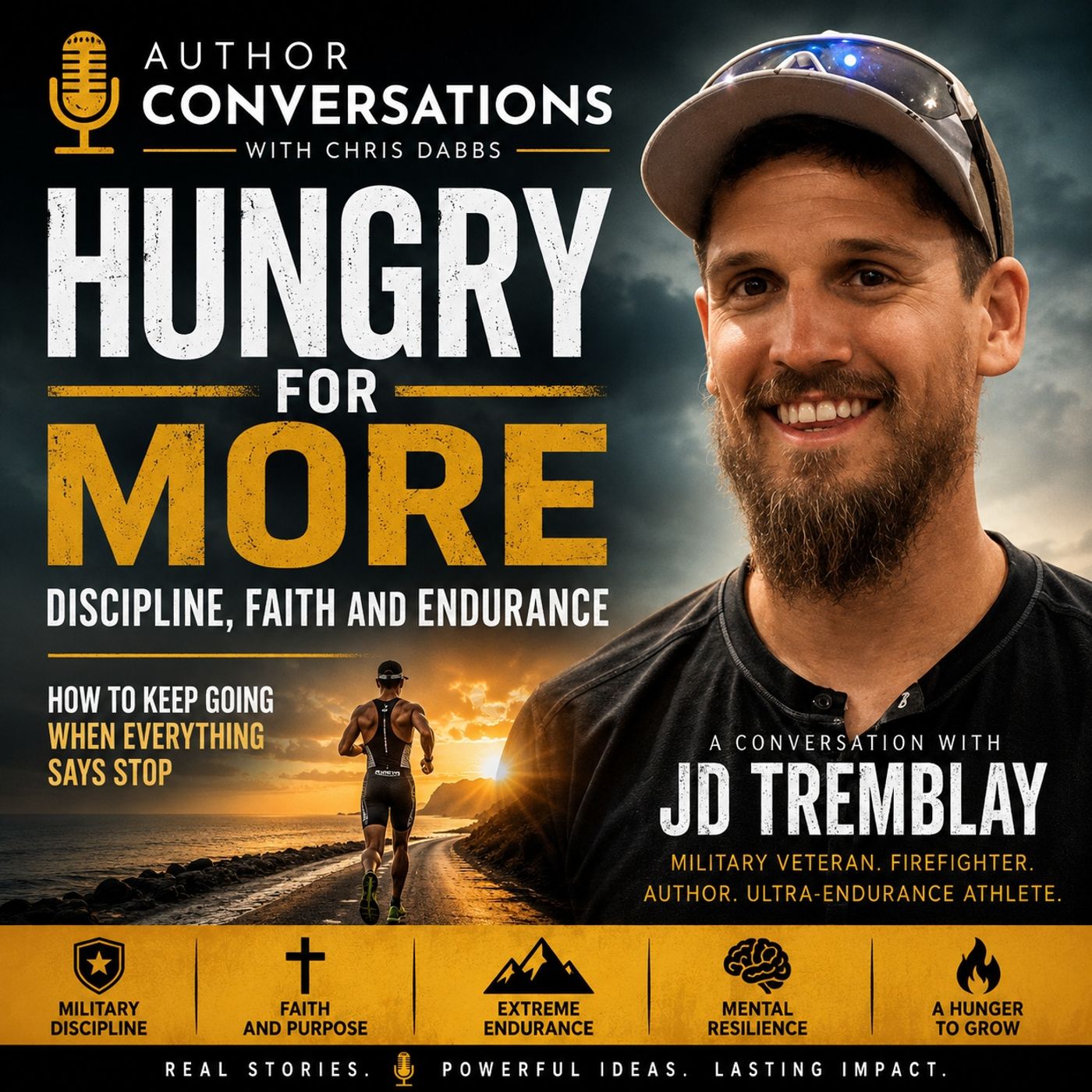
What separates genuine discipline from temporary motivation?
JD Tremblay joined the Canadian military at just 17 after growing up in northern Quebec, experiencing his parents’ divorce and being bullied during childhood.
The structure he encountered in military life would help shape an extraordinary journey through firefighting, mentorship, entrepreneurship and some of the most demanding endurance challenges in the world.
In this episode of Author Conversations, JD joins broadcast journalist Chris Dabbs to discuss the experiences behind his book, Hunger for More in Life: Conquer Mental Struggles, Defy Limitations, and Discover Purpose Through Epic Achievements.
JD explains why the military does not simply give someone discipline.
Instead, it provides structures and systems which can produce discipline when they are followed consistently.
He also reflects on completing the EpicDeca: ten Ironman-distance triathlons across ten consecutive days and six Hawaiian islands.
JD describes what happens when exhaustion strips away confidence, motivation and even your sense of identity — and why adjusting the plan is not the same as abandoning the mission.The conversation explores the importance of recovery, the dangers of comparing ourselves with carefully curated lives online and the need to distinguish between genuine ambition and the pressure to prove ourselves to others.
JD also discusses the Christian faith behind the Hungry Warrior Academy, drawing inspiration from the story of David and Goliath.
For JD, being a “hungry warrior” is not simply about physical strength. It means developing the courage, purpose and spiritual resilience to confront challenges despite fear.
This is a thoughtful conversation about childhood adversity, military service, mental endurance, faith, leadership and the continuing hunger to create a life of meaning.
Chris and JD discuss:
Joining the Canadian military at 17
• Growing up in northern Quebec
• Experiencing bullying as a child television performer
• How systems and structure create discipline
• The difference between motivation and commitment
• Training for extreme endurance events
• Completing ten Ironman-distance triathlons in ten days
• What happens mentally when the body wants to stop
• Why changing the plan does not mean abandoning the goal
• The importance of recovery and slowing down
• The dangers of social-media comparison
• Faith, courage and the story of David and Goliath
• The meaning behind the Hungry Warrior Academy
• Helping people develop physically, mentally and spiritually
• JD’s humanitarian work supporting children and communities
ABOUT JD TREMBLAYJD Tremblay is a Canadian military veteran, firefighter, integrated engineer, naturopathic practitioner, mentor and ultra-endurance athlete.He is one of only a small number of athletes to have completed the EpicDeca, consisting of ten Ironman-distance triathlons across ten consecutive days and six Hawaiian islands.
JD is the author of Hunger for More in Life, a book exploring mental resilience, ambitious goals, personal purpose and the lessons he has learned by pushing beyond perceived physical and psychological limits.He is also Director of High Performance and Mental Resilience Advisor at the Hungry Warrior Academy, where he helps Christian men develop stronger bodies, sharper minds, deeper faith and a renewed sense of purpose.FIND OUT MOREHungry Warrior Academy:
https://hungrywarrioracademy.com
Book:<br...
(upbeat music) Well JD, thank you very much for joining me today. It's a pleasure to have you here and it's great to have you with us. Now, you know, looking back and researching for these questions, okay? It looks like you've had a fascinating journey. What's up joining the Canadian military at just 17 years' goals through to becoming an ultra-endurance athlete, mentor, firefighter, and author. I don't know how you get this time to do all those things. Let's start right at the beginning, okay? Now, my first question to you is, what first drew you to military service at such a young age?
What made you want to join up? - Yeah, I had my parents divorced at the age of 14, so it was already a non-healthy environment. My parents were just looking for both their own journey. And also I was bullied as a kid, so in childhood, I did not have a lot of friends and so joining the military seemed like the only option. My parents did not have a lot of money set aside. We grew up, I say poor, but now we work with the anthropic ways of poor countries. And so I grew up in the northern part of Quebec, not a lot of opportunities through finances.
And so at the age of 17, it seemed like a viable option. I don't regret it at all for what it's for. - Oh, no, exactly. I think it's a great reason to join up, isn't it? I mean, really, to give yourself the opportunities and to think about moving forward in your own life, really. Especially at that age. So tell us about the young JD Tromblay. Like before the military, what were you like? You mentioned that you were bullied. I mean, wow, what was happening? - Yeah, I grew up in the northern part of Quebec and it was mainly a blue collar village.
And so I grew up going on what we call nowadays social media and being a star. I was on television every single night and I was doing commercials. So typical childhood where the kids would bully you as a result of your fame. So I had the opportunity to essentially use it as a catalyst to help me grow. So instead of using it as a victim mentality, that I could have easily just played in that realm. I decided to just use it in terms of how I see criticism from others and separating from the people that I love, such as my family.
- Wow. - That's amazing. So you were bullied for being successful. I mean, come on. (laughing) - It just, it just, it just, it just, I was making money. It was different way of making money as a kid. I was on TV. Back in the days, we have to look at it too that there was no social media, Facebook, TikTok, all of these platforms do not exist. So even in my house, we had four channels for TV, which is with the majority of people would have. And I was on TV at least once a night at minimum. So people would see me every single night when directing a news or when you're seeing commercials.
And it would be for all sorts of companies. So yeah. - Wow. - Well, you know, honestly, you just can't win sometimes, can you? So what you thought then is just kind of take your life into your own hands, but also give yourself up to military life, right? So, I mean, what appealed to you about doing that at the age of 17 there? I mean, was it like you say? Because really, you were, I guess emotionally strong at that time. And so yeah, you'd go for it. Whereas most normal 17 year olds just wouldn't know why it looked really.
Well, this, I did not know what to do in school. And it did not really seem to me appealing to spend a lot of money on some form of education that I did not even know what I wanted either way. My parents were looking both for their own journey. And so they were not there to advise me in that sense. And so military just seemed like the viable option. And then there was this idea in the civilian, I thought that military would give you a military uniform and then they would cook your brain and give you discipline automatically.
And I discovered that they don't, they give you a structure, they give you systems. If you follow the structure, if you follow these systems, which now I do use in my life, then and only then the byproduct would become discipline. Perfect. I was good to ask you about that. Because at the end of the day, it does discipline come from knowledge or does it come from following a system or does it come from an innate thing? I mean, there's a bit of every all of those parts in there, isn't it now, right?
But I mean, looking back at all that, which of those lessons then do you think are the biggest ones that still shape who you are today? Because like you say, it must be something along the lines of following a system to create discipline. For sure, definitely the military age just gives you somewhat of a blank card. They give you these rules of engagement or they give you a structure and a system and then they give you the mission. And then within these parameters, then you just have to go from point A to point B and just get the job done.
So now I get to use this framework even in my life today, where we have, I had to do the epic deckum. I wanted to get from point A to point B. I created this plan and this strategy. And then I implemented it. Well, yeah, and this is what we're going to get to now because I mean, you've got to have a plan. You've got to have some sort of strategy to be an elite athlete like that. You know, a mentor and author and a faculty of firefighter. I mean, come on. I mean, did you always see yourself heading in the direction of either of those sort of occupations or things really?
Yeah, definitely. As a young age, what was, I believe four years old, I was already, so we grew up again in a poor environment, but we still had a poor in the back chart. And my parents, times were different in the 90s. The economy was much different. So we, I was diving in the water. And one time I saw my brother had his floaty fold to the surface and he did not know how to swim. So immediately jumped into emergency gear and I saved his life. And that happened multiple times that I saved the other individuals' lives.
And so I already wanted to be of service to others and I already knew that it wasn't the medical field. Well, why not? You see that? That's amazing, isn't it? I think that from an early age, you know, you wanted to help and serve others. Oh, great. Well, perfect. And you've already mentioned one of the achievements that immediately stands held in your life, I think, you know, is that Epideca challenge, right? Now, for listeners hearing about this for the first time, you've got to tell us exactly what does it involve, please.
So the Epideca is a triathlon. Triathlon is three sports into one, which is swimming, biking and running. And then within the triathlon umbrella, you have multiple distances. And then some listeners might have seen it in the Olympics. So that's one of those distances in triathlon. One of those distances is called the Ironman distance, which in the Imperial system, or for the US, is 2.4 miles of swimming, 112 miles of cycling. And then you follow it up with a full marathon. And then you have to do this all in one day.
For the Ironman to fool, Ironman distance, you have to do it in 17 hours. But for us during that particular event, we had 24 hours from the start of the first Ironman to finish it and also to get to the next island. And so we did 10 Ironman distances in 10 days of them consecutive days over 6 Hawaiian island. And that equates to 1,406 miles of swimming, biking and running. And you just say it. It just rolls off your tongue as if it's nothing. (laughs) You were right. But most people, they struggle to understand what one Ironman can do to somebody, right?
And you can feed you 10 consecutive days as you said. I mean, first of all, that must have taken some serious planning. I mean, in order to be able to move around. Did you have to move from island to island independently or were you shocked around? We had a team. So I had to pick my team, pay for their lodging, pay for everything about the crew had to be covered by the athlete. And we were four people in the crew and also me, so five in total. And then I split them into two teams. So one team would be on day one.
And then the other team would be resting or as much as they can. And then they would be altering between the teams. Between the teams. Yeah, wow, gosh. I mean, I can see that you're planning and structuring of this kind of events and this kind of challenge. You know, the military service must have helped with that and your own innate ability, right? But I mean, what made you take on such an enormous challenge? Like the epic decker. I mean, how? Why? Yeah. Yeah, I wanted to be a lot different. I saw an opportunity a few months before the epic decker.
One guy got injured and he was one of the 10 that was registered for this particular event. Now it never happened in the history. And so this brand called Epic 5 had that event going on in 2022. And when the guy Joe Jave wrote on his Facebook a platform that I was following, he said, I am not going to be doing the epic decker because I got injured, hit by a car. And I just decided to buy his registration and be one of those 10 people that would be involved in that race. So 10 people registered. Only six showed up on the start line and only three finished in the world.
Wow, that is amazing. I mean, that's really lucky that you managed to get onto it, right? But I guess you'd been following the guy. So you knew what you were getting into, I suppose. I mean, you know, when you're doing this, there must have been a moment where you really did think that you just couldn't do it anymore. You just can't finish it. I mean, why did that feel? I was ready to do anything that was in my power and within my variables to ensure that I would complete the epic decker. So even financially, I put myself in a position that I could not quit.
So I eventually ended up selling my house so that I can pay for the finances of this particular race. So I understood that I had nowhere else to go to if I decided to quit. And that was that particular moment on the night of the third Iron Man where my crew chief sat with me and said, "You're timing days on your previous days. You are not going to finish. We did the math and you're not going to finish." And I said, "Well, I am going to finish." At the epic decker, she said, "Well, we made an arrangement with the organizer that you could maybe jump with the epic five and do some other..."
And I just cut her off. I said, "It's written in my plan. I wrote 29 pages in my strategy plan. This is exactly how it's going to go." I said that I would not quit. And you are there to just implement the strategy plan, not question it or find some alternatives. I am not here for the epic five. I am here for the epic decker. I am here for the mission, which is this form of military mentality. And then I created it by a system because I use the... all of everything that I learned even in university as an engineer.
To, again, I create this plan and look at all of the variables in this form of life equation. And then I just went for it. And I finished on that day. My legs were really tight on that particular day. I remember because it was my birthday on the next day. And we only had less than half an hour of sleep because I did finish. But I had to take my plane immediately after. So as I got in from the run, so I had done the swam, the bike, and then finally the run, we had to clear the hotel real quick and then just go straight to the airport.
And when I got to the airport, my Sarah, that was in my team, just noticed that I could barely walk. So she put me into one of those wheelchair at the airport. And now someone had stolen my pants. And so I'm in my underwear. I'm hurrying up. I'm in a girl's hoodie and my face is all burned up. People are wishing me happy birthday because it turns out that it was the day of my birthday and then they're pushing me through an airport. Just... It was a memorable birthday, like that for sure. But my...
I had a long day of my day off, and I had a long day off. And I had a long day off. And I had a long day off. And I had a long day off. And I had a long day off. And I had a long day off. And I had a long day off. And I had a long day off. And I had a long day off. And I had a long day off. And I had a long day off. And I had a long day off. And I had a long day off. And I had a long day off. And I had a long day off. And I had a long day off. And I had a long day off. And I had a long day off. And I had a long day off.
Yeah. Yeah. Well, you know, honestly, my hat's off to you. It's just wonderful hearing this. And I think, you know, for our listeners, this is what focus is like, right? This is what determination is like. I mean, it sounds to me that, okay, yes, of course, the challenge was really through the physical, right? But it's also the mental part of it. You know, you've got to block out, or it's like an athlete, right? As you know, clearly. I superior athlete who blocks out all noise and just concentrates on focusing on winning or performing that task, right?
Is that what would you agree? That is exactly what we did. Yeah. Of course. I understood that I could not. It's minimal if you're able to do some task switching. So if you're able to chew gum and run, your brain is able to function in that way. In larger tasks, such as thinking about your finance, thinking about your life, thinking about school, thinking about businesses. So at that particular moment, I cut every single thing out of my life. I didn't even have social media at the time. It was, I had a Facebook, personal Facebook, and that's about it.
So it was just about my cognitive bandwidth was completely focused towards the race. I even optimized my nutrition because I understood that my energy in terms of regulation would have a lot to do with digestion. So digestion takes a lot of your energy. So I resorted for a somewhat of a vegan diet. Like I'm not vegan anymore. I'm not advertising a vegan diet, but in that particular event, I was vegan. And that's because it was going through my system quite rapidly. And I would not have to focus too much on digestion.
I would just get everything that I need in terms of a powder form or some other ways, like fruits and vegetables. And then I would just be able to focus, even my energy, my whole energy is focused just on that particular. Yeah, exactly. So as you say, your cognitive energy and your digestive energy, because every calorie counts, I guess, right? When you're doing something like that. Yeah, definitely. I was spending about, give or take, 10,000 calories per day. And there's no way that I was taking in 10,000 calories.
So it was more of a weight loss program, a sadistic weight loss group. I was going to say, I need to lose some weight, right? But I'm not zoomed in now. We think about it to be there. My gosh. Okay. So let's move on to how you help others. Because I mean, it sounds like you have got some real talent here to be able to talk about it and be quite interesting about it. Because some elite athletes, there are bits of, you can't really talk to them very well. But I think you will definitely, you're definitely there aren't you?
You're laughing, you're joking. You understand that people need help, right? So you help others to build resilience. And when people hear the phrase mental cuffness, for instance, right? But what do you think they often get wrong with this? What do they assume that that means? They assume that it's going to be easy or that you're somehow going to receive a magic pill or that you're going to watch one more TikTok video and that within a few minutes, then all of a sudden you will be tough mentally.
And that can work in terms of a certain level of motivation, but motivation works for a short period and provide the result that you actually put in versus discipline where discipline takes a while to build. And so you need to build all of these foundational blocks, understanding that motivation is part of the recipe, but discipline is also part of the recipe with mental cuffness. And I'm asked, we said, you can't have discipline without, I guess, the mental cuffness and a bit of a plan going on, right?
So explain to us what and our listeners, you know, viewers, what does resilience look like in everyday life for most people, do you think? What resilience is the ability to handle discipline for a long period. For many people when you hear their word discipline, they attempt to cringe or think of it in a negative way. So if you're able to switch it, do we posit it? So for me, it was easier in some sense because my level of discipline in terms of my non-negotiable was already fitness. So for me waking up in the morning and doing fitness or going during the day, doing fitness, it was already in place, but for some people, their level of discipline and their non-negotiable isn't fitness.
To start, we're talking about starting to build a discipline, do I need? And so after I build that discipline, then that's been, eventually I just built that resilience to accomplish many feeds. So exactly. I think that's the whole point, doesn't it, right? You can use that skill, if you like, or you can use that trait to be able to do many, many things as you said. You balance all of those, if you know the fight to the day, all of those things because of being disciplined and everything else. So when you're helping somebody, what advice do you give them then to help them get through, I don't know, difficult season in their life or something like that.
How do you help them like that? Well, the first thing that we do is we run them through our epic foundation and then our deck of system. The epic foundation is eternal restoration, physical temple, eye for identity and seed for community. So yes, they will join a community at the Hungry War, your academy, their identity, what is it rooted in some people that's rooted into work and then they want to have healthy relationship at their home. But yeah, they don't want to sacrifice certain parts of their work in order to have that relationship.
And so we have to really work as to understanding where their identity comes from, their physical temple. For some people, they're great at praying and meditating and they're great at working. And again, they neglect their mindset and their physical health. And then again, when those four pillars are not in alignment with the goal that you're trying to achieve, which is ultimately based on your value system, then you're not capable of having that resilience because over time your body will break down, your mindset will go and it will be really difficult to handle the pressure over time.
And the eternal restoration is for some individuals, they thought that attending church or wearing a certain type of clothes because of their parents, then going to some form of church ceremony, then they were ultimately having this form of relationship with, because I'm Christian and this is a Christian organization, a relationship with God essentially, which everybody, regardless of their faith, has to believe in some form of entity that is outside of them that controls all of the variables. Because even when we look at the epic deca, for me physically and mentally, I was able to control a lot of variables, but there were variables that were outside of my control.
And those were given to, for me, God, but for some people, who are they given in times of need and if there's a storm, do you even have a relationship with God? And so really putting your values before your goal wouldn't make sense. And so that would be the first step that we take in finance. Gosh, right. So, I mean, there's a lot there, isn't there? I mean, you know, at the end of the day, we're talking about really unpacking somebody's life and then kind of looking at every aspect of it for the four pillars.
Now, can you just remind us about the four pillars again? I think that's quite an important part of what you teach basically, isn't it? For sure. So, it's based on the epic deca. And so deca is our system and epic is our foundation of block and E is eternal restoration. P is physical temple. I is identity and see is community. That's perfect. Okay. So thank you for that. I think that makes sense. So, gosh, right. I mean, you know, obviously with people trying to listen to our podcast and understanding about lifelong fitness and things like that.
I mean, if you think about it, do people actually overcomplement, they're overcomplement even their health and wellness things? I mean, are there mistakes you see people making when it comes to longevity and staying active, perhaps as they get older, like me or something? I mean, how would you help those people? Well, definitely. It's an overload that a lot of people are doing, whether it's on the physical side of things. So, we've seen it. If I look at the data, which many people have noticed, but maybe some of the listeners haven't as well touch on it during the COVID period, a lot of people and a lot of athletes will just take one group of individual and that's the statistic.
Athletes, the athlete numbers increase or decrease depending on how they need to bring down or bring up their numbers has significantly improved as a result of them slowing down. Therefore, proving that for the majority of athletes, they were overdoing it even in the gym. So, that's for the majority of people. We are overstressed by a lot of noise. We are not placing our attention where it needs to be. And then, when you're saying about overcomplicating things, I had a client this week and he said, do you think that I should buy different types of shirts because I've heard that linen has a different frequency and it's going, and as I'm going to stop you right there, because again, you're thinking about all of these trends, but what is mandatory is for you to bring your way down to a healthy level prior to thinking and overcomplicating and adding something that is, in my opinion, necessary along the way, but it's so far down the line that even if right now, we would be considering it, it would be foolish to think about changing your entire wardrobe instead of looking at your personal health.
So, in terms of longevity, a lot of people are overcomplicating their actual health by following each trend, whether it's even cold bath or cold plunges, they're overcomplicating it, changing their wardrobe or following every trend instead of really doing the basic, which are free for the majority of the actual system, the majority of free. Yeah, exactly. So, you think they're trying to just basically distract themselves from going through the painful parts of things, is it as simple as that, do you think?
Are they really convinced that it's going to help them to change things, who are really in short? Well, because they're seeing someone that is taking some substance that sometimes is even illegal, and they're having a nice body, or that's what they're trying to aspire, and as a result, then they're associating the two and they're saying, well, now, because I want the body, now I will do exactly what that person is doing, but they're not seeing that either it's illegal drugs or it's an entire lifestyle that that person has, it's their identity, it's the way that they are becoming an influencer.
So, by quieting down the noise, and I would say that the hardest part of even an athlete, the hardest part, even for me, it was recovery. It was about just slowing the brain down and understanding that it is mandatory for the body to recover. Well, from everything you're doing, exactly. It has to, doesn't it? Otherwise, how can you just keep going, even in the military, if you're out of maneuvers or if you're fighting, you're still going to have to recover, right? You try to just go on for days and days, no, understand.
Okay, well, tell us about the Hungry Warrior Academy. Is this where you sort of like help people like this? And you know, what inspired you to create the Academy then? Well, for sure. We created it after the book became a success. It was the best seller in French English and Spanish. It's in five different languages and in multiple countries. It's available on Amazon. That's because a lot of people were asking me, how did you do this? And apparently the answer is not, it was easy or it's natural for me.
And so I needed to put a plan on paper. And then a lot of people, again, followed that system, received a lot of result and then wanted more. And so it created the Hungry Warrior Academy, which has online courses, online sessions. And we have some workshops as well. Wow, that's amazing. All right. So, you know, that's the really powerful name as well, right? Hungry Warrior. I mean, just quickly, where did that come from? That's just because you were from, you know, obviously, one stage of Hungry Warrior.
No, but what does that mean? You're not talking about being physically hungry for food. Are you talking about fighting? You're talking about wanting a goal? Is that it? Yeah, exactly. It was, it's them from the story of David and Goliath, which most people, Christian, are not understand the concept. David was fighting against the giant that everybody in the army thought was impossible to beat. And David, so David had some brothers and he was delivering some food to his brothers. Now, looking at the context of his brothers, his brothers were assuming had a certain level of training.
So they were warriors. They were inside of an army. So they were warriors considered their title was the war warriors. And then also they had a certain level of equipment, you know, by, by, by themselves. So they've been also were assuming that they've been at war prior to war in some form of combat. So again, they're in all aspect, you know, you can see. But when we look at the person that was really hungry to please God, the, the person that was really willing to sacrifice even his life for the well-being of the entire nation, it was a shepherd.
So it was not necessarily the person that was the fittest or the person that had the most money and that time shepherds were the lowest level of society. It was the person that had the heart for a transformation, the heart to really please bad being that we call God. And so without any armor, he went back to his training and he was as we can read between the lines, obviously, is that he was the hungry warrior versus his brothers who were simple warriors. Right. Yeah. It's like saying, I think it's the thing about bravery isn't there as well, you know, like bravery.
If you're, I don't know, in the military or something and you're ordered to do something and it seems like it's bravery, that's not necessarily bravery. Bravery is doing something that you're not ordered to do to save somebody, right? I don't know whether you, you know what I'm talking about that, but, you know, it's really, really hungry for sure. Bravery is to do something even if you don't have fear. So you're not going to have the fear, but you're good doing it. So it's about having courage to do that.
So in spite of fear. So we understand that there is fears. It is difficult to live in this world. There's all sorts of moving parts and variables that we can't control. It's because we want to control parts that we haven't, we've made a lot of mistakes, but it's in spite of fear that we are to advance in that combat and be hungry for more in life. And for success in these challenges that they come to you with, right? That people, all sorts of different people will sign up. So what does come with the biggest challenges then that people sign up, you know, for your help with?
Definitely. So we have a physical section, we have a mental section and we have a spiritual section. And then they would sign up for a session that is online. And then they get in a room with some guys that have been in some form of battle that they are, where they have seen. And so they're capable now of battling some of these challenges. So for example, we had a guy that came in and he was struggling even with tackling big projects and he was working for a large company and turned out that he had it in him and we saw it.
And now he, well, I don't want to say it exactly at the end, but he is in the process of even purchasing and being part of one of the owner of that large company. So making a right now it's about a $50 million deal. So he's doing very, very well and it started out again just being an employee. So understanding something you're worth is by having all of these warriors that have gone through these battles and that are now able to guide you into that process. Yeah. Well, that's the thing. That's really interesting.
That's the mental side of things, right? So as opposed to the physical, so people come to you if they need to focus on a particular or learn how to focus, it focuses the wrong word, please tell me, but to focus on that particular thing. So that person had to focus on building up whatever it needed, whatever they needed to do in order to be able to buy into that company, right, by the sounds of things and you help them to focus and get that resilience to move forward with that, right? Yeah, we put them through our deck of system and the deck of system is through.
So D is discipline, E is energy regulation, C is capacity and A is action. And so for him, his issue was C and A, which is the capacity. So understanding where he needed to fit in, what is his purpose in the for for us, the Christian, right? So we call it the kingdom. So where does he fit in to the kingdom? And for us, we were from the outside seeing what he was capable of achieving, but for him, he was just not seeing where all of this would stand and then eventually making some actions. And that's because for him, he was doing actions, but he were not in the right direction.
So he was essentially shooting his arrows all in the far, all of his bullets in the field where he needed to be exactly at the right place, shooting his arrows. Yeah, concentrating your efforts, right? So not just like everywhere, but what's the point in that when you actually, you do want a particular, or to hit a particular goal, you're focused on it and aim for it, right? I mean, I know that sounds easy, right? That's not, but, you know, I think that yeah, this is one of the things. So is this the kind of transformation really that you hope that your members, clients, people that sign up that they kind of come through with, you know, something that's, well, pretty life changing, really?
Yeah, we've had people that we had one guy lost 28, you know, in two weeks over some training with no injuries. Well, let's be fair. He had a blister on, I can't remember which foot it was, but anyway, he was a blister. So he, and that's not, that's not a significant injury was the way it was. It was an injury. Yeah, exactly. Yeah, I mean, okay, if you say it's the blisters, like, oh, he had a bit of a long tone now or something, but I'm just that you love the sound. Yeah, but I had a blister. Okay.
Yeah. Yeah. Well, that's why it took me two weeks and not 10 days, right? I mean, you know, so no, that's, excuse me. That's, no, that makes sense. I mean, you can't just like throw that away. It is the reason for this. So okay, you mentioned the book. So what prompted you then to write hunger for more in life then? Why was there a particular message you felt compelled to share with that then? Yeah, it was, after the epic Decker, a lot of people were reaching out to me and saying, how did you do it?
And again, for me, as I said, it was natural. So that's the real answer. But the real answer, the reason why it was natural is because I worked these skills daily for years before that. So my mental resilience was already present. I had already put in place plan. I understood how to create this battle ready plan. I knew how to be that leader even in kind of a pressure. I understood how to calculate all of these variables when I did my engineering degrees. So it was not just about knowledge, but it was about using it.
So it became some form of powerful tool. So that degree was not just piece of paper. It was what I utilized to complete the epic Decker. And so that's, that became my superpower. And then, but again, there's nothing special about JD finishing the epic Decker. It was just, yes, I achieved it, but as a result of following the system that I put in place, not giving up. I think that's the point though, isn't it? You've proven the system by following it. And dequefus, you can't actually meet that tool.
I mean, brilliant. So if someone reads the book, right? And remembers kind of just one lesson, a year later, after reading it, right? You know, we all kind of do that. Don't we? Oh, yeah. Or you start to change your life and follow this thing in your mind. It always comes back, you know, is it? Oh, yeah, I remember that. I need to be doing this. Or, you know, what lesson do you hope that would be that somebody remembers? Well, definitely that we have limiting beliefs that are that fall far shorter than what our actual goals are capable of being achieved.
The book will only provide you with the tools of achieving all of these goals in a step-by-step process. So someone of changing your environment, how to utilize the neuroendocrine system to better your performance. While still, I break down the nervous system and the endocrine system. And then, after the explanation, I tell you exactly how to use it. But again, it's up to you to put those actions behind it. And so those would be the two factors that I would love to that readers. And you don't have to be a knelture triathlete to read the book.
It's for everybody. All of these tools are for everyone to use discipline is can be utilized in your marriage as much as your business. And totally. I think that's a really good point because again, people just don't realise, I mean, how long? I don't realise. I think we all take it for granted. But yes, okay, oh, we're going to go, as you said, watch some influence to tell us about this or that or the other. But at the end of the day, these are tools. And it all comes down up to up here, doesn't it?
So your mental resilience to be able to follow through on the plan that you really do want to put forward. We could all give up. We can all stop doing that, you know, epic deckers. Can't we? After day one and 15 minutes, but not after you've invested so much time in it, so much time and energy, if you can change the variables, right? Obviously, if you injure yourself, you might be out of it. But, you know, unfortunately, this is JD was just starting to run out of time here, which is really upsetting because I'm loving this conversation.
But after everything that you've achieved so far, after everything you've overcome from your childhood, you know, after everything that you've experienced, are you done now or are you still hungry for something else? Yeah, definitely. It's just the different table. Right now, we are building hungry warrior academy. We have core heart starting, um, with online sessions and we do have some workshop place throughout the year. And then we have a philanthropic side. So we are right now in five different countries providing for thousands of children.
So we've given houses away. We've given clean water to entire villages and we're providing opportunities for children that for them, they grew up in an environment where sometimes we can away by, I would call them bad people or people that have low values. And so we're providing these opportunities for these children. And then we have a mentor system to be able to help these kids have a different mindset. So even if these resources are too big and they're able to, again, move in the direction that they are wanting.
I got you. Wow, it's amazing how much you give back, right? But it's not like you, you are one of those people that's kind of selfless, um, say like, I don't know, the discipline needy to be like a priest or something like that in, you know, whatever, in whatever religion, you know, where you have to focus on that and you are giving back at the same time. But you've done a lot for yourself, right? So it's not like you are just giving away all of yourself because you do, you know, you succeed for your own benefit as well.
So incredible stuff, really, Gage, honestly. So where can listeners and viewers find out more about your work and connect with you online, you know, your socials, that sort of stuff. For sure. We're on our social media and they can reach out to us at hungrywaryouracademy.com. Hungryworriedacademy.com. Brilliant. Now, before we close off, I always ask people, is there anything that I have missed asking you that you think is super important because I would hope to close this off without you telling me something super important that you forgot to ask?
Well, is there anything else that people should know that I haven't asked? No, there's nothing that I see that you haven't asked us. I really appreciate your concern because... Well, no, no, it's got to be done because you know, listeners, if there's anything that you think that I should have asked or any comments that you'd like to make for JD, please leave them in the comments down below because I know, JD, by the time I first of you are, you really want to get involved with that conversation with them.
So you can help as many people as possible, right? Done. Yeah, absolutely. Well, listen, JD, thank you so much for joining me today. I have super enjoyed this conversation and hearing more about all of your journey through your life, you know, your approach to resilience, right? And what continues to drive you forward? I mean, it's amazing what you've done, honestly. And it's been a pleasure speaking with you, you know, I mean, this me telling you, it's amazing what you've done, whatever my opinion counts for.
All right, but you have done it. So there you go, JD, John Lowe, thank you again very much for your time. And just one more time, what's your website address? Hungry, why you're again, amy.com. Perfect. I hope that we speak again, JD. In the meantime, have a great rest of your day, and I'll speak to you again soon. If you enjoyed this conversation, you can watch more author conversations here. [MUSIC]
 Apple Podcasts
 Castbox
 Castro
 Goodpods
 Moon FM
 Overcast
 Pocket Casts
 Podbean
 Podcast Addict
 Podcast Republic
 Spotify
 YouTube