The War on Both Sides | Keith Daniel Saunders Sr.
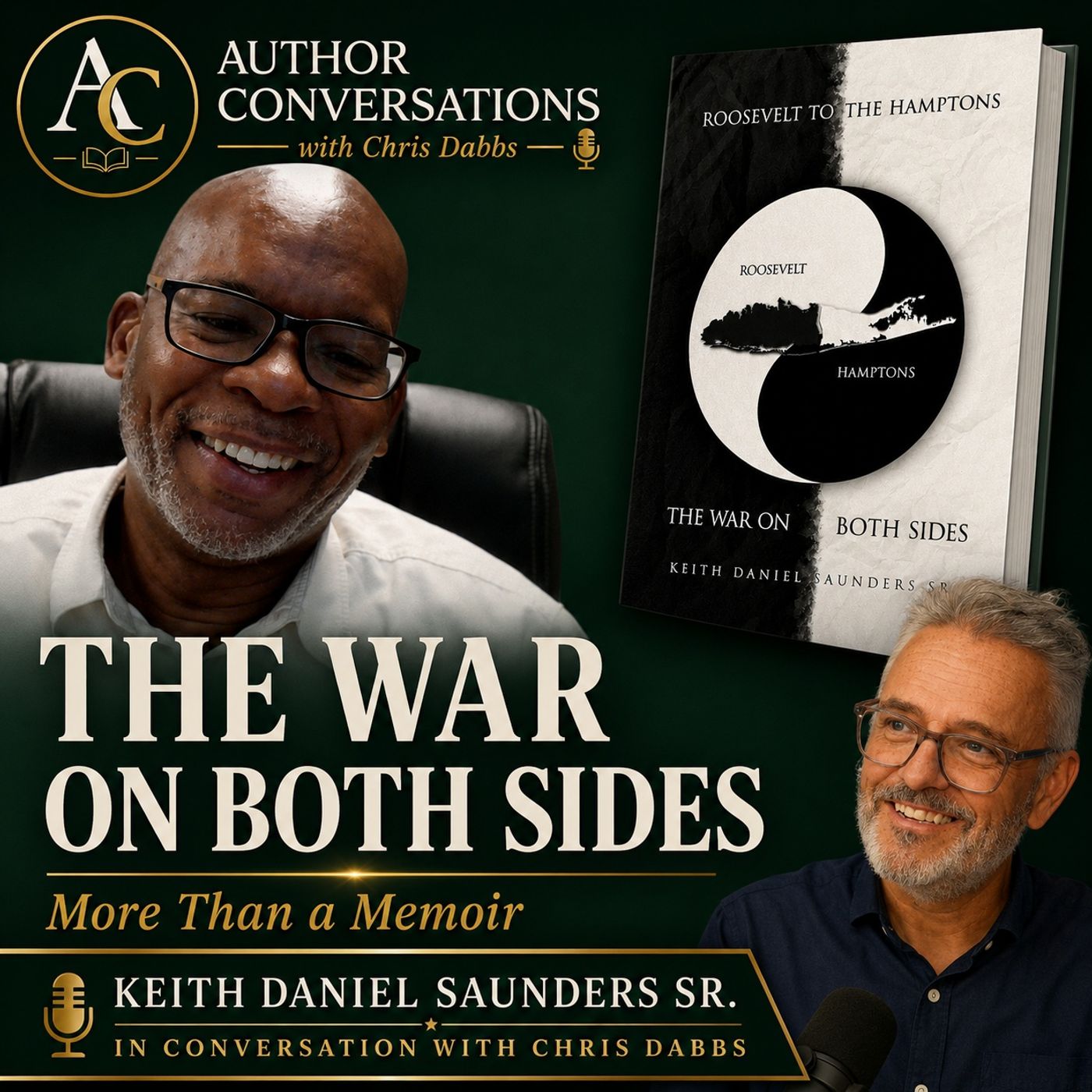
After more than thirty years as a teacher, principal and community leader, Keith Daniel Saunders Sr. has dedicated his life to helping young people overcome barriers and realise their potential.
His memoir, Roosevelt to the Hamptons: The War on Both Sides, isn't a story about military conflict—it's a deeply personal exploration of identity, belonging and navigating a world where people are too often judged before they're understood.
In this thoughtful episode of Author Conversations, Keith reflects on growing up between Black and White communities, the discrimination he encountered during his career in education and why genuine leadership begins with empathy rather than division.
Drawing on decades of experience working with students and families, Keith explains why he chose to write his memoir, the lessons he's learned about resilience and why understanding another person's perspective is one of the most powerful tools we have.
Rather than assigning blame, this conversation challenges listeners to question assumptions, embrace self-awareness and recognise that lasting change starts with honest dialogue.
So, whether you're interested in memoirs, leadership, education, social issues or simply hearing an inspiring life story, Keith's message is ultimately one of hope: every community becomes stronger when we're prepared to listen to one another.
📖 Featured Book: Roosevelt to the Hamptons: The War on Both Sides
🌐 Episode Page: www.author-conversations.com/keith-saunders
IN THIS EPISODE
• Why Keith finally decided to write his memoir
• Growing up between two worlds • Identity, race and belonging
• The realities of working in education
• Leadership through empathy
• Challenging stereotypes and assumptions
• Helping young people succeed
• Why self-awareness changes everything
• Lessons from a lifetime in education
• Building bridges instead of barriers
CHAPTERS
00:00 Introduction
01:18 Why Keith wrote Roosevelt to the Hamptons
04:42 Growing up between two worlds
09:05 Identity and belonging
14:31 Life as an educator and principal
20:14 Facing prejudice and misunderstanding
26:03 Leadership, empathy and listening
31:18 Why education changes lives
36:52 The message behind the memoir
42:11 What Keith hopes readers take away
46:35 Final reflections
You can now watch the interview on YouTube
Become a supporter of this podcast: https://www.spreaker.com/podcast/author-conversations-with-chris-dabbs--6905413/support.
Every book has a story beyond its pages.
In Author Conversations, broadcast journalist, presenter and newsreader Chris Dabbs sits down with the writers behind some of today’s most fascinating books to uncover the research, experiences and ideas that never made it onto the printed page.
Featuring bestselling and emerging authors from around the world, each episode goes beyond the blurb to explore the real stories behind the writing.
From untold historical discoveries and groundbreaking scientific research to personal journeys, business insights, faith, true crime and the human experience, every conversation is designed to inform, challenge and inspire.
Drawing on more than two decades of professional interviewing across radio, television...
Hello and welcome to author conversations as usual I'm Chris Dabbs, but today our guest is educator, community leader and author Keith Daniel Saunders Senior Now for more than 30 years Keith has worked in education, serving as a teacher, a principal and youth advocate while helping shape the lives of thousands of young people. His new memoir Roosevelt to the Hantons, The War on both sides, is both, I guess, deeply personal and socially provocative. It explores growing up in Roosevelt's long-awaited, his experiences navigating both black and white communities, the education system, race, leadership, faith and the lessons that shaped his life.
So after that introduction Keith, it's a pleasure to welcome you to author conversations. How are you? Well thank you, thank you for the opportunity to appear on your platform. I'm truly honored. I've no no, no that's all I'm truly honored to talk to you about your book because obviously having does research around it, it's quite amazing you I think, because it's not simply an autobiography is it? I mean, you've looked at it's a kind of a memoir, a social commentary, it's about educational leadership, history and cultural observation.
And I think that the key part from what I've seen so far, not that I want to do spoilers or anything, but I think what you're saying is that America continues to experience divisions that affect both black and white communities, but differently. Yes, absolutely. So on that sort of theme really, let's go for it. I mean, what actually sort of inspired you to write Roosevelt to the Hamptons, the war on both sides? What inspired me to really lock in and write the book is based upon my 30-plus year career in a business.
I was in a district out of the Suffolk County, Long Island in which it was predominantly white and I experienced some ways to trauma. And as a result of that, it really motivated me to really share my journey as a black educator on Long Island. And it's called the war on both sides because the trauma that experienced in South Hampton is also the trauma that also experienced in some of the districts that look like me. So it is a matter of wow, there's a lot of commonalities in both districts. And it is more of an evaluation of a public school system in education that we receive.
It's interesting, yeah, because obviously you're saying the war on both sides. I mean, how did you mean that? I mean, you're not talking about a real war, is it combat situations? But there's clearly what a war in education or a war just as a war of ideology in the thought process. When you are an African-American male educator on Long Island, the expectation is that when you work in a predominantly black school district, that you will be treated as a specific kind of way. The expectation that the community will have some just love you.
There's an expectation that the chosen will gravitate towards you but that's a misnomer. I've been called an aquatom. I've been called a sell out, but meanwhile, I do more community work than anybody. And sometimes when I'm in meetings, parents don't realize that you're maybe the only advocate in that room fighting for their child. But the perception is because I wear a certain tie because of the history of America in the public school system where it pertains to African-Americans, you automatically consider a sell out because you are working for the system that had the Dresscott decision, the Havd-Plessy Bridge Ferguson, that had a variety of other historic landmarks, the Dresscott decision.
So when you work for a system that's connected to that, people can't see beyond their experience. So when you're in the black community, they look at you sometimes as somebody has an Asian provocateur working for a system that's designed to destroy them. Not realizing that you may be the only hope behind the scenes fighting for them. And then you work in the white school districts, the perception is that you are D.I. higher, that you're not qualified, that you're here on another kind of social program that was just a affirmative action, they're just assuming that you're affirmative action higher.
And sometimes they don't want to take direction from an African-American male and leadership because they're just assuming that they're smarter than you are. That's the war on both sides. You make a conscious effort to come back home and serve your community, but you get rejected when it's time to make hard decisions and make corrections and behaviors. But then when you go to the other side, the grass is not green over there because the perception is you're not qualified to be here. Who do you know?
How did you get in the door to being in this space? So you get caught in an economy of, wow, I'm getting pulled in both directions. But my faith in my belief in the higher power of my belief in God is allowed me to, that's where the underlying focus in the book is being who are you connected to and what is your power to be able to navigate between a war on both sides without losing yourself. The key is not to lose yourself, let other people define you and your journey. The key is to make impact and allows the children and families and teachers wherever you go.
And as people get to know me and my professionalism, they eventually come around to see that I am a professional. I deserve the right to be here. I put the work in 33 years in a game. You can't question my credentials. You must be doing something right, right? Definitely doing something right. Right now I'm sitting to you now talking to you from my office here at Roosevelt High School where I'm the principal. 33 years ago, I grew up in this community. I did my student teaching here and one of my dreams was to come back home and become the principal to make a difference.
A lot of people not aware Roosevelt was the only school ever taken over by New York State back in 1992-93. So we would always school ever taken over by New York State. And I was a student teacher here when that occurred. So my focus has been ever since that I want to be the one to come back to make change. I want to be the one to come back to make a difference. It took almost 35 years from sitting here talking to you now. So all things are possible if you have faith in yourself or belief in yourself and belief in the power of power, have supportive people around you or also see your potential and no matter what other people are saying, you got to keep knocking at that door.
So you get to door that open. Well, that's very true. I think it's a good lesson. And it's clearly I can't exactly resonate with what you were saying. First of all, I'm white. Secondly, I live in the UK. Things are different, obviously. But there will be thousands, millions of people who do understand what you're saying. And I think that this is the whole point though, isn't it? You try and do good in your community and you potentially get rejected by both sides. And you're the person in the middle who, as you say, is an advocate for one side or an advocate for the other.
You know, honestly, it must be something. But clearly, you are now doing what you wanted to do and you're back in that office or you're in that office rather than 25 years later. So I mean, how did growing up in Roosevelt really sort of shape the man that you became first of all? I mean, how did that work? During the time that I grew up, I'm a 70s baby, 70s my birthday, birthday year. And growing up in that time period, Roosevelt was a predominantly African American community. I was one of the only few people on my block who didn't have a father in the house.
A lot of the men were present in the homes. Families were together. There was a lot of businesses that were owned by African Americans in the community when I was growing up. So I saw role models. I saw examples. And it was a motivating factor to be my mother kept me involved in sports. And luckily, the men who were the coaches took time out me to help me become the man that I am today. Even sometimes they took away from their own children to pouring to me because I was friends with their children and you had these conversations as adults, then you see the outside of it.
But I was fortunate that a lot of men in the community poured into me and my mom was focused when my mom went to college but she didn't graduate because she had me seen a year. So her emphasis, it was drilled into me that you were going to college. It was drilled into me that you were going to be successful. It was drilled into me that you were going to break generational curses. So when I grew up in this community, I witnessed this shift. When it cracked cocaine into the community, it really started to destroy the fabric of the community.
The businesses started to go away, crime increased, drugs took over. Young men who I knew personally, who were athletes and academics and came from quality homes got caught up in his life. And so I got a chance to see another dichotomy of the war on both sides from a community that was thriving where a lot of well-to-do African Americans and professors lived took community that was on a decline. And I'm a teenager in high school experiencing this decline. And watch your friends now go to jail and watch your friends now go to the mall and get murdered.
So these are young men who would never eat as kids on the street like they say about that life. They would never enter that stuff. But once you get involved in that illegal activity, it becomes a magnet. And now you have to defend the turf. You have to defend the area you have. So it turns young, innocent kids into killers because they want to preserve the amount of money and profit that they're generating from the illegal product. And now that's another war on both sides of the refluxual. You went from a quality home to doing illegal activities.
Now you go to jail. You know better. But because the money kept coming in, you decide to stay, roll the dice to risk everything. And now you incarcerated. Now you got a prison record. So the community helped shape me because I got a chance to see two different worlds at the community, what the community words, what it became. From my mind, I knew what it could be because I got a chance to see what it could be. And when you get a chance to see what it could be, you pour your energy into that to develop yourself.
The community that raised me here, Roosevelt, I didn't have an African male teacher at oral class. I got to college. Never. Never had a male teacher. So you talk to a young man who didn't ever follow that home. My grandfather was an alcoholic. My uncle was an alcoholic. So you talk to a young man who grew up in a community with no male role models, really, except for the coaches and a few cousins. And I still made it because of the love and support of the overwhelming community. Out of very loving grandmother, very loving mother, I had extended family who really looked out for me.
Like I said, my friends' fathers took time to take me to games and this and that and other to fill in that void. So the community made me strong because of the adversity that I went through. I like to say my story is about struggle, survival and transformation because I struggle, I survive and I transform into the man I am today. I'm a mentor to a lot of young people. What people understand is the perseverance I was married as well before my wife died from breast cancer, but I was 39 years old. And I had to figure out how do I move on as a widower and still be a professional and do the things they have to do.
But again, the survival and the transformation, the way God works in your life, if he's continued to believe, God will provide answers. Late wife before she passed told me clearly that you were one day, find a wife. You were one day, have a son and she wanted me to be happy. But I grew up with God five years later, I found a wife and I only did have a son and had twins. One boy, as he promised, I like to say the promise in the overflow. The promise my daughter is the overflow had twins. So that worked out that.
I mean, does your daughter mind being called the overflow? But it's quite amazing. They celebrate achievements. They start off with, it was very tough, but I did this and did that and everything else. You're kind of open with conflict and trauma and uncomfortable truths. I think we can tell this already. You come across this very honest and very sort of, why was honesty more important for you? What do you do in the way that you wrote the book? When you get through the journey, it will make you feel good if you get to the end of the journey.
You see the transformation, the transformation is incremental. And a lot of people are experiencing what I experienced, but they do it in silence. My voice, my sharing, my transparency, my humbleness. I wanted to reach people who experience the same thing and struggling in silence. I want them to know that you too can overcome. You too, if you believe in yourself, have confidence in yourself. Just keep pushing and ask my underlying message is just to keep pushing. Because the reality is negatively is blunt and harsh in your face.
My opinion is the positivity has to be just as blunt and harsh in your face. Because we live in a Twitter society, Instagram, a meta society. Everything is instant, instant, instant and short bursts. If you know those most adults in children nowadays don't develop human relationships through human communication, I'm talking to you right now through a computer, right? A lot of people communicate to be in the same room and they text them back and forth. That human element is being missed. So part of my struggle and my struggle, I want people who actually read paper, turn pages or get an e-book or audiobook to really dive into the fact of, yes, he struggled.
Yes, he made some bad financial decisions. But look at what God did for him. Look at how he overcame all of that. No, exactly. And obviously you nearly touched on the favorite subject of mine, which is clearly the social media aspect of the world that we live in today, which is interesting to say the least. Working in education and being in educating, you've spent decades, clearly, 30 years, plus working inside schools, as you've said. What point, though, made you realize that education wasn't simply about teaching subjects in case, in other words, you could have math, you could have geography, whatever it is.
But really about changing lives and mentorship. All of the things that I guess you received from other people's parents. For me, it was one professor, I'm Professor Kit of Jenkins at National Community College. He really, really changed my life where I went to college. My thought was, I want to make a lot of money. So the first emphasis, I want to be an accountant because you associate money with accounting. Then it was like, I'm going to have former athletes. I said, I want to be connected to sports.
I want to be a physical therapist. And when I connected with this gentleman on campus, he corrected my diction. He corrected my speech. He gave me advice on life and proper way of doing things. He always used to say, this is the order you should do things. Establish your career. Then find a wife and then purchase your house and then have children, do it in that respect of order. He was more than just a professor. And then I was taken in African history course. And that's when I began to learn more about my history and culture beyond slavery.
The public school system only teaches you what they want you to know. History is really his story. It's the story of the victor. Whoever wants, whoever gets the spoils, writes their version of the story. So when you're doing his story, you're left out. I was left out of his story until I got to college and started learning about my story. And my story is American history. My story is world history. And then it boosted yourself a state. Myself a state started to grow. My confidence started to grow.
I went from real quiet to all skinny kids to a boysterist, a young man who was confident. And some people had difficulties dealing with the confidence. And I like the quote for Deon Sanders, don't let my confidence prick your insecurities. So for me, it was that time when I started learning, I said, I wanted to have the impact on children that this gentleman had on me. So I switched from a major to African history and culture and education because I wanted to go back into the community which I came from to serve the community on the level that he served me because he changed my life forever.
With just conversations about life, it's about history, it's about women. It's about everything. Just realize that you have to be more than just exes and old math, reading science and social studies. You have to become a one-stop shopping and be the social worker because you deal with social emotional learning. You deal with conflict mediation. You deal with all these different things. And I think I'm perfect for that because my book documents that I've been through it all. And because I've been through it all, I can relate to you on all the different levels.
If you just lost your mom, okay, I lost my mom. If you were divorced, what do you call it? I've been there, I've done that, but I've had cancer. You've got to love it and have cancer. I know what you take to deal with that. I've been forced to accused of different things as a teenager. I've been there. I've seen it all. So now in my profession, when I'm speaking to parents, there's a maze by the spectrum that I can have a conversation with them on because I've been through all of it and I survived all of it.
So it makes me stronger. I've my determination, my focus, my life, I started an organization called Saunders, Oli President Network, and Spying America's Youth Incorporated. It's the plural of my first wife's first name of Sonia. And the emphasis was on keeping her name alive, but also the due to work that I couldn't do in the school system because in the school system, you got rules and regulations. In your own entity, you can fill in the gaps of what they're not getting in school. So it became a powerful tool for 18 years straight, working in a small community in North Babylon to really mentor young men and young ladies, college tours, basketball tournaments, chess, what is chess?
How does that game impact you in life? So we were able to really bring and get speakers from all works of life from professional athletes to local businesses and banks and so forth about credit and finances. So we were filling in the gaps that I didn't have as a kid, because my mom was horrible with money. So I said, let me bring in some people to really educate you on money. What is compound interest? How does that impact you? When you buy this credit card, okay, what impact is going to have you at 27% interest rate?
So it became just an amazing opportunity to really pour into young people. And I've had students over 30 years ago still keeping contact with me. Wonderful. I mean, that's really good, though, isn't it? I mean, I can totally see what you're saying. And I think even on this side of the Atlantic, we are crying out for those sorts of lessons that you're giving extra curricula outside of school. We're crying out for that because we believe that the younger people need to know all of this. So in the university, they've got no idea sometimes how to do basic finances, you say that.
I lecture at the University of Brighton here. It's one of those things where sometimes, yeah, I see it. This student's my own children. We're the same, you know, but I try really hard. So, yeah, wow, 18 years of doing that, that's incredible. That's absolutely amazing. We start because of the pandemic. Oh, right. I got you. Right. Really, we're all kicked off then, didn't it? Right. So, I mean, amazing. Okay. Now, obviously, what I'd like to do is just to grill you on your history, kind of, tell us about the book because, you know, some readers will pick up the book because they're educators and they want to know more.
Others because they're interested in race. Others simply because, whoa, it's a memoir. They read memoirs, right? But what do you hope finishes, you know, the final page when someone does? And they say, "Oh, do you know what? I'm really glad that I read that." What kind of thing do you hope, what message do you hope that they're going to take away? The message that they take from it is that, "Doc is so caught up in your own individual race where you can't see anybody else." Everybody that black is black is not great.
Everybody that's white is not bad. Through my journey, I've had some great benefactors who were Caucasian short story. When I was in elementary school, transition to middle school, my mother worked as a nurse. She had a wealthy client who would pay her her salary and give her this money for my tuition. When I got older, my wife was sick with cancer at a boss who said, "Don't worry about work. One of the days that you need to take her to chemotherapy, take her and go, I take care of it." So, throughout my journey, I've had some, I call the white guardian angels along the way.
It made me open my mind to the realities that everybody that looks differently is not bad. Everybody that looks like me is not good. So, you come to the realization that, and also, my book is designed to bridge cultural divides and spark conversations about race, I did in the imperfect. It's designed to be about self-awareness. Self-awareness is extremely important. It's very resilient. The book is available in Amazon. It's available in Barnes and Noble's called RRoosevelt to the Hamptons. Size.
You can get it off my own website, which is Keith, K-E-I-T-H, D-As-A-D-A-V-S-A-U-N-D-E-R-S. .org, or you can go to Roosevelt, like the President Roosevelt, to Hamptons.org. So, we also do public speaking, and we're going to travel to the UK. So we do public speaking. We are very diverse in our audiences. We do trainings on a variety of different things. We cater directly to our audience. So the key thing is, Roosevelt to the Hamptons. You want to contact me, you can contact me on Instagram at Keith_Sonders_Senior, or you can contact me at info@ Keith_D_Saunders.com.
Fantastic. I couldn't have said any of that better myself, Keith. That's pretty cool. Well, thank you for that, because this has been a fascinating conversation, and it's just such a shame that we haven't got longer to talk about it, because there's so much that we could unpack from this. But anyway, just to remind you listeners and viewers, this book is called Roosevelt to the Hamptons - the War on both sides. Yeah. And if today's discussion has sparked your interest, you'll find links in the description wherever you're watching this.
Keith, thank you so much for joining me on author conversations. I hope that you continue to help young people that it sounds better, because it seems that you will be. Thank you. Thanks. Love you to meet you. Take care. Take care, sir. Bye. Bye. Bye. If you enjoyed this conversation, you can watch more author conversations here. Bye. Bye. Bye. Bye. Bye. [MUSIC]
 Apple Podcasts
 Castbox
 Castro
 Goodpods
 Moon FM
 Overcast
 Pocket Casts
 Podbean
 Podcast Addict
 Podcast Republic
 Spotify
 YouTube