Ghost Ships, Secret Experiments and the Mystery of Do Not Open | David Dye
📡 A final Morse code message: "The lid has been opened."
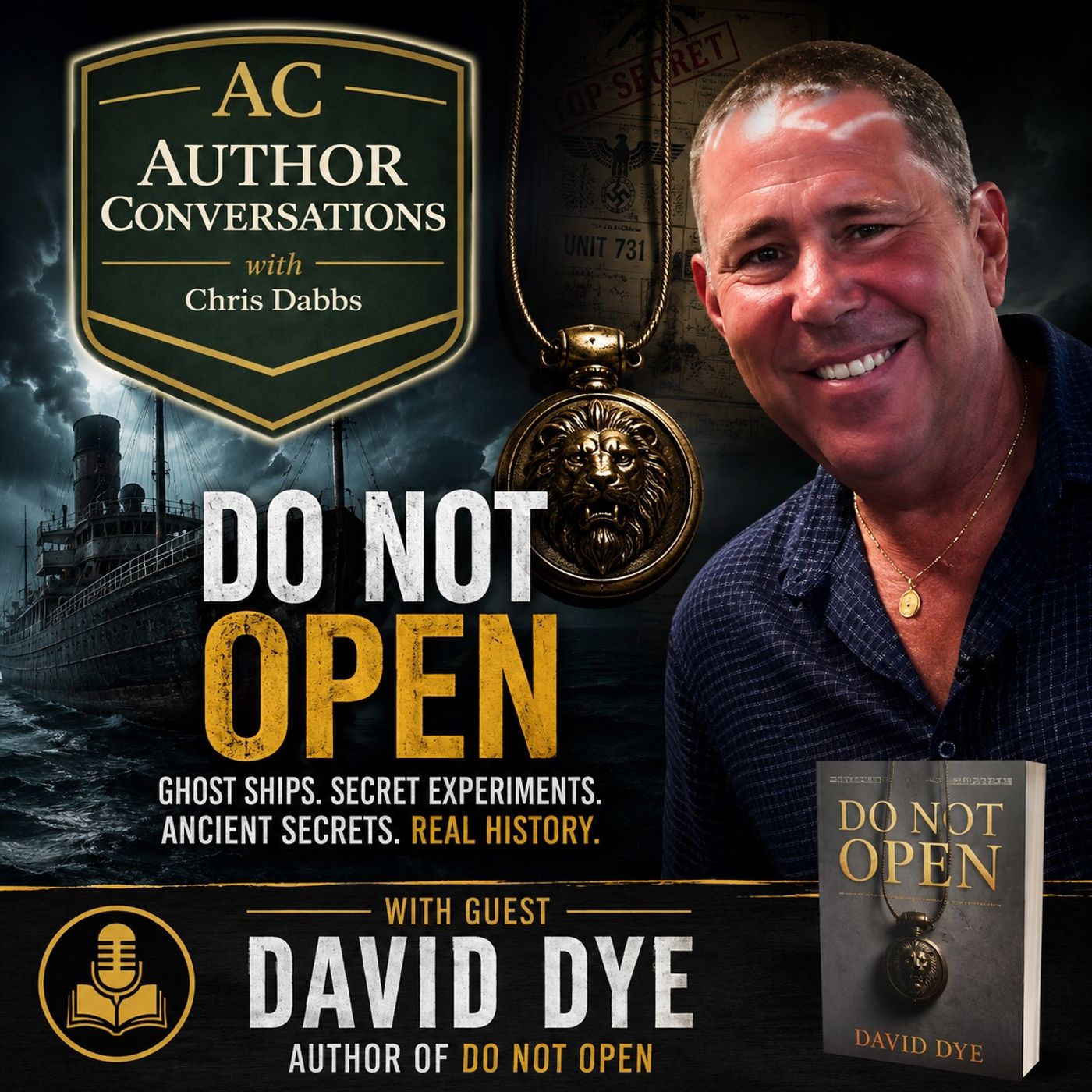
🎙️ Author Conversations with David Dye Do Not Open: Ghost Ships, Hidden History and the Mystery That Refuses to Die
What if one of the world’s most chilling maritime mysteries was only the beginning?
In this episode of Author Conversations, Chris Dabbs sits down with author David Dye to explore Do Not Open, a historical supernatural thriller inspired by the legendary ghost ship mystery of the Ourang Medan.
⚓ A drifting vessel discovered at sea.
😱 A crew found dead, frozen in terror.
📡 A final Morse code message:
“The lid has been opened.” David reveals how real historical events, wartime conspiracies, mythology and unexplained mysteries became woven together into a story that blurs the line between fact and fiction.
📚 In this conversation
🔎 The true mystery of the Ourang Medan ghost ship 🏺
The origins of the mysterious amulet at the heart of the novel
⚔️ Nazi occult research and wartime secrets
🧪 The disturbing history of Unit 731
🕵️ The enduring mystery of the Somerton Man
✈️ Research trips across Europe and America
🎬 Why readers keep telling David this should become a movie
📖 How a retired police officer became a novelist
💬 Memorable Moment “I wanted readers to wonder how much of this was real.”
Throughout the discussion, David explains how he carefully blended documented history, real people and famous unsolved mysteries with supernatural fiction to create a thriller that feels unsettlingly plausible.
📖 About the Book Do Not Open follows a modern investigation into one of history’s most infamous ghost ship legends. As hidden records and classified files emerge, the trail leads through ancient mythology, wartime experiments, secret organisations and a mysterious amulet capable of unleashing either despair or hope.
🌐 Find David Dye Website: David's website
Buy the book: Do Not Open by David Dye
🎧 Listen to More Author Conversations Official Author Conversations podcast page: YouTube
⭐ Enjoyed the episode?
Please follow, rate and share Author Conversations. Every review helps more readers discover great authors and fascinating stories.
Become a supporter of this podcast: https://www.spreaker.com/podcast/author-conversations-with-chris-dabbs--6905413/support.
Every book has a story beyond its pages.
In Author Conversations, broadcast journalist, presenter and newsreader Chris Dabbs sits down with the writers behind some of today’s most fascinating books to uncover the research, experiences and ideas that never made it onto the printed page.
Featuring bestselling and emerging authors from around the world, each episode goes beyond the blurb to explore the real stories behind the writing.
From untold historical discoveries and groundbreaking scientific research to personal journeys, business insights, faith, true crime and the human experience, every conversation is designed to inform, challenge and inspire.
Drawing on more than two decades of professional interviewing across radio, television and digital journalism,
Chris creates thoughtful, in-depth conversations...
Hi there and welcome to author conversations. I'm Chris Dabbs and today I'm joined by David Dye, whose author of Do Not Open, a historical supernatural thriller that's inspired by one of the world's most unsettling maritime mysteries. Now, David has had a fascinating career path from law enforcement on one hand to technology training and quantitative finance and now fiction writing. Now, you know, that unusual background feeds directly into the investigative style of his storytelling, combining real history, classified secrets and mythology with supernatural suspense.
Oh, I can't wait to get into this, David. So the novel begins in 1947 when the crew of the SS Silver Star discovers a drifting ghost ship in the strait of Malacca. On board, they find every crew member dead. Their faces frozen in terror, and alongside a cryptic Morse code message, the lid has been opened. Well, from there, the story stretches across decades of hidden history, secret Nazi occult experiments, unit 731, ancient legends, wartime mysteries, and the strange case of the Summerton man, all connected by mysterious ancient amulet believed to carry extra ordinary power.
David, after that intro, welcome to all the conversations. I can't wait to talk to you. Thank you. So, okay, let's start off with a nice easy one, really. I mean, where did you get the idea for the book? So my two boys and I would watch Discovery Channel quite often. It was something when they were young, it was age appropriate, and we had, you know, watched unsolved mysteries and like all of those. And, you know, after they grew up and left, I started watching one of those shows again, unsolved mysteries.
And I was like, you know, what if I could go ahead and take all of these unsolved mysteries and lore and time together and actually say, here's here's what caused them, you know, all throughout time. The Orang Mdun was probably one of the most interesting because, you know, it still, is it war or is it fact? And there was enough fact in there and documentation to make you wonder. I mean, you have to decide for yourself. So, yeah, with the ship and exactly what happened, the first argument that it comes up as the ship was never registered, which makes sense because it's a were smugglers.
So they're not going to register their ship. So, you know, exactly what did happen and did it happen was unknown, except, you know, going back, I was able to find that there were articles written mostly in from Germany, Denmark, that went delved into the story and said, here's what happened. It was interesting too because back at the time, unlike modern communications, the relay stations and the ships didn't keep logs of the Morse code, which is the SOS that was sent. So there's no way to say definitively that yes or no, it didn't happen.
And the more that I went into it, I was able to find a CIA document that mentioned your Rung Mdung. And, you know, that said, a lot of the travels, this could be travel dangers that we have today, really could be part of what had happened with the Rung Mdung. And then come to find out that one of the maritime publications actually documented the Rung Mdung. So, which goes back to, you know, just because it's documented, they didn't have the internet at the time. So you couldn't, you too a bit, you couldn't stream on FaceTime.
But you could be able to say, you know, at that time, if it's written down, then people took that as it's no longer lower, this must have happened, or someone's taken the time to write it down. So I started there because that was the most intriguing and enough background to be able to make you question. Did it happen or didn't it? And I kind of worked backers and said, okay, so it starts with the Rung Mdung, but then, you know, what caused it, and then went back into time and, you know, kind of picked out other mysteries.
While I was writing it, I was trying to keep as much historical facts as possible. So a lot of the people that are in the book actually existed at the time, they may not have been doing the exact, you know, for example, in Normandy, I had one of the shipmates and he did exist, but he wasn't a shipmate. He was actually a doctor that they called Dr. Satan because he was disbard from medicine. I was like, all right, that he was in Normandy. He was a doctor. He was evil. I'll use that as part of the background of the character.
So it was fun going back and trying to say, okay, how can I string these together? The difficulty was keeping the timeline straight, you know, to make sure that, you know, if I beard off by two, three years, then people were going to be like, that was two, three years too early or too late. So just going back and trying to tie these back together was, it was fun. And my wife and I spent quite some time traveling to like the, we went to Belgium, France, England, New York, Ellis Island, Italy, Spain to do the background of the research.
So a lot of the places are actually real. We visit them. Hotels, restaurants, the neighborhoods. So yeah, it was fun to write and research and, you know, to be able to see you, yeah, that couldn't have happened because here's what it looked like at the time. Wow. So this is the kind of thing where your attention to detail really works, doesn't it? You know, I mean, yeah, because at the end of the day, you were a police officer. And then you went to become what a trainer and Microsoft and stuff. So Microsoft SQL Server Trainer.
Yeah. Wow. Okay, SQL Server, right? Yeah. Well, that just scares me when I hear that. But, yeah, I mean, you know, this is the amazing thing. So I guess this is what attracted you to writing stories that kind of blur the line then between fact and legend or lore as you were putting it, right? Yes. Yeah, that was, that was the whole point. I mean, to try and decide what's back, what's fiction, what's lore, mythology. And even in the book, with mythology, mythology is generally what what you can explain back in the time then it fell back to mythology.
And, you know, here's what causes a solar eclipse. You know, here's, here's what causes tsunamis, things like that, you know, that they couldn't explain that they didn't have the science at the time. They use mythology. Imagine living by that doctor being, I said, well, one way it would be quite good, isn't it? Because you just wouldn't know both, you know, I think, yeah, I'm, you know, you're right. You know, the internet, it's, it wears spoils now, I think, we can do whatever we want. But this is one of the issues, isn't it?
Like the opening premise of the book, right? Is I think deeply unsettling here because it feels plausible. So, I mean, was creating that sense of this might actually have happened. This actually might have happened and is real important to you? Yeah, it was. I wanted to go through and like I said, I wanted as much fact as possible. And during my research, and then trying to tie everything back together, like for example, Unit 731 was a unit I had never heard of. And, you know, when I researched it and found just the heinous crimes that they were doing, and you know, after, after they were found out and somewhere arrested and tried, a lot of whom the doctors and the researchers were given light sentences in order to work on projects for, for Russia, for, you know, other countries.
So, you know, I thought that was a disturbing fact that, you know, I, and I forget how I had come across it. But I was like, this really fits into the story quite well. Or I can make it fit into the story. And that was one of the reasons that, you know, that one of the theories that the Irungma Dunn exploded is because they were carrying hazardous materials, muggling hazardous materials. And I thought, well, why not? That could be materials from Unit 731. So that, that would make sense. Yeah, yeah.
So, once the Unit 731 actually get up to that, what, what was they up to? Unit 731. So, back in the 40s, there was a war with China and Japan that was started by the Manchurian incident where Japan staged an attack, making it look like it was from China, which then allowed or gave them the justification to attack China. During the attack of China, they took over the Manchurian province. And that's where they set up Unit 731. So Unit 731 was mainly biomedical and chemical weapons. At one time, they infected fleas with syphilis and dropped them into a village to see how that would affect them.
They did experiments like freezing someone's limbs and then dethroning it to see what type of effect it had. So they truly heinous crimes. But, you know, they relied on chemicals, biochemical and human experimentation just to see, you know, where, where they said a bullet can kill one person, a bomb can kill many indiscriminately, but we want to be able to target, you know, biochemicals or chemicals or, you know, a frailty of humans and disease and see how we can target and affect thousands. Yeah, okay.
I see what you're going there then. So, it's lucky that we're not talking about gene therapy, even though they're probably on their way to doing something like that. We're not therapy even, but gene warfare, right? Yes. But, okay, all right, well, that's enough of that bit, nothing. But let's move on to the amulet then, because that feels almost like a, like its own character, doesn't it? I mean, when did that central idea first come to you? Actually, when I looked at the Arungma Dunn, well, I looked at it, I picked seven different mysteries and laws and said, you know, what could these be tied together and how could it be?
And the the amulet just was low hanging fruit. You know, it was something that, you know, to release the evil, but, you know, the amulets, when at the end of the story, I go into how the amulet was created. And, you know, it wasn't just one event. There were three different events that created that amulet, each of which had its own supernatural power or power or effect. So, you know, tying that together, and then putting it within, within the story and then showing that, you know, just it's not truly evil, it depends on who's holding it, the intentions of who has it.
And so, what could it actually, without giving us too much? What could it have been used for if it was not entirely evil? So, it was based after Pandora's Box, which was a mis-translation. It was a vase. And so, the amulet, I thought, well, other than just a vase, what if it was an amulet of a vase? And then in scribe on it said, "Do not open." And that was, in the story of Pandora, Zeus set Pandora down to punish humankind. And he said, "Since he was made human, then he knew curiosity would be or downfall."
And what would make you more curious than to carry an amulet around your neck, always staring at it that says, "Do not open, wondering." You know, how, what's, why shouldn't I open it? What's inside? So, in the myth, all the evils of the world were placed within Pandora's Box, within the vase, the amulet. And when it was opened, then ellipsis was the only one not to leave, and that was hope. So, Zeus had put hope within the amulet, but ordered you won't leave. So, in one part to the story, I mean, again, kind of to fit it to my needs, hope was still within the vase.
So, depending upon who had the amulet and what their intentions were, what their heart was, then it didn't mean it was going to release the evils of the world again. You know, hope could still be released. And in one story that actually, you know, when it was opened, it did show that, you know, fighting stopped, and you know, that was without running that part, you know, but it showed that hope was had been released. See, well, that, well, that's great. I mean, you know, it's nice to know that there is something that these things can be useful, these supernatural kind of elements, or amulets, you know.
Okay, so, you mentioned this already, but I think it's probably worth diving into it a bit more for any authors that are listening and looking for tips on this, right? I mean, the book moves through obviously multiple periods of history and different global events at the same time. But how difficult was it to structure something so ambitious without losing narrative momentum? And also, how did you check, you know, keep track across all that time? So I started out with an outline that was always evolving.
And I began writing. And like I said, the Orangma Dunn was one of the most compelling stories, mysteries, lore that I had found. So I figured this is a good place to start. It was easy to write. It came to me. And after that, that's when I said, okay, do I go forward? Do I go backwards? You know, in the story, Tommy is really has no redeeming qualities whatsoever. He wasn't a real person, but his brother was a real person. And George Edward Ellison, he was British expeditionary force. He was at the first battle of Mons, the angel of Mons.
And he was the last British expeditionary force soldier to be killed in Mons, 90 minutes before the armistice had been signed. So I was like that with the history of that, you know, I added a brother. And I was asked, you know, why did you change the name? And the reason was because, you know, I didn't feel right to have a war hero and then anchor him down with this terrible brother that didn't exist. But, you know, George Edward Ellison was based on a real person. And then I just began to follow it throughout time.
And, you know, I worked backwards and then went ahead and moved forward. So as I was writing it, like the outline was a good part, I did a lot of research. And like I said, I tried to find time relevant people, events, places. And I was able to do that. And then, you know, I would have to go back and rewrite. I had an editor at the time when I first started writing this. And, you know, I would do maybe three, ten pages a day at first. And he would give me back one or two. And he's like, look, you know, just right.
You know, that, and that was the best advice I had got. He said, just right. You know, I'll take care of the editing. Don't worry about your grammar. Just right, right? The idea is down. And then we'll go through them. So after he gave me that advice, it went, it went much faster. You know, I still, and he said, don't overread it. You know, don't spend time before you start writing again. Don't read what you wrote before. Just continue writing. Read the last paragraph, start writing again. And that really did help.
You know, that was, that was something that, you know, I started turning out more pages. I think out of 282, I probably had, there was well over 350, you know, before we got started narrowing it down. You see, but this is great though, isn't it? It's exactly what you want an editor to do, isn't it? You know, guide you and advise you and act as a mentor. So yeah, well, excellent. Well, that's, I think we always try to, yeah, just, just get there, really. You know, I'm trying to think how do it? How can I explain how I would feel holding myself back from writing because I wanted it to be perfect, you're right, you know, and I think that's the thing, isn't it?
Because it's so close to you that you want to make sure that it's done, especially, you know, that you've got such a strong kind of cinematic quality to the story, especially in those maritime scenes. I mean, did you actually, when you were doing this and writing it and all that, we visualizing it as almost like a film while you were writing it? You know, I didn't have that idea at first. I had some advanced readers and they were all like, this would be better as a movie. And so, you know, as I started going through it, I think I wanted to keep the same feel, you know, so it flowed.
But I actually had someone that has come to me and, you know, they're interested in saying, you know, would you be interested? You know, if it's right to have either a television series or a movie made out of it. And so, I mean, hopefully that works out. I've gotten really good feedback. So, but yeah, the main feedback that I did get was, you know, this really should be, you should make this a movie. Well, hang on a sec, I'll just call Spielberg and see what he has to say for me. But yeah, amazing, you know, I mean, that's going to be high praise, isn't it?
So, we have to keep a lookout for that as to whether it's a movie or a TV show. That's just a whole other career path for you as well, isn't it up to everything that you've done? Oh my gosh, screenplay writing and everything else. But I think that one of the things that's that's quite memorable for all of this and it is actually incredibly simple is that, you know, the lead has been opened kind of thing, right? I mean, did you know immediately that that would become like the emotional hook of the whole novel?
No, not at first. Now, I didn't at first. And then like I said, some of the advanced readers were like, yeah, that was, so I think I went back and, you know, I kind of added that. And the fact that it just not anyone could open the lid, there was, you know, a specific way and, you know, that, you know, it just that did become kind of the hook. And that's how great. I mean, as well, I'm okay. So, I mean, actually, yes, you know, like a lot of readers, a lot of the public enjoy stories that mix conspiracy theories with real history.
And it's kind of what you've done, isn't it, right? Why do you think the audiences like us are so fascinated by hidden truths and all these secret histories that keep running around the place? I think they always, you know, is it true or is it not? You know, to be to be the one to say, oh, I proved it was true or oh, I proved it was false or just, you know, to wonder. You know, there are a lot of books that are written that, you know, they leave you hanging and, you know, did it really happen? Like the summer to nana, the last chapter, you know, that's one that I'm working on the next in the series now.
And that's one that was really interesting to me too, you know, and I considered opening up with that. But, you know, I decided to be better to start where it began. But there's, like I said, there's enough facts within the summer to man within that mystery to make you wonder, wait, could it really have been this person? You know, what caused it? What caused the death? Well, was he a spy? What was he caring? So, you know, I think people, they do enjoy that, you know, and I've got a lot of feedback and from the reviews and the messages and emails I've gotten, they've been like, you know, I couldn't believe it.
They actually, they said, you know, I Google this person, they really existed and that's, you know, this restaurant, cultures, that's a real place. And so, yeah, I mean, to say, wow, that that was true, and to actually tie it back to the time period and the location and the people around it. So, I think that that's everyone finds that interesting to say, wow, you know, even though only part of it is true, just, but what part isn't? And that's that's kind of what catches on. Yeah, yeah, it's kind of like gossip thing, isn't it?
As you said, you know, I knew about this way before you guys find found out, you know, and it's all, yeah, I think it's great. In order to do that and to stand by the water cooler or whatever and to talk about these things. And obviously, the novel it touches on other things as well, like despair and hope and the consequences of forbidden knowledge. I think this is the point, isn't it, right? You know, do not open all of that sort of thing. So, beneath those thriller elements, really, what themes were you most interested in exploring?
Like you said, despair and hope, the diversity based on who had the annulet and, you know, what the effect that it had, even if it wasn't open, you know, what affected it had on people. You know, some just complete obsession and others were terror. I mean, just being around it, which which is explained in the story, why, you know, why that had occurred. You know, I like the fact that, you know, it wasn't just based on Pandora's Box. The whole way it was made, you know, there was myth, three myths behind it before even got to Pandora's Box.
And each one of those myths had its own
force behind the annulet. And that also kind of drove the story when, you know, when in war or, you know, when it got to World War One with Hitler. And even World War Two, when Hitler came in possession of it. So, you know, I think that how the way it changes hands and the way that it moves throughout history. Yeah, yeah. Well, this is, again, where your attention to detail has managed to sort of manage that journey, right? Which again, you know, is very interesting. I think that, obviously, we're starting to run out of time, David, can you believe I mean, the time just flies.
This is incredible. It always happens. I get very upset. But we've got time for a couple more questions. But I mean, was there a moment then when you were doing all of this research, you know, with the unit 71 and all of these things, where the story was becoming kind of darker than you originally intended it to be. And if it was, I mean, what did you do about that to try and pull it back already? I guess you wouldn't just drag it through and say, I'm not going to use that. But you try and change it, right?
Right. Yeah, I got to, with unit 731, that that was probably the darkest. You know, and the more that I researched than just the more disgusting it became. So I think I had probably another chapter, chapter and a half of 731 units, 731. And like you had said, I was like this, that it went way, way to the dark side. And I thought this, that's not what the way I wanted to portray the story. So yeah, I changed that, abbreviated it, and, you know, took out some of the details just to be able to kind of keep the flow and the feel of the story the same.
So it wasn't really because the, it was just too warfare. You just didn't want to be, like, sensationalized things and sort of like draw away from the book. Okay. Yeah, from the, from the main narrative. And that makes sense. Okay. So let's just go back to a nice, simple question after this, 731 thing. I mean, do you think that some mysteries are better left unexplained or unexplainable even, you know, we've got what UFOs, we were bigfoot, you know, the classics. But what do you think about that?
I mean, is that something that, you know, you sat there and watched all these things with your son, your sons or other? What do you think? Is it good to have that there? It's just in case or do we really want to know the answers to these things? To be honest, I think it depends on the person I know for me, you know, I want to know the answers. I was one of those kids that when I was young, I'd get my toys and take them apart to see how they worked. And, you know, so that was always interesting. And, and I mean, to me, you know, I can't think of a single mystery that it's better left unfound, you know, or just leave it alone and let it be a mystery.
You know, I'm always interested in, you know, did it really happen? And if it did, how did it happen? Exactly. I'm with you on that one. I've got to say, right? When I was growing up, there were in the UK, there was a series of magazines that like a weekly series or a fortnight, you know, every two weeks or something, series of magazines that were called the unexplained. Okay, so, you know, UK authors of my age will understand this. And so they came out and it covered, I don't know, maybe one, two, three or four mysteries, you know, spontaneous human combustion or something like that, right?
And I'll never forget the pictures that they used in this magazine. And it's like, well, it's greenish really, it was horrible. But, you know, I used to think it as a 12 or 13-year-old, oh my gosh, why is that person's ankle there? Right? And you probably know the picture I'm talking about. But it's something where I also wanted to know why and why that happened rather than, oh my gosh, it can't just happen, right? And I'm sure that most people like that. And I'm not going to spoil that one by letting anyone know exactly what science says about that, but anyway.
Okay, so to wrap things up David, when readers finish the book, what do you hope that they think after they close that book and they go, wow, and then they turn to their partner and say, you know what? What is it that you'd like them to think? Well, the way that it ended was kind of on a cliffhanger. And I've gotten that, you know, please tell me you are following up on this, you know, at the ending, there's still a lot more story to tell. So I hope that they still have that desire. But like I said, I like the reviews and the feedback that I get where they say, you know, I've I actually looked at stuff up that person existed.
This plane's existed. You know, that made me wonder. So was it really there? And like I said, my wife and I spent quite a time, bit of time traveling. And just to make sure we were getting it actually correct. And like with Ellis Island, we went to New York two times and spent two, three days on Ellis Island getting the, you know, the way that they were they were moved through Ellis Islands, you know, how they were checks, how they walked up the stairway, how their eyes were checks, how chalk was put on their on their collars.
You know, we took pictures of them and you know, several of the families and the people mentioned in the book on the boat and on Ellis Island, actually we went through the manifest and we used those names and the stories that we could find about them. So I hope that they just get a feeling I, it spurs their interest more to say, Hey, how much of this was was real? Because a lot of time was spent trying to make sure it was accurate as possible and using real people. Brilliant. And yeah, obviously comes across doesn't it in the story and everything that you, yeah, as I say, the amount of attention you spent on it and crafted the whole book.
So Ellis Island, second, isn't it though? It's about keeping an audience and making sure that you sort of, you know, satisfy them in one respect, but keep them coming back for more later on. So let's hope that something happens with it with, well, at least another book and we'll see what happens with screenplays and things like that. Yeah, yeah, I already started on the other book. I just finished novella and we're going through the first round of editing now. So that will be out in a couple of months, but I started a couple of weeks ago, the second book in this series.
So yeah, open to peak everyone's interest again. Yeah, exactly. Well done. That's great then. Good. Well, hopefully listeners, viewers, you can obviously try and find the book. David, whereabouts is it sold by the way? It's sold on Amazon, books of million, Barnes and Noble, Walmart, Apple Books. So pretty much any can get it anywhere. The audio book will be out next month. Okay, that's cool as well, because people obviously like an audio book nowadays in the fast, in the fast changing world that we're in.
And do you have a website or something that people can sort of find out more about you? I do. I do. It's David and I do. Author dot com. David and I author dot com. Excellent. Well, guys, you know, look David up, you know, getting touched, send some feedback through when you finish reading the book or even halfway through. I'm sure David loves to hear from you and help you along the way if he can. But David, listen, thank you for joining me on author conversations. I've been Chris Dabbs, your host today.
And the book is Do Not Open, a historical supernatural thriller that blends maritime mystery, wartime conspiracy, mythology and investigative suspense into a story that asks what happens when dangerous secrets are finally uncovered. Wow, this is a great book. If you enjoy atmospheric thrillers grounded in real historical mysteries and also knowing how much work David has put into the research in this. Well, this is definitely one to look out for. You can find Do Not Open online now, including through Amazon as David was just saying.
And if you've enjoyed this conversation, please follow author conversations for more interviews with writers about the stories, ideas and experiences behind their books. David, it's been great talking to you and learning about the craft of writing a book that you've just done. And look, good luck to you. And thank you very much for joining me. Thank you for inviting me. Thank you. If you enjoyed this conversation, you can watch more author conversations here.
 Apple Podcasts
 Castbox
 Castro
 Goodpods
 Moon FM
 Overcast
 Pocket Casts
 Podbean
 Podcast Addict
 Podcast Republic
 Spotify
 YouTube