Spiritual Sales: How Spiritual Practices Unlock Extraordinary Results | Chris Sharpe
Chris Sharpe
✨ Can spirituality actually make you more successful in business?
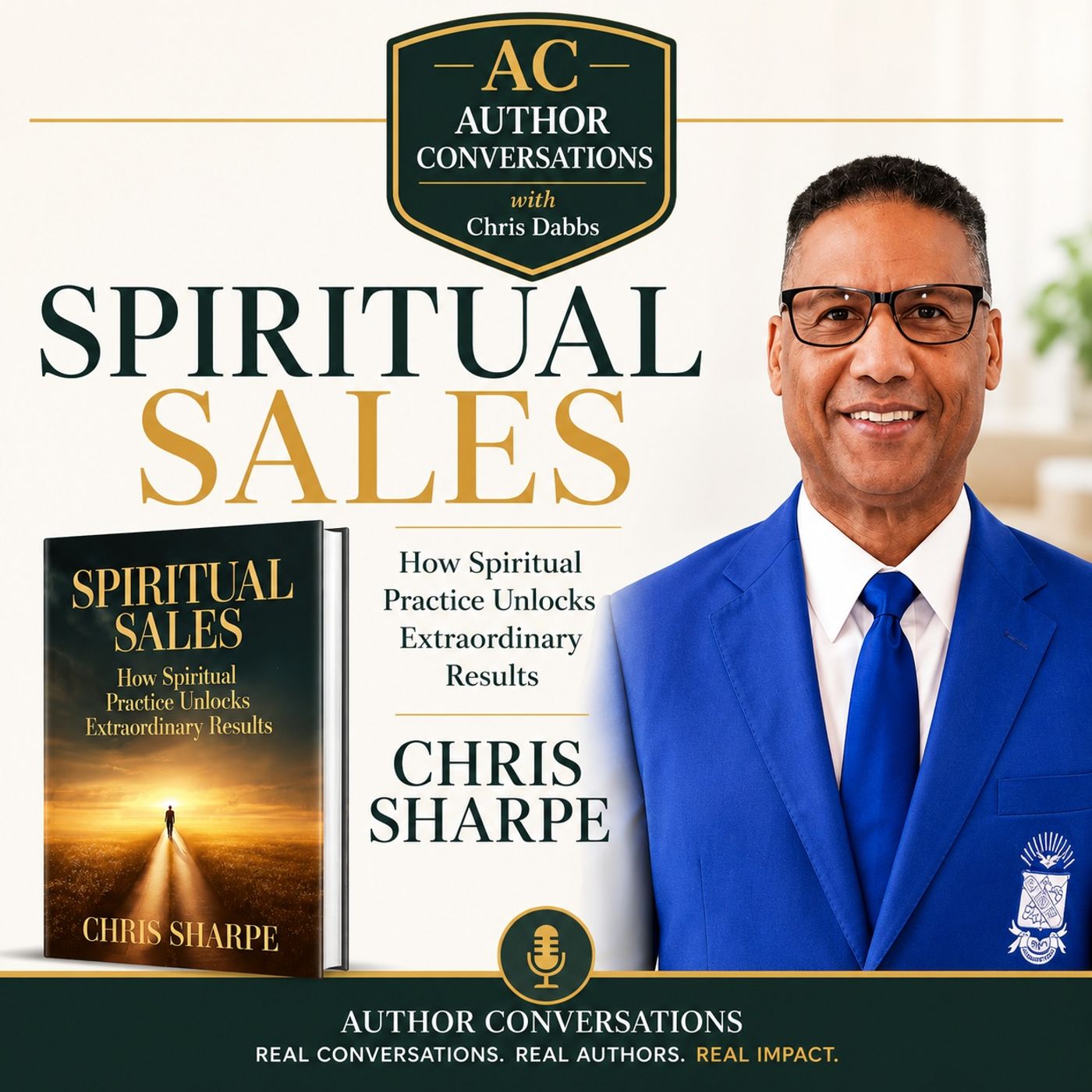
In this episode of Author Conversations, Chris Dabbs speaks with author Chris Sharpe about his book Spiritual Sales: How Spiritual Practice Unlocks Extraordinary Results.
Chris argues that the most effective salespeople are not driven solely by targets, pressure or persuasion.
Instead, they achieve lasting success by developing self-awareness, purpose, service and authentic human connection.
During the conversation, we explore how spiritual principles can transform not only business performance but also personal fulfilment, leadership and relationships.
📚 In this episode:
✨ What “Spiritual Sales” really means
💼 Why authentic service outperforms pressure-based selling
🧠 The connection between mindset and commercial success
❤️ Building trust through genuine human connection
🚀 How spiritual practices can improve performance and fulfilment
🌍 Finding purpose beyond profit
Whether you work in sales, run a business, lead a team or are simply interested in personal development, this conversation offers a different perspective on what success can look like.
▶️ Watch this episode on YouTube:
https://youtu.be/PRX5mz_CuOo
00:00 Introduction
00:16 Meet Chris Sharpe and Spiritual Sales
01:36 What Does Spiritual Sales Mean?
02:30 Sales, Leadership and Spirituality
04:00 Why Success Starts Internally
05:09 Spirituality vs Religion
07:34 Chanting Before Difficult Sales Meetings
08:49 Redefining Success
10:44 The Problem with Traditional Sales Advice
13:04 Spiritual Principles in the Corporate World
15:26 Karma, Faith and Personal Growth
16:34 Viewing Sales Through a Spiritual Lens
17:55 Identity, Purpose and Why Me Why Not?
20:41 Mindset, Self-Belief and Resilience
21:52 Personal Stories and Proof of Practice
22:21 What Leadership Means to Chris Sharpe
23:19 Applying Buddhist Principles to Sales
24:21 Who Should Read Spiritual Sales?
24:49 Audiobooks, Learning and Motivation
27:03 The Secret Behind Long-Term Success
27:26 Final Thoughts on Spiritual Sales
27:54 Upcoming Book: Why Me Why Not?
28:15 Outro
Become a supporter of this podcast: https://www.spreaker.com/podcast/author-conversations-with-chris-dabbs--6905413/support.
Every book has a story beyond its pages.
In Author Conversations, broadcast journalist, presenter and newsreader Chris Dabbs sits down with the writers behind some of today’s most fascinating books to uncover the research, experiences and ideas that never made it onto the printed page.
Featuring bestselling and emerging authors from around the world, each episode goes beyond the blurb to explore the real stories behind the writing.
From untold historical discoveries and groundbreaking scientific research to personal journeys, business insights, faith, true crime and the human experience, every conversation is designed to inform, challenge and inspire.
Drawing on more than two decades of professional interviewing across radio, television and digital journalism,
Chris creates thoughtful, in-depth conversations that give authors the time and space to tell the stories that matter most.
Whether you’re searching for your next great read, fascinated by the creative process...
Hello, and welcome to author conversations. I'm Chris Dabbs. And today I'm joined by another Chris. Now, just before we came online, we decided that there needed to be more Chris's in the world. So by the end of this, you'd be the judge and let us know in the comments, okay? But I'm joined by Chris Sharpe, who's the author of the new book, Spiritual Sales. How spiritual practices unlock extraordinary results. Mm. Well, Chris has spent more than four decades working in sales and business leadership.
But what makes his story particularly interesting is the way he combines, well, professional ambition with spirituality, mindfulness and personal growth, which believe me, does not happen too often in sales, right? So in this book, he explores how practices like gratitude, resilience, chanting and inner reflection can help people navigate pressure, rejection and success without losing themselves in the process, which I think happens to a lot of salespeople. And I should know, because I've also been a salesperson in my life.
There you go. So Chris, you also bring a deeply personal perspective to the conversation and you kind of draw on your own experiences in corporate America, leadership, faith and identity, which we're really interested in listening to. So, Chris Sharp, welcome to all the conversations. How you doing today? I'm doing well thanks for having me, Chris. Hey, listen, no problem at all. I'm really looking forward to talking about this because it's one of my pet subjects to be very excited because I spent quite a long time working in corporate, American corporate companies actually in sales and things.
And so, there's enough about me though. Your book is called Spiritual Sales for Someone. And hang on, I'm just, I'm getting excited. It's called Spiritual Sales, right? And for someone that's really hearing that title for the first time, what do you think that actually means to them? Well, it would intrigue them. First of all, I think it's going to bring people, I say, hey, what's this all about? You know, we're all spiritual beings. So, I think basically, I know that I have a spiritual soul and heart.
And we bring it to our lives every day. I just happen to be sales person. And I wanted to tell people that if they're having problems in life or in sales, I have a tool that may be able to help you because it helped me throughout my 40 years. Well, yeah, you spent decades working in sales and leadership, as I mentioned. And I mean, at what point did you realize, well, spirituality was influencing your professional success? And I think at this point, let me ask you to clarify between spirituality and religion, perhaps.
Okay, so I look at religion as something we do every day, something we do religiously. Simple. To me, it's a practice. So, it takes work to sit down and chant. And not everybody wants to do the work. So, basically, cause an effect. It's basically what you put into something is what you get out of something. And I want, oh, sorry. No, no. And I think that doing chanting, "Nam Yohau, Renge Kyo, throughout my life, has actually helped me in my career." And I have seen it with actual proof. So, that's why I wrote the book.
Right. So, proof, obviously, in your results and your management style and your teams, results and things like that. Absolutely. Absolutely. That's really interesting that because obviously, in leadership roles, you were a mentor as well as a kind of boss, right? The traditional boss. So, to a sales team or to a team of, of who work with sales managers, whichever. And so, that is what inspired you to sit down and write the book. OK. I think one of the things that I really want to try and find out because in the sort of-- but one of the big ideas in the book, OK, seems to be that success starts well internally, rather than externally, right?
So, can you explain that philosophy? Because we all think that salespeople are born, not made, right? Absolutely. That's a great question because it does start internally. You have to have the motivation to get up every morning. You have to have the desire. And if you like what you're doing, that's icing on the cake. So, you definitely start within. You have goals. You have an outside situation going on. So, you want to have them blend. And when you chant-- I found for me, chanting helps me to reach these outside manifestations that I want to have.
Say, I want to have three sales today. I want the three-- I make it two. I make it an appointment. I may not get any sales. But I put the work in. I made the cause for something else to happen to me down the line. Let me see. That's exactly the way I would look at it as well, right? And I think this is the thing. You're mentioning like chanting and religion, spirituality. And so, you kind of open me writing about practicing or both Christianity and say Buddhism as well, right? So, how have those two beliefs shaped your whole outlook on business and life?
And I mean, not just by being a nicer person or whatever, but the NMYOHO RENKI KIL of Terrible, that pronunciation-- Nam Yohol. And say, nam, which is devotion, devotion, something you do every day. Miyeohol is the mystic law of the universe, because we don't know how this all happened. And if you do know, let me know, the mystic law of the universe. And RENKI KIL is how we do the blossom, the cause and effect. The RENKI KIL is basically like the lotus flower that's blossoming in the mud. So, the KIL is the action.
So, the RENKI KIL, and you have to put in the work. You can pray about it, but it's-- some gods are not going to come down and just give it to you. You have to put in the work. So that must come from Buddhism, right? Because I don't recognize that in Christianity. So, how do they work together in that respect? I think it's the same. I really do. OK, so you say Christianity. I believe in Jesus Christ. I've been saved. At first, you grow up. You find your way. It was first Christianity, because that's what we learn.
I mean, basically, or whatever religion. So that was my religion. I actually-- I am saved. I'm going to just do this. I wasn't going to do it. But yeah, I believe in the Lord. I am saved, whatever you want to believe, the light, whatever. But for me, what worked for me was actually having a philosophy that you sit down in front of a gahanzen or whatever you do and put in the work and you pray. And you chant for 20 minutes a day about a situation. That works for me. Some people find, hey, Lord, do this for me.
Do that for me. I don't like that. I rather put in the work and do it this way. Yeah, absolutely. Because you're in charge of your destinies, what you're saying, right? Absolutely. Absolutely. So that makes sense. So, I mean, you say to do chanting before difficult appointments and meetings. And before you have anything really that you need to deal with that, like you say, getting on the phone, whatever, really. So how did that practice help you deal then with pressure and rejection? Wow. That's a great question.
Oh, boy. I would say not so much that is more fair. When you're chanting right before you go to appointment or you're on a call in a car chanting alone, that doesn't happen as much anymore in my practice. Because I have a foundation of faith. So basically, it took time to get to where I'm at. And I talk about having every 15 years, you're going to see some big growth. You're going to have growth in your life. But over 15 years, you're going to see, whoa, where did I come from? 15 years ago, I was here.
Now I'm here. And it was because of this practice, I can really see actual proof of this practice, helping me get there where I'm at now. And where I'm at now, I may not be a president or whatever, but I've lasted, I've stayed in the game. I've been, I have a good life. I mean, to me, that's success. You know, totally, totally. Yeah, I agree. I think that that was-- Children's with people. No, sorry. I was going to say, you know, I think that's the peaks and troughs thing, right? So you are actually kind of like not manufactured, but managing your peaks and troughs, right?
Instead of being swept along by-- oh, yeah, 15 years time, I'll be OK. Or you look back, as you say, and you're amazed at what you've managed to achieve. I see that quite often. And I think, is there a particular moment in your career, then, that you decided that a spiritual mindset is completely changing the outcome of a difficult situation? So rather than being-- I don't know. I hesitate to say combative, right? But looking at things from a spiritual way, how is that helped? I mean, when did you realize that this is the thing to do?
I realized that's when I was in New York City. I had a job at MCI World Comm. And I was a salesperson. And there's a Buddhist center on 14th Street in New York City. And I would chant to do better in my sales, because I was having a rough time. I'm like, I worked on commission only. I said, how am I going to make this money to pay my bills? And I was a Buddhist before. But as I grew, that's when I applied it to sales, with that job at MCI World Comm. And I got a promotion. And I saw actual proof me getting sales.
And things were working for me, because I went in there every evening. I took the train. And I said, hey, now I'm your whole ring, ACL. I got to get this thing moving. And I saw actual proof that it's working. And that's how I applied it to back then. OK. I mean, focus. That's the thing as well then. A lot of sales books, podcasts, and all that sort of stuff. They focus on the tactics of sales, right? Scripts, closing techniques, take away closes, this sort of stuff, right? Your approach feels like it's much more personal and reflective and grounded, really.
I mean, why did you want to take a different route? Well, the training, I need the training. So what I'm chanting for is to learn about-- so what you're teaching me, or what the corporation is teaching me, the training classes, is to use it and make it work for me. So I'm-- this is giving me help. The universe is-- I'm aligning with the universe to put me in the best alignment to work the training that I've been taught, basically what you're saying. The corporations are the work, the scripts. All of that is applied with the chanting.
I think it is fantastic. So tell us about how you've worked it in your teams, then. How did you get a team that you're involved with, or managing, or influencing, to use these sort of techniques without them, well, basically stepping back from it, saying it was mumbo jumbo or something? Well, I wouldn't apply people in the corporate world. Hey, I'm a Buddhist, and we are going to do-- no, no, no, no. Because I just go by how I am as a human being. So if they see me a certain way of living, or-- for example, OK, so I got a degree the other day.
But people may be influenced by seeing me do something. And so someone the other day, 2014, he started college. And he just graduated this year in spring. I mean, I was a friend of mine. I'm not saying I did it, but we influence the people that we meet. When they see someone doing and living a certain way, they're going to act differently and say, hey, I can do this. I can do this. He did it. What else he-- You know-- No, I'm going to restri-- Yeah, it's about having confidence, isn't it? Having a mentor, or not even an official mentor.
Now I think it's a really good idea. And you mentioned corporate, the corporate world. You couldn't really go in like that and just say, hey, I'm going to apply Buddhist principles and all of this sort of stuff. But I mean, can you see this kind of thing working outside of corporate America, or corporate world, really? Can you see it working for, I don't know, entrepreneurs, maybe, or creatives, or somebody else? Because a lot of people feel burned out, right? Or disconnected from anything at the moment?
Well, yes. I was a district leader in our Buddhist organization. So in our group meetings that we do have, you know, you lead with discussion meetings. You talk about people's problems. You talk about things in their life that you're learning Buddhist concepts. And you try to apply it within your life. And as you do that, you'll see that you're, hey, I'm conquering this. I'm conquering that other problem. And hopefully, you know, through that chanting and being an example for people, we can apply that in the workplace.
Basically, you want to not talk about Buddhism. You know, you don't come to the workplace to do that. But people will always talk to you on the side and say, oh, you're a Buddhist. Then you, hey, the door's open. And I'll introduce people to this practice on the job. And they say, hey, introduce me. And they've come to Buddhist meetings. And they want to learn. And they want to improve their life. I don't know what's going on in their life. They may have a problem. And they go to these meetings with me.
And find us, hey, this is great. Chris has something here. Yeah, exactly. So let's take a look. I think if I'm right, that pleased, obviously, correct me. But Buddhism is about trying to clean your mind. Is that right? Well, we have desires. So earthly desires are not bad. They're fuel for your enlightenment. So we want to take these desires and chant about it and burn away the karma. You want to look at life. I'm looking at life on a bigger picture. Like, we've been here before. We're going through this journey of life.
And we want to get it right. We want to do the best we can. And by chanting, it helps your karma from things that we don't even know about in the past. Why do we continue doing this behavior? How can we change it? And it takes time. And by chanting, you're burning away these things that you want to accomplish. So you have these goals and you chant about it. And you get to these places in your life and you align with the universe where you can actually see the results of what you're chanting about and make it work and achieve your goals.
So it's really mystical, actually. But you want to basically don't give up. You want to have faith. You want to always do your affirmations. You want to use it all. God's giving you all these tools. Use them. Well, no, quite. This is the thing. It's something from my personal perspective. I'm a pretty logical kind of person. And trying to think about how that would work for me, obviously just listening to it and thinking, well, I'm not going to sit there and start chanting whatever it is. Just stop when I work, blah, blah, blah.
I wouldn't be the only person who says that. So what would you say to people to start looking at sales through a spiritual lens in your book? What's the central message for that, then? The central message would be, do what works for you. Like I agree with you, Chris. And I thought about it, too. You're not going to sit down. No one's going to sit down and get into this-- It's too much work. Come on. It's a lot of work. My life is fine. So if your life is fine, keep doing what you're doing. This is just, if your life is not fine, and you have issues going on in relationships, you have issues with your parents, your kids.
It applies to not just sales. It applies to your life. And if you try it, if you come to that point where it's emergency and just say, hey, I got to change something in my life, this would be a good place to start. Try chanting Namiahoran Ghe Kyo and see if it will help you. This is interesting, because we're talking about that side of things, your Buddhism. And then we're talking about sales as well. But it kind of seems to me that the Buddhism part of it is obviously comes before sales, because that's got to be you.
OK, you understand. Or one, it's got to be us. And then, of course, you've got the other things like identity and things. And you've got another book kind of up called "Me Why Not." And that explores your life, I guess, or navigating corporate America as for you. You're a black professional, and you've done really well. So I take it that you're using spiritual sales to sort of shape that story and help others to do your similar thing, right? Absolutely. Absolutely, Chris. You know, you're a mentor to me right now.
I'm learning from you. And this Buddhist life is about having a mentor also. And we have mentors on the job in sales, like you said. And in real life, you can apply it not just in sales, but into other parts of your life. I agree. It's very important to always be learning. Always, you're teaching me so much right now. And you want to always learn from people. I say no one's your friend. Everyone's your teacher. And you want to keep a philosophy like, I'm here to try. Try, and I'm your home, Renge Kiel.
That's all I'm saying. If you have a problem in your life or in sales and you're trying to make your numbers, this is an avenue that worked for me over 40 years. So Tim, this getting, I mean, obviously, we can't spend a lot of time talking about it right here. This isn't the right platform for it, right? But you mentioned the chance. Obviously it rolls off your tongue. My Renge gave all that stuff. But what is that exactly? Do you just repeat that phrase? Absolutely. And it clears your mind? OK, so it doesn't work overnight.
It's a seed. It's like a plant. You have to water your life. So when you grow something, when you're growing your life, don't expect results like overnight. Rome wasn't built in a day. So what do we do? We chant Namiahal Renge Kiel. It's foreign. It's a different language. What am I doing? All these things went through my mind, too. And why did I do it? Because I trusted the person who introduced me to the practice. I met a person who I used to play basketball with. And he said, hey, Chris, you ever heard about?
And I'm going, no, no. They come to Queens and what do those booters temple? And that was the journey. That's how it started. Someone you know in life. You know, if we you trust. And then you-- that's the chance that you'll do. Yeah, I find it amazing. I mean, OK, so you're talking to pragmatic sales people through your book, right? Some of the people will be those people, right? Let's give them a case study, all right? So tell us when I don't know, your faith, your mindset, your chanting, and your self-belief, I think, probably, where it comes in, right?
Help you to overcome specific moments where you question yourself professionally or your identity or whatever it was. How can you pinpoint a time when it actually helped that particular time? Two months ago, I had to make some sales. So certain amount, I think the number was like 12 for the month. And I had three sales, and we're two weeks into the month. But I kept chanting, kept chanting, kept chanting. I wasn't it wasn't a chanda fervent chant to make the-- it was just Christmas, do this morning and evening and continue.
So that's what I did, and I made my numbers. So that was about two months ago where I got to that point where, hey, oh, what's going on here? Three sales were into the month. I need to have a certain number 12 sales. So that's actual proof to me that chanting helped me. If I didn't focus and get serious and determined to make these numbers, I would not have-- to me, I don't think I would have made these numbers. But something miraculously happened to chanting. Yeah. Well, it helps you to, as you say, to do the work to get the numbers, right?
So I-- yeah, I'll fix that cake. I mean, part of you, what we've been talking about, is you seem quite passionate about helping other people grow and talking about the chanting. And really, you're invested in the fact that, as you said, that you're a district's person for your Buddhist temple or the organization. I mean, what does leadership mean to you personally, passing on this kind of knowledge and helping people to grow? I think it's a light. It's enlightenment, chanting, Buddhism. People are interested in Buddhism.
Every time I tell people I'm a Buddhist, they're like, whoa, you're Buddhist. And they want to know more. And I just want to tell them more. If you want to know more here, here it is. Here's a book. And I applied it to sales because that's what I do. I do. I can't. And I sell. It's all-- I just want to tell you that if you have-- people have things going on in their life and they don't open up. And this is a way to-- if you need help, or something is going on, try this. It helped me at MCI World Con.
It helped me get through no salary, just commission. So I applied it to the sales book to show you that you start chanting. You can actually-- you write it down. You make a determination. You keep moving forward. And you'll see that you can do it. You can do it. And other things are going to happen along the way. Well, yeah, exactly. It's not just going to be focused on sales, is it? Other things. You're a family man. You have a whole family. You have work. You have spirituality. So obviously, you have spirituality, right?
But I mean, to say a sales person comes on. Because in the title, it's going to react. It's going to attract those people, I guess. But if they come along, stop reading. And they get through it. And they're like, OK, what's one message that you want them to take from that? Oh, that's a loaded question, Chris. Hoping that there is a message. But of course, there is, right? So sales is-- I see what you're saying. You're going to get this book. A sales person who would pick up this book would want to get help.
Because I would read the audiobook, or listen to audiobook in my car, for motivation and guidance. So I'm hoping that other people will do the same thing. I've listened to my book, Why Me Why Not? A couple months ago, just to give myself motivation and encouragement. When this becomes an audiobook, I'm going to be listening to this also in the car to give me motivation and encouragement. So I had a person read my book, and it took out the lessons in the back of the each chapter. I have a couple of questions or a couple of things that you can do to-- [VIDEO PLAYBACK] No, that's true.
Yeah. Oh, right. Well, that's very kind of you to say. That's pretty-- well, unfortunately, we're running out of time. Otherwise, we could go on, right? But listen, what's next for you, Chris Sharp? At the end of the day, obviously, we want to have more Chris's in the world, as we said earlier. But what's next for you? Basically, to work with people that are like myself that want to help people. So you have a message, or you have a platform you want to-- what are we here for? What are we here for?
So I want to basically help people get what they want in life. And that's really all that I can do. That's all that. That's all. I can really do. You give you what I got. Yeah. And hopefully, we'll all get through this big happy family. You know, one of those things. Well, that's all I want to do. No, that makes sense, doesn't it? I mean, at the end of the day, it sounds like you're a good person. You've thought about how the universe and everything else sort of works together and how people work together.
And I'm sure that that's the secret of your success and everything else, isn't it? So we're out of time, unfortunately. And I don't know whether you can hear that emergency vehicle that's going past my office at the moment, but anyway. Yeah. So unfortunately, we're out of time, Chris. Oh, man. I've worked with Chris Sharp. Thank you very, very much for joining me on author conversations. As I mentioned earlier, the book is called Spiritual Sales, How Spiritual Practices Unlock Extraordinary Results.
And you know what? It's available now on Amazon. Do you have a website as well? They're a Chris that you can sort of like a-- now you can plug? Yes. Oh, Chris Sharp writes.com. I like that. Chris Sharpe writes. Yeah, I like it. OK, great. So remember that everybody, ChrisSharpewrites.com. And I'm sure you can find Chris on socials and things like that. You can also look out for Chris's upcoming book, Why Me Why Not? Which we talked very briefly about earlier on, which explores the leadership of resilience and navigating corporate America with purpose and authenticity, which I think is really quite important.
So listen, thanks for watching. I've been Chris Dabbs. And I'll see you guys next time on author conversations. Chris Sharpe, thank you very much. And I really hope that we get to speak again. Take care. Thank you.
.
[END PLAYBACK] [END PLAYBACK] [END PLAYBACK] [END PLAYBACK] [END PLAYBACK] [END PLAYBACK] [END PLAYBACK] [END PLAYBACK] [END PLAYBACK] [END PLAYBACK] [END PLAYBACK] [END PLAYBACK] [END PLAYBACK] [Music]
 Apple Podcasts
 Castbox
 Castro
 Goodpods
 Moon FM
 Overcast
 Pocket Casts
 Podbean
 Podcast Addict
 Podcast Republic
 Spotify
 YouTube