The Crooked Dog: How One Rescue Dachshund Inspired a Children’s Book Series | Joanne Stubenberg
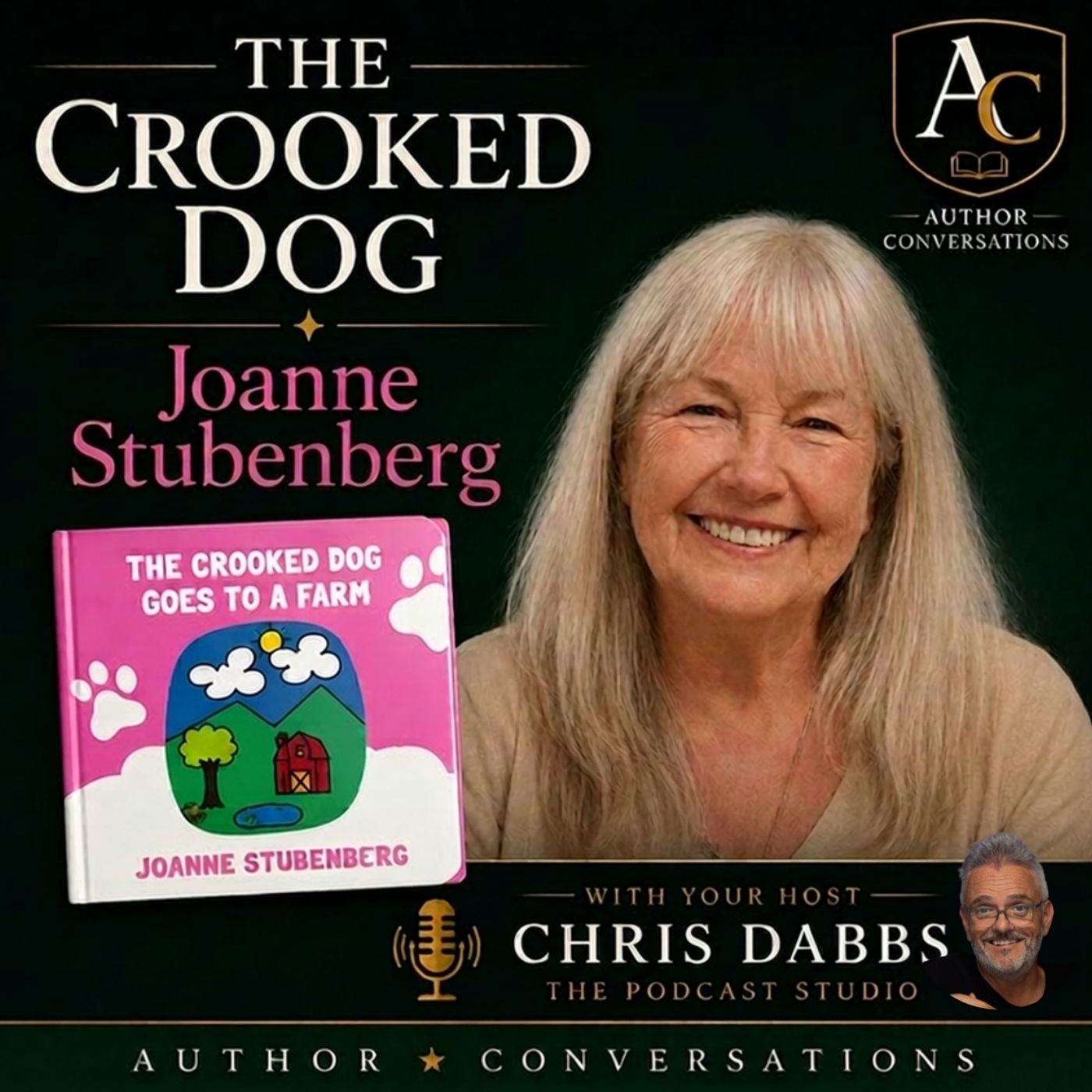
Joanne Stubenberg
What can one rescued little dachshund teach children about kindness, bullying, compassion and responsibility?
In this heartwarming episode of Author Conversations, Chris Dabbs is joined by children’s author and illustrator Joanne Stubenberg, creator of The Crooked Dog series.
Inspired by her real-life rescue dachshund, Jojo, Joanne shares the remarkable true story behind the books—and explains why stories about animals can often reach children’s hearts more effectively than lectures ever can.
From rescuing an abandoned dog and helping him recover from a devastating spinal injury, to creating books that gently teach empathy, responsibility and friendship, Joanne reveals how becoming a grandmother inspired an entirely new chapter in her life after nearly a life-long-career in banking.
Whether you’re a parent, grandparent, teacher, pet lover or simply someone who believes kindness matters, this conversation is filled with warmth, wisdom and hope.
Watch this video on YouTube: https://youtu.be/_B3Qg6ox9q8 - Due to an intermittent internet connection during recording, Joanne’s video occasionally freezes briefly. Her audio remains clear throughout, and we felt the conversation was too valuable not to share. Thank you for your understanding.
🎧 Official Author Conversations Podcast Playlist: HERE
Official Podcast Page: https://www.author-conversations.com/joanne-stubenberg-crooked-dog
📚 In this episode we discuss: • The true story behind Jojo, the rescued dachshund who inspired the series • Why animals can teach children empathy better than adults sometimes can • Helping children understand bullying through storytelling • The lifelong responsibility of owning a pet • The emotional reality of losing beloved animals • Becoming a first-time author after 45 years in banking • Why becoming a grandmother changed Joanne’s life forever • Writing and illustrating children’s books • How children around the world—even in different languages—have connected with Jojo’s story • What’s coming next in The Crooked Dog series
🔗 Connect with Joanne 🌐 Website: https://thecrookeddogseries.com
📚 Books:
- The Crooked Dog
- The Crooked Dog Goes to a Farm
00:42 Meet Jojo the Rescue Dachshund
02:46 The True Story Behind The Crooked Dog
04:46 Teaching Children About Bullying 0
6:21 Why Pets Help Children Grow
07:42 From Banking to Children's Author
09:02 Jojo's Rescue and Recovery
11:14 The Responsibility of Pet Ownership
14:17 Writing Gentle Stories with Big Lessons
15:09 Why The Crooked Dog Goes to a Farm
17:31 Using Animals to Teach Kindness
18:06 Writing and Illustrating the Books
19:13 Children's Reactions to Jojo
21:24 Family, Hawaii and Life in Bali
23:25 What's Next for The Crooked Dog Series?
24:03 Joanne's Message for Every Child 25:57
Where to Find Joanne's Books
27:13 Thanks for Watching
Become a...
Hello and welcome to author conversations. As usual, I'm Chris Dabbs. Today, I'm joined by Joanne Stubenberg, author and illustrator of the Crooked Dog series of books. Now, after more than 30 years working in banking, Joanne was inspired by becoming a grandmother to follow a lifelong dream of writing children's books. No, that sounds cool. So her stories are inspired by JoJo, a rescued, dex-hand, whose resilience, loving nature and slightly crooked body became the starting point for books about kindness, friendship, responsibility and caring for pets.
So today, what we're going to talk about is the Crooked Dog, and the Crooked Dog goes to a farm. Two books that are great, and also, why stories about animals can help children to understand compassion in a simple and memorable way. Joanne, it's lovely to have you with us today. How are you? You're doing well? I'm doing fine. Thank you so much. Good. Good. Well, before we get into the books ourselves, or themselves, tell us about JoJo, and have this little rescued dax-hand, and I hope I pronounced dax-hand correctly, first came into your life.
Well, a long time ago, we were having one of those times when people couldn't care for their dogs, the economy was bad. And so I had done alone for someone at the Humane Society, and I asked him to put me on the list for any dog sense, because that's what I had. And I got a call one day that they had found this little dox-hand up in a golf course, up in the mountains. And he was all by himself. He had no no-chip, no tags, no nothing. And he was just, he was a skeleton. He was so thin. And they asked me if I wanted him, and I went down there and brought him home.
And he got along great with my other dogs. So it was a good fit. He was a very good dog. He was very different from most doxons. He didn't bark. He could bark. I heard him bark once or twice, but he wasn't a barker. And most doxons are. So that was different, but he was wonderful until he broke his back, which was very traumatic, but we got him through it. And he came through that very well. Of course. So that means that if he broke his back, that means the crooked dog story is kind of true, right?
No, it's very true. Yeah. That's it. It's a true story. And I even gave the death of Hoppy on one of the books. I'm sure they appreciated that. Yeah. Yeah. So, okay, well, this is great. I mean, where you always a dog lover then, I mean, did you have dogs when you were a child, for instance? You mentioned that you've had dogs when when Jojo came along, but did you have any of this a child? Grippling growing up, my grandparents used to breed doxons. And so we always had several of them around. They were everywhere.
We had Symi's cats and doxons. You might as well. I guess that's a mixture, isn't it? My wife, three doxons. I didn't say, yeah, I don't know what that means. And doxons are still a hairy doxon. Two of my doxons were long hair. And they're really good breed because they have hair. They don't have fur. So people with allergies can have those kind of dogs. Yeah, my dog has hair, actually, which is quite good. And they don't molt. They don't shed to their, so that's really cool as well. So, oh, excellent.
Okay. So I guess I need to ask then, is Jojo still with us? No. We lost Jo about two years ago. He lived to be 17. He was a wonderful dog. And he's in the back yard now. That's where we cut out where we put him to wrap. Yeah. I made him a quilt because he used to get so cold. And so he's wrapped up in his quilt. Oh, that is too nice. I have to say, I mean, my dog's 11. Oh, but yeah, oh, that sounds lovely. Oh, so, okay. So on the crooked dog goes to a farm then. What's the lesson then in the crooked dog goes to a farm, do you think?
Well, one of the things I noticed when my grandchildren were very young was there was a lot of bullying going on between little kids. And their parents didn't really know how to stop that behavior. So I wrote the book a very gentle way of showing children how bullying is wrong and can be corrected. And I think it did help several children. And now, now, now, children's an urinal group. Yeah. Yeah. It's very important because if that stopped early enough, it won't be a pattern that children get into.
Yeah. I think this happens a lot nowadays, doesn't it? You know, with social media and those things people say. So yeah, it is tricky. I mean, maybe this is one of the things you were thinking about, you know, having a dog in your life as you said, your grandparents were breeding dachshunds. My grandparents actually bred Yorkshire terriers, but I never got to buy one really. Anyway, what do they, what do they think to you about companionship and things like that? Do you think that that really helps with kids to be able to concentrate on being I don't want to say nicer, but you know what I mean?
Nyser to each other. Well, when one of my grandchildren was very young, he was sitting on the couch. And Joey was on the other side of the couch just staring at him. And he, he was about, I guess my grandson was about four years old. And he, he said, Nana, he's staring at me. And I said, that's because he's waiting for you to call him over because he wants to be your friend. And so he did. And, and Joey went over there and they became the best of friends. So it's just, it's just being learned, children learning how to be gentle with animals helps them with everything.
It's a, it's a sounding board. Definitely. Well, that's true as well. Yes, because we all talked about our animals, don't we? So, you know, it's, you know, in one way or another, whether a pure cat person, yeah, I mean, you cats dogs everything, right? But you know, this is it, isn't it, right? You spent more than 30 years in banking before publishing children's books. So we're still sitting there in the back. 45 years. My hat. Well, so I mean, did you always hanker after being an author and writing stories?
No, it just, it just came to me after the grandkids started coming. And we would read at night, at five or six books every night from the very beginning. And that's when it finally dawned on me. I could do that. And I had things to share. What changed be it? When you became a grandmother, did it just like making you feel more sort of, I guess, motherly or? It's like my heart grew so big. Being a parent is a very hard, wonderful experience. But being a grandparent is even better. Because they're not yours.
So you can, you can spoil them, you can do whatever you want. And it's just fun. I had so much fun with the boys. Okay, that's lovely. I hear that, you know, grandparent saying I can give them back at the end of the day or whatever. Sorry, it's all good. Whereas I couldn't give you like, yeah. So okay, so having a look back at the book then, the crooked dog, let's think about this. So for listeners or viewers who've not met in yet, Jojo, or Joey, who is Jojo at the beginning of the first book then?
What's the story? That's at the beginning of this story. That's when we first meet Joey and he's rescued and we take him home. And my son just fell for that dog like a ton of bricks. And he was so happy to have that dog. And when Joey broke his back, it was my son who took care of him constantly. And he did a wonderful job because Joey did heal. He was a little bit crooked afterwards, but he was good to go. He could walk around. We put ramps on the stairs so he didn't have any stress on his back.
It was just a good time. He sure did because he was about four years old when his back broke. So he had another 13 years of good health. He was a good boy. He was a good eater. He wasn't picky. He wasn't a typical complaining dog. He just loved everything. And he knew he had a good life at that point. Well, especially because, you know, we don't want to ruin the story kind of thing. Well, the beginning of the story. But, you know, he's found, isn't he? Because he's alone and he's scared, right? He was terrified.
Yeah, it was a, it was very hard for him. But the people, the people at the Humane Society were really wonderful. And they, they knew that I would take good care of him. So that's the thing. I think that people that the Humane Society or the RSPCA or whichever, animal charity kind of can recognize when someone's actually a real caring person for animals. Which, you know, they're goodness, I think. But I mean, because it's a bunch of responsibility, right? I mean, you know, there's no getting away from that.
Lafeat in animal. I was, you know, shocked when we got our dog. Well, one of the things about owning an animal, a dog or a cat or a horse or anything is that you have to commit to owning and giving that dog a home for its entire life. You know, it's not, it's not a part-time thing. They're part of the family. No, absolutely. And I was, I was quite amazed at it, actually. And I used to, I must admit, I used to be quite upset about it because of, you know, going away on holiday, I couldn't, because it was going to cost me so much more money and everything else.
But as, you know, as you go closer to the animal, you think, oh, it's, yeah, he's not about money at all. It's about, you know, there are person kind of thing, you know, their own personalities and all that sort of stuff, right? So now it's great. And yeah, I was never allowed growing up to have a, to have a pet, which is what we were talking about with responsibility because my, my father said he wanted to protect me from being upset when the pet passes away. So I don't think that's very good because, you know, what do you hope that, yeah, exactly.
So what do you hope children understand about all of that responsibility and all about that will basically heartache when that does happen? Well, it's, it's, it's very hard when you lose a pet. It's very hard, but even though their lives are quite short compared to ours, they're a wonderful addition to a family. And the children learn how to treat an animal as they would a person. And to give them all the love and the tear that they can. And that responsibility, right? Oh, yes. It's a tremendous responsibility.
My son learned the hard way about that when he was small, one of our doxans, he accidentally left the gate open. And, you know, doxans are very curious and he got hit by a car. And that was a very hard lesson. But after that, you know, some probably still feels really bad about that, right? I'm sure he does. I'm sure he does. But when we got Joey or JoJo,
my son took it upon himself to make sure that Jo had the best life. And he did. So it's a hard lesson for children. Yeah, it's very hard. Yeah, it is. And, you know, thank you for sharing this with us. You know, I can hear it is emotional to talk about this. And, but the books, you know, they're gentle, all right, they, but they're still dealing with big ideas, right? And being scared, being hurt. So how do you, how did you sort of figure out how to balance those things for younger readers? Well, that was the whole point to get the youngest readers involved in the books before they even get animals so that they understand it is a responsibility besides just a wonderful treat to have a dog.
So let's look at the cookie dog. Let's look at a cookie dog goes to a farm. The farm setting, it seems to open up a whole world for JoJo and Kelly, why did you want to take the story there for the second book then? That was, I was concerned about my younger grandson. He was a little bit of a bully himself. He wasn't bad, but then I saw some of his friends. They were getting pretty rough. So it occurred to me that if I wrote a book about bullying and read it to them every night, that it would, it would change the way that they were acting.
And it did. It helped a lot. Well, I think that's the thing, isn't it? It helps, I guess, children learn how to be kinder to those who are smaller than, than, than, right? You know, so they wouldn't even go around bullying someone who was bigger, would they, right? Not usually anyway. So how does, how does JoJo learn that lesson? Well, JoJo learns the lesson after he knocks two or three other small animals down, then he sees a larger animal and it's a goat and goats can be rough. And when Jo got too close to him, the goat ran into Joian, knocked him over.
And suddenly he realized what it feels like to be on the other end of that stick. And that's not a good place to be. And I think I made that point sharing. The other way to stick. Yeah. Yeah. Yeah. Sorry, you were saying you, you, you made that point very clearly. I thought I did. I talked to several of the children after they read the book and they understood. And that's important if you get children to stop that behavior. I believe that it'll carry through to every child. And someday down the road, it won't be a problem.
And I used the animals instead. Yeah. I used animals instead of people as the examples because children could, they don't like being told no, they don't like being scolded. So if they read about little animals rather than people, sometimes they're not so apt to ignore the lesson. I hope that makes sense. And those pictures they do look really cute. I have to say. So well done on those. But do the pictures come first for you? Think. Or is it the story that comes first? And then you draw the pictures.
No, I do the story first. And then after the story's all set, then I do the drawings to match the story. Which kind of makes sense, I guess, really. You know, and the way that you've drawn them in that style, it's just hand drawn, it's warm, it's, you know, it's lovely. I mean, was that a deliberate decision to use your own illustrations? Are you, you know, or did you, did you feel? Well, my family has a lot of artists in it. And I am not one of them. But I talked to one of my aunts about the drawings for the books before I started.
And she said, just make sure that the drawings are very childlike. So that's, that's how they came to be that way. And they are. And I hope they, I think they really do tell the story and push that along. How have you found your grand children or other children? How do they respond to animal stories? Now, all your stories, stories of Jo Jo Jo, do they love them? Well, I'm sure they do. But, you know, are there any other stories that they've started to read because you've influenced them to do so?
I'm not sure about other stories. I have, I've had several. I was down in Bali for my daughter and her family lived there for several years. So I used to go down to Bali a lot. And one of my grandson's friends was there with his father his little sister. And the father asked if he could read the book, the crooked dog to his daughter. And I said, sure, but she didn't speak English. They were from Brazil. So all she spoke was Portuguese. So he opened up the book and he read it to her fully in Portuguese.
And she loved it. And most kids during the reading, when they see that Jo is broken his back, there's a lot of crying. It really, really gets to them. And I had one of my co-workers took, I gave, I gave her daughter who was about five at the time, no six maybe. I gave her the books and she loved them so much. She had to do a book report once a week for her class. And after a while, the teacher called to tell her that she might want to use a different book because every week she did the crooked dog.
It was pretty funny. So I had that a lot. So you've got to find, yeah, yeah, you've got all these little fans. Yeah, I do. A little, a little people. So okay, you guys, uh, that must be so cute though. Okay, so you mentioned Bali. I mean, you were born and raised in Hawaii. And now you split your time as you say, between home and visiting family in Bali, I guess. So I mean, how do those places, which are pretty different, I imagine? How do they shape the way that you see family and story telling?
Because you're making a big effort to go to another country, right? So to see parts of your family, I mean, how did that affect the way that you do things? Well, Bali is a very family oriented country. And the children are held in very high esteem. So it's not hard to get into that mindset when you're in a place like that.
And there's children everywhere in Bali. And I just thoroughly enjoyed them, some spoke English, some didn't. But the parents could do what the gentleman from Brazil did and they read it in their language because they could read English. So it was, it was a lot of fun. I enjoyed my, I went to Bali eight times. And that's a very long flight from Hawaii. It takes about 24 hours. Coming in there. Really? Well, I tried several different routes, but I found that going from Honolulu to Korea to Bali was the best.
I tried going from Honolulu to Singapore to Bali and Honolulu to Australia to Bali. And those are very, all of the flights are at least 12 hours. There's a little bit of result. It will take, though, to be fair. It's hard. Exactly. So we're, yeah, we're, okay, well, we're running out of time drive, which is a real shame. But I need to know, and our listeners will need to know, I mean, would you like the Crooked Dog series to continue with more adventures and more books? Have you got any more planned?
I do. I've got one more book finished and I'm working on the fourth book. You heard it here. So it's going to series. It'll be a series. Good. Good. So what, so as a closing thought that, what would you like? What's your main aim for a child to remember after hearing or reading the books then? What can they take away? My main goal is for children just to be their best person and to share that with their friends and have, it cascade. So that the children all have this positive outlook on life, on loving their animals, loving their families.
It's very important to me that children are happy and loved. That's it. The one. Yeah. But you say that to you, but I think that's pretty good. You know, that's pretty deep. I mean, good today, you know, children need to know that pets are forever members of the family, right? This is what you say. The responsibility that a child takes on when getting in you pet is important because it helps people, it helps them to grow, doesn't it? As a human, it does. It does. And as a dog or a cat or whatever gets older, the children see the change in them and they understand that they have to be, was an older dog.
They have to be very gentle with them. You can't just pick them up and carry them around. You have to be very gentle because just like people, when they get old, they're frail and you just have to take more care. And the kids see that and it makes them better people. And then they realize their humans also need, as they become older or grandparents or whatever they need to think or think about grandparents rather and make sure that they're, you know, gentle with them as well. Well, anyway, here we are.
Okay. We've run out of time. It's such a shame because I love listening to the stories about JoJo. But Joanne Stupenberg, thank you for joining the North American Association. The books that we've talked about today are The Crooked Dog and The Crooked Dog Goes To A Farm, which are a children's series inspired by JoJo, The Rescue Daxland. And don't forget, there's a couple more books on the way as well. The stories build around kindness, responsibility, friendship and caring for pets. And then of course growing and caring for others too, you can find Joanne's books through her Amazon author page and the direct book links supplied with this interview.
So once again, Joanne, it's been an absolute pleasure to meet you. Thank you so much for taking your time out to talk to me about the books. And just let everybody know where else they can get, they can get your books. I do have a website also. I do. The Crooked Dog Series dot com. That's my website. So in that case, listeners and viewers, then you can head over to that website and check out exactly what else Joanne has been talking about. But in the meantime, make sure that you subscribe to learn more about the books like The Crooked Dog.
And also make sure that you leave a comment, some comments down below so that Joanne will love to be able to see them. And it would be just fantastic. And I'd love to see them too, actually. But it would be nice to see them. And obviously, let's get a conversation started about how pets and how being kind to pets help kids, right? And the world at the end of the day without being too deep. So thanks again, Joanne, for joining me on author conversations. And I hope that we speak again soon. Thank you Chris.
Thank you. Bye bye. Take care. If you enjoyed this conversation, you can watch more author conversations here. [BLANK_AUDIO]
 Apple Podcasts
 Castbox
 Castro
 Goodpods
 Moon FM
 Overcast
 Pocket Casts
 Podbean
 Podcast Addict
 Podcast Republic
 Spotify
 YouTube