She Lost Everything in an Accident, Then Built Her Life Back
What followed was years of rehabilitation, relearning basic life skills and rebuilding an entirely new life.
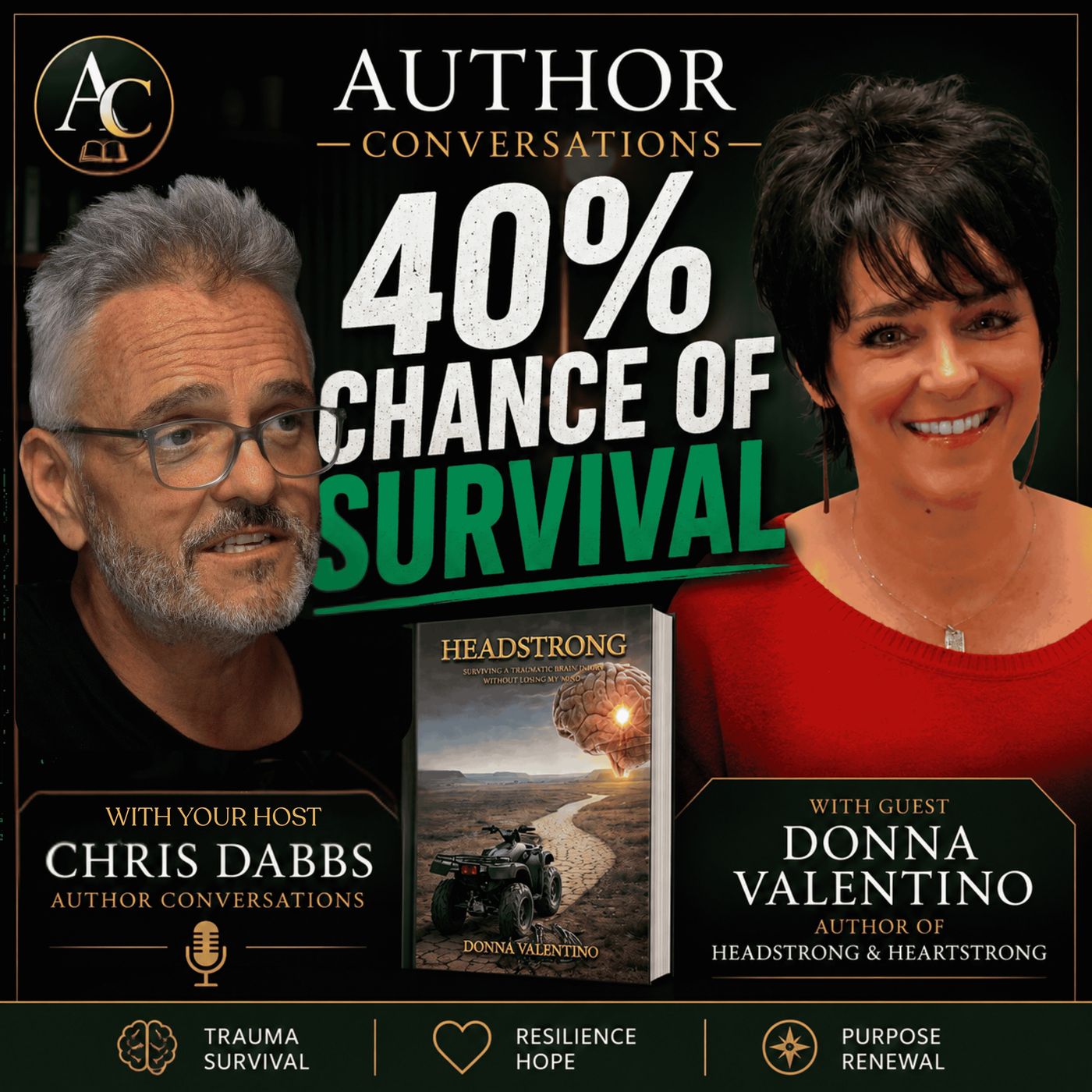
In this powerful episode of Author Conversations, Donna shares the extraordinary story behind her books Headstrong and Heartstrong, beginning with the catastrophic ATV accident that left her with a severe traumatic brain injury and continuing through one of the most remarkable recovery journeys you'll hear.
Doctors gave Donna Valentino just a 40% chance of survival after a devastating traumatic brain injury. In this inspiring conversation, she shares how she rebuilt her life, found new purpose and turned unimaginable adversity into hope for others.
Donna describes waking from a medically induced coma, struggling with memory loss, hallucinations and confusion, and facing the daunting task of learning how to swallow, walk and reclaim her independence.
But this conversation goes beyond survival.
Together we explore identity, resilience, purpose and hope.
Donna explains how the experience transformed her outlook on life, why recovery is about far more than physical healing, and how helping other traumatic brain injury survivors became her life's mission.
Rather than allowing tragedy to define her, she chose to use it to encourage others facing life-changing illness, injury and adversity.
Whether you're navigating your own recovery, supporting someone you love or simply looking for an inspiring story of human resilience, Donna's journey is a powerful reminder that hope can survive even the darkest circumstances.
The conversation is positioned as much around identity, purpose and rebuilding a life as it is around the medical realities of traumatic brain injury.
In this episode
• Surviving a catastrophic traumatic brain injury
• Living with a 40% chance of survival
• Waking from a medically induced coma
• Hallucinations, memory loss and rehabilitation
• Relearning everyday life after brain injury
• The emotional impact on family relationships
• Finding hope during recovery
• Why gratitude became stronger than bitterness
• Supporting other brain injury survivors
• Turning unimaginable trauma into purpose
• The stories behind Headstrong and Heartstrong
📖 Books featured:
Headstrong: Surviving a Traumatic Brain Injury Without Losing My Mind
Heartstrong: Overcome Obstacles and Live Life to the Fullest
🎙️ Author Conversations with Chris Dabbs brings you inspiring conversations with authors about the stories behind their books—and the lives behind those stories.
00:00 Introduction
01:08 The ATV accident that changed everything
03:18 A 40% chance of survival
05:41 Waking from a medically induced coma
08:02 Relearning how to swallow, walk and live again
11:06 Memory loss, hallucinations and brain injury
14:20 Losing your identity after trauma
17:43 How Donna's family coped
20:56 The turning point in recovery
24:18 Finding purpose after surviving
27:41 Why gratitude replaced bitterness
31:09 Supporting other traumatic brain injury survivors
34:27 Headstrong vs Heartstrong
37:12 Advice for anyone facing life-changing adversity
40:03 One message Donna hopes readers never forget
41:12 Where to find Donna's books
https://donnavalentinobooks.com/https://donnavalentinobooks.com/
Become a supporter of this podcast: <a...
[Music] Welcome to author conversations with me as usual, Chris Dabbs. Today's guest is Donna Valentino, author of Headstrong, surviving a traumatic brain injury without losing my mind, and heartstrong, overcome obstacles and live life to the fullest. Now, in 2009, Donna suffered a catastrophic ATV accident that led to fighting for her life, the severe traumatic brain injury. She endured emergency surgery to recover, a lengthy coma, intensive rehabilitation, and years of recovery afterwards. But, you know what, rather than allowing that experience to define her, Donna transformed it into a mission to help others facing trauma, uncertainty, and life-changing challenges.
Now, through her books, she shares both the brutal realities of recovery of which I'm sure we're going to hear about many, and the hope that can emerge on the other side, which hopefully we're going to hear more of. Donna, welcome to author conversations. It's lovely to meet you. Hi Chris, nice to meet you. Thanks for having me. No, no, not at all, not at all. You know, this is the whole point though, isn't it? It's not about so much the the whole accident and all of that sort of stuff and the recovery, whilst that is interesting.
But, you know, clearly, what it's all about really is about how it inspired you, really, to move forward with your life, isn't it? I mean, you know, how are you feeling today? Are you all good? I'm fantastic. I don't really have anything to complain about, and we all could complain if we wanted to. Nobody wants to hear it. Especially my wife, she doesn't want to hear it. Oh yeah, to see that's what I'm talking about. No one really wants to hear it, but I don't bother with complaining because it's pointless.
Exactly, exactly. So this sounds like the kind of thing that would inspire you, right? So what inspired you then to write both headstrong and hardstrong? It was a it was actually a good friend of mine who had written three books and he told me that you have a story to tell and people would want to hear it because you are not the only person who has ever suffered an injury like this. And he introduced me to, I think it was brown books publishing and had a great interview with the lady there. And she said, yes, we're going to we're going to write this book.
My goal was to help other people, not just the person who is injured, but the family members, coworkers, friends, because they were all affected. And I'll just say this out loud, 10 people could have the same accident and you're going to get 10 different results. And God left me with my marbles. I've seen other people that really struggle to recover. And I've I'm recovering still. I will recover for the rest of my life. But the book was definitely a way was very cathartic for me to be able to write my story because I don't pull any punches.
I'm just honest and blunt about it. And I think that people appreciate honesty and bluntness for us, one of the new Yorker, if you couldn't tell. That's what we do. We we pretty much just say it exactly how it is so that there's no, did she really say that? What did she mean by that? No, here it is. No, I see what you mean. And no, I think you're right. It's not just the person who who's recovering in whatever way, but it's just a family also. I mean, I think it is, you know, I don't know if you know but the formula one racing driver, the X world champion, yeah, Michael Schumacher.
Yeah. You know, he had an accident, you know, not an ATV. He was just skiing, right? And he had an accident. And well, basically his family have closed ranks on him clearly to keep his his privacy. But, you know, he must be going through all sorts of things. And the family must be going through as well. And it's not only high profile people clearly. Your family would have done, but you've gone through, you know, just as much trauma as as Michael Schumacher's. But, you know, at the end of the day, where did you decide where one book ended?
Heart Strong or Head Strong? And the other one began because Heart Strong came second, right? It did. And it's interesting because I like everyone else. We all have obstacles. They differ. But everyone has obstacles. And there are everyone has those family dynamics and they differ from family to family. And I just felt that my upbringing and my marriage, there were obstacles along the way. So the word trauma is an interesting word because I had a traumatic childhood. And again, we can go back to that feeling sorry for yourself, don't because whatever my story is, someone else is worse.
So I just felt that what I went through, my mother was basically a religious zealot. She was a born again Christian. And I was baptized Catholic because I'm Italian. That's what Italians do. And then 18 months later when my brother was born, he was not baptized. So my mother became friends with at the time Jews for Jesus. I'm not sure if they they still are referred to that way. But she really went into this, she dove head first into it. So the message that I received from my mother, it was the way it was received.
She told my brother and I in fear and with fear. So God to me was this big mean, angry God. So if I did this or if I did this, I'm going straight to hell. So I was on the fast track. I'm just saying, you know, aren't we all pretty much, but so I was raised to fear God, but not in a good way. It was fear and there is going to be like lightning bolts striking me down if I do something that God doesn't like. So when I left my home, I basically threw the baby out with the bathwater. I blamed my mother for the way she taught me, but basically I blamed God because of the way my mother taught me.
So God was not in my life for many, many years. And because my now ex-husband is Jewish, if the mother is not Jewish, and the children are not Jewish. So I converted, and it'll be really honest with you, the message that my mother gave me did hit home, but it never felt good converting. It didn't feel good right here. Something was wrong with it. And I'm not throwing shade on anyone's religious preferences or their ethnic background. None of that. I'm just saying that for me, it didn't feel it felt wrong.
It didn't feel wrong. It just didn't feel right. So I did raise my kids Jewish. They had their botmits for barmits for, and even my daughter being the oldest her botmits for, I was, man, I didn't want to do this. I want to do this. I've been to a few, and let me just, I'll just say something out loud. Again, I'm not throwing shade on anybody. But do you know what you spend for botmits for a barmits for? A lot. So I had to come to terms with that, and I did the best that I could with it. And then by the second time around from my son's barmits for, I deaf, I, I, I did it.
It worked out well. They're memories for everybody. But I did not find God again, until well after my accident, he kept me alive. I'm just going to be honest with you. My recovery, I am still here because he wants me here. I didn't, I, I should be dead. But I'm not. So it begs the question, God, what is my purpose? Why am I still here? Yes, I've written two books. The books aren't about me. None of this should actually be about me. It's really about him. Why am I still here? So God is answering the question, but God answers the question on his time, in his way.
And I've accepted that that's going to have to suffice. I'm going to wait on God to find out why am I still here.
And all you can do in the meantime is do your best work kind of thing, I guess, isn't it? That is correct. So it was a good friend of mine was in an accident. Actually, he, I was in the accident. He, I forget what it was. Can General Hart fill you? It was, it was, it was bad. He was a fireman. And I went to visit him. And on my way back, it was raining. And somebody decided they were going to just, oh, I need that exit. They just missed me by about that much. Okay, well, I on my way home and thinking, am I supposed to scream and cry?
Like I could have been in a really bad wreck. And all of a sudden that Paran than I'm just shifted. I just, I realized that God saved my life again. Okay, oh, so this was after the accident, right? This was after the accident. So all the recovery that went on after the accident. There is no fix. In my mind, I thought, well, this needs to be fixed. So that's just fix it. It doesn't work like that. It's not like a, the energize of money when it runs out of batteries, you put in a new one. It doesn't work like that.
So it's the reality of accepting, accepting stuff. That's accepting is basically saying that I guess this is how it's going to be and move on and deal with it. It took me five years to grieve the loss of tennis. I was a really good player, played on a team for years. It wasn't just the loss of the sport. It was the loss of the camaraderie with all the other players on my team. So it's sort of like a domino effect where you have an accident and the dominoes just keep falling. So I can no longer play.
I tried though. Trust me. I did. I gave it my best shot. Let me tell you what happens when you have double vision. I see the ball. I also see that ball, which puts the real ball. Right. So and I had a two handed backhand and I had a wicked two handed backhand. Couldn't do it because I don't have any function out of my left hand. I have no fine motor skills. Even after I had surgery on it, it just, again, accepting what I can no longer do and that's tough because Donna was that one that can do anything.
Just I can fix this, do that, drive here, do, boom, boom. I'm good. I went from doing everything and going 90, nothing to nothing. So after my accident, I could not move my left arm at all. It took months before I could get any feeling whatsoever. So the trauma really wasn't just mine. It was my children. They got to experience as no one should see their mother like that. I spent 49 days in the ICU with brain bleeding, pressure. They basically had to do a craniotomy where they opened up part of your skull to let the brain swelling go down.
The double vision that was something I had to deal with. I can't do anything about double vision. Double vision is it's my friend. It's now my friend. I have to accept that double vision is my friend because there's no cure for that. But all the orbital bones around my left eye were broken because the ATV landed on my head. So that was a twisted cheekbone, all the orbital bones broken. I have scarring across my forehead and I have a nice scar right down my middle because I had, what was it? Lacerated liver and bowel perforations.
My son got to see that. So talk about trauma. This is again the domino effect. It wasn't just me. My family members had my friends. Some people deal with it well and some people don't. Some people can take trauma and kind of bury it and then it raises its ugly head years later. So it's a matter of just dealing with trauma. The frustration part is difficult for me because I'm really proud of myself. I hung a picture on them all last night. That's not easy to do. No, why? When I hold that nail with a little hook and I do this, it's like don't hit the fingers.
Click out it on a wall. Sorry for laughing, but yeah, you're right. It's like on the cartoon. It was on the Warner Brothers. You know, you're going to hit your thumb, right? That is correct. Yep. So I've had to get used to asking someone else for help. That's tough one. That was tough for me. Sometimes it's still tough for me. In fact, I need to have a a keyless entry lock put on my door. I personally cannot do this and I'm struggling with asking a friend to do this. I can't live. You know the funny thing about it?
People want to help you. It's just up here in my head. No one thinks it. Me and goes, oh poor thing. Oh, no, they want to help. Let them help. So a lot of it is just get stuck up here because it's so the frustration factor gets high. And I have to learn how to do things a different way, just adapt. So accepting and adapting to things that also are my friends, whether they want them to be or not, they are. So I just have to find different ways to do things and try to figure out a way to do it where I will not get frustrated and want to throw it in the street and run it over with my car.
That's my new Yorker coming out me. I should run that thing over. Oh boy, that doesn't solve anything. Does it? No. I mean, you know, this is incredible resilience, you know, at the end of the day, it's easy to say, well, I don't know what I would do or what would most people do or whatever. You either, as you said, really, sort of cope or you don't cope, right? And hopefully, I guess what you're hoping that you readers will take away is some sort of way to cope with this because they've seen you go through you losing, well, basically tennis is a passion, but probably more than that, right?
It is, but we have a bit of a love of your life. So, you know, with the team and yeah, people don't understand once you're not in the team or perhaps when you're not working somewhere, you know, it's a kind of similar thing. You miss the people, the camaraderie, like you saw. Correct. The competitiveness, the whole thing. And then you go to some, you know, will you think you can do it, but you just can't. And then you've got to hold yourself back, right? That's what you're saying. In dubbing, fine motor skills, no, I think we get it.
I mean, it's easy to get, but I mean, cry, whoo, crykey, as we would say in the UK, Andrew Strowham. I like that. We're going to have to adopt that. And then the people and go, what'd you just say? Yeah, exactly. Crykey. Anyways, I think that it's, you know, I think you've done really well. Oh gosh, and not that it's the answer me to judge you or anything. I'm not saying that. But I mean, what do you think that readers could take away from your story in order to be able to be, well, you know, you, you've got some good tales of the town.
So I'm good, you know, advice to give. So what would you prefer that they found themselves out of your story and can, and can take away? My opinion on this, um, fine God, he's there. He's there. Okay. So I went back to church a year ago, last, yeah, a year ago, I started a field of pull right around Easter week. So my experiences as a child going to church, I felt it was hypocritical. I didn't, I didn't gain anything from it. And I felt that people were hypocrites. Me wanting to go back, it was a non-denominational church.
And as soon as I walked in the door, it wasn't anything like I remembered as a child. It's completely different. I remember standing up and singing the hymns and the tithing basket going around and everyone had to put in their life savings in the basket. Okay. Now you go and there's, there's a band playing up there and they're playing this beautiful Christian music. I was blown out of water. And I felt God's presence. And I can remember them saying at the end, if you want to take communion. And as soon as I heard the word communion, mmm, something, it was a trigger.
And I thought to myself, calm down. Nobody died. You're remembering something, a trigger from your past. And you need to open the door to the future. And I went and I did it. And I guess what? I'm still here. Nothing happened. Big deal. So I think it's a matter of opening your mind and your heart and by finding God and praying to God. And you know, people use the word prayer. People can get all like, you know, itchy over that. No, I just talk to God. Like I'm talking to you right now. I talk to him all the time.
I talked to him. In fact, he's my best friend because I talk to him all the time. God sees all, knows all. He knows my heart. Can't hide anything from God. He knows it all anyway. But by being open and keeping my heart and mind open to God, he's going to show me the way. And I think that people have different opinions about God. But prayer is not one of those words that you think of. You go, oh, I can't do that. Have you ever been in a situation where somebody will get up and pray and they're like a master at it.
It's like, boy, I, my prayers don't sound anything like that. Who cares? God doesn't care. It doesn't like care. So if somebody is a great prayer warrior, here's what I say to you. Good for you. We all have our own gifts. And God will help you on your journey and it's a journey. It's not, this isn't a quick fixture like, you know, wake up next day and go, ah, I feel better. Life is the same. No, it's not. It never will be again. It's adapting to new you. And I think that people, if they realize, if they stop fighting, what they can't change, your doors will open because we're all fighting what we can't change.
It's out of my control. I have no control over it. Zero. I'm going to get stressed out and upset about something I can't change. What a waste of time. It's actually a bunch of negative energy. But if I keep my mind and heart open to God, that's positive energy. I'm sure you've heard this before. What you put out is what you're going to get. You will reap what you sow. So if I plant good positive seeds here, because what we say to ourselves here is what comes out. If we talk negative to ourselves up here, oh, you, excuse my friends, you suck.
You're terrible. You're worthless. You're blessed in human being. That's going to come out. That negative energy will come out. And that's not helpful to you. And it's not helpful to anybody else. I want God's glory to shine through me. I want to live like Jesus lived. Is it tough? It can be if you wanted to be because it means giving up something else, sacrificing something else that you love for something better. So I just think if people want to take anything out of either one of my books, you are not less than you are not worthless.
You still have a life. God still left you here. Ask him why am I still here? There's a reason why he didn't take my life. So that's probably the biggest thing I want to tell anyone is that yes, you can read my books. You can hear them on an audio book, which I actually recorded myself. I was like, if you don't like my accent too bad. Who doesn't like your accent on it, surely. Honestly, I get comments on it all the time and I live in Texas. Okay, well, yeah, it's a bit different. You think with the y'all and I'm fixing to do something, I'm like, y'all is not even word.
And I'm not throwing shade on anybody. It's like crikey, right? Well, in your country, you say crikey and that it means something. And someone says, well, I'm fixing to do something. I'm like, you're going to fix something? I'm just saying that the vernacular is different from the York two Texas. So it's just a matter of adapting again. I'm going to use the word adapting. You have to adapt. Well, they go see. So you've adapted a lot, right? Including just like that is correct. Yeah, adapt not only because of the accident and recovery, but also because you've moved somewhere else, which adds extra pressure, doesn't it?
I mean, not many people would kind of notice that if you see what I mean and make a big difference. Very true. You know, I think it's interesting that you've done that because yeah, you're right. You know, if I went to an arrow country, you know, in the UK, there seems to be another accident every 30 or 40 miles. Okay, it's far, you know, you guys have to travel quite some way, right? Because you've got a lot of space. But if I go, I don't know, maybe a hundred miles from London, the accident is like wildly different.
So true. Yeah. And I feel like a foreign person. Right. Actually, and where I live, strange enough, if I look out for my window, I can see the English channel. So 23 miles away, it's France and Europe. So it's all weird. But anyway, it talk about England. If I was going up towards Birmingham, this is what I was talking about, it would be so I would feel out of place and kind of foreign. So having to adapt to that, whilst I'm adapting to everything else as well, which is, you're a strong person, I think, Donna.
And I think part of this is that you've actually used this as a cathartic thing, right? To write your books and to sort of go through it. But, you know, it's not that easy to do that. Okay. So it must have been difficult for you to revisit some of these experiences, you know, while you were writing this book. And did you find that, you know, your beliefs helped you with this then to be able to overcome those because you were, you know, you knew that you were sharing a story that was important? Absolutely.
I knew that I'm not the only person going through this. Someone else's injury could be entirely different. But I know deep down, I have empathy for that person because I'm still here. I'm still in that position. I might be better than I was, you know, that accident was 16 years ago. I've gotten past the point of even caring to remember when the date comes up. I don't care. So, and but people in general don't like change. So when you have a traumatic injury happened to you, all the things that you loved, something's going to change.
You are, I am not, the old Donna is gone. This is the new Donna. And I have worked with people at, it's called bind, which is brain injury network of Dallas. It's in Plano, Texas. And there was something about that group of people where they took in a certain number of people who survived a traumatic brain injury could be anything could be a stroke, aneurysm, TBI like I have. And I read my book to two people who had dysphagia. So I'm going to use Bruce Willis's name on this because everyone pretty much knows who he is.
He's suffering from the same thing. So all of a sudden with his frontal what's called frontal lobe cortex. Yeah, yeah, he has his, he can all over read. It's sad. So you take something you've done your whole life and maybe even enjoy it and all of a sudden it's, you can't do it. So I read my book to two people who had dysphagia. And then they asked me if I would like to do a writing workshop. I was honored to be able to do this. So I did a writing workshop and I set it with sheet of paper with their name, the date of their accident.
I made the font like super big. I wanted to know what disability have you been left with. Basically I started who were you before? What happened after your injury? That's a whole gray area of a lot of anger, sadness, heartbreak. One man had a wife who just couldn't deal with them anymore. And so I'm just saying that there are after effects when you have an injury that might not feel so good to you. And then after the middle part, there was the who are you now? So I really kind of wanted to go through that whole gamut because it's important.
There's the, well, the beginning, the middle, the end. Where are you now? And I loved doing this. And there were some people in there who literally fell asleep. That's okay. And I didn't care. You know why I didn't care? That's their injury. I'm not going to throw shade on your injury. That's you needed to fall asleep. You do you. When COVID hit, watch it 2020, that one man that used to fall asleep, he called me and asked me if I would edit his book. He wanted to write a book. What a journey. This was for me.
It was a year journey of learning to do things. I had no idea how to do. But I loved doing it. You know why it opens up the it makes you realize that this isn't dead up here. This is just you need to adapt. Again, I'm going to use a word adapt to learning different things and helping somebody else. So I was able to help this man get his, what do you call that? The get a cover for his book. It was printed on Amazon Kindle. So I was able to do this with him. And it was an adventure because it's his story.
Okay. He wanted to be a mercenary. Okay. Awesome. In my mind, I'm thinking, hmm, I wonder what happened in your childhood that brought you, I mean, I don't think anyone gets is born and says, I want to be a mercenary. Something happens along the way that you go down that path. So I wrote a chapter in the little bit that I knew about his childhood and he got back to me and said, oh, no, no, no, no, no, no, no, no, that's right. Good. Give me what's right. And he would tell me and I'd rewrite it. So they were one or two, maybe three areas where I rewrote things with information that he gave me because I'm a reader.
I love to read. I'm in that old school where you actually take a book and pick it up and read it. That doesn't happen anymore. People are on Kindle. They're doing audio. You do you. He wrote that book and I moved to Florida at the time and then he continued to write three more there after. So that was me helping somebody else to succeed on his dream of writing a book. So I think that if you if you choose to look at things in a negative way, then that's where you're going to stay. But if you want to look at it in a positive way, there are ways to help other people achieve their dream.
Just because you had an accident doesn't mean that you're you are worthless. You have to find something something else that's going to give you that encouragement to do something that you probably never would have done if you didn't have that injury. Do you think I would have written a book if I didn't have an injury? Probably not. No, because you've been playing tennis, didn't you? I was too busy. I was too busy with my two-in and back in. I'm going to have a good time. Exactly. I'll book a key for leave this.
We're running out of time unfortunately. That's too bad. I was having a good time. I know. Same here, right? And I'm sure that I listen to some viewers who are also having a good time and listening, you know, about your your utter positivity when it comes to this. I mean, you know, you're writing about wanting to be the person you never had when you were sitting in that wheelchair. And, you know, at the end of the day, you're actually doing it as well, helping people with a phase year or a phase year as you say, if I've got it wrong.
But, you know, it's quite amazing that and I think it's also important to think to remember what you said about the brain injuries aren't just like for accidents. It's also stroke, recovery, you know, it's all fragility, you know, aneurysms, all that sort of thing. So, you know, I've just very, very quickly on this one that because otherwise, I know we're going to get really upset when we have to call it closed. So, I mean, looking back now, do you think that, you know, the Donna that existed before the accident would recognize the person that you've become now?
Nope. She would not, she wouldn't even, I'd be a foreigner like, who is that lady? Really? Now, oh yeah. Know the change? This, there have been so many changes and the changes keep coming. I might be a grandma in a few weeks. First time grandma. So excited. So, I'm just saying, no, that Donna wouldn't recognize this Donna. Well, I guess what at the end of the day, we're really glad you're here Donna, obviously, passing on, you know, your wisdom and helping other people as well. So, quickly, give us your website address please.
So, the people can be like getting touched or find your social media and all that sort of thing. I can do that. So, Donna, Valentinobooks.com will bring you to my website. It's actually really well done and they'll enjoy it. There's my biography in there. The books are in there. There's a photo gallery. I think that people if want to know who I am, they can check that out and they'll figure it out. I am on Instagram, perspective by Donna. And I know I'm on Facebook as well. And I think whatever it's set up in such a way that whatever's posted on Instagram is on Facebook too.
And I am not a computer person. I'm being dead honest here. Someone else does that for me. It's right over my head. Yeah, sure. Well, that's great. That's great. Well, listen, Donna, Valentino. It's been lovely having you on today and talking about headstrong, you know, surviving traumatic brain injury without losing my mind and also talking about heartstrong, overcome obstacles and live life to the fullest. Honestly, yours is a really extraordinary story of survival, determination, resilience, adapting, finding purpose, you know, after unimaginable adversity with that.
You've done so well. My heart goes out to you. You've enjoyed this conversation. If you've enjoyed this conversation, basically, listen as viewers. I'm just assuming you have please like, subscribe and share the episode with someone who might find inspiration and perhaps some help in Donna's journey. And until next time, thanks for listening to author conversations. I've been Chris Dabbs. Donna Valentino. It's been wonderful to meet you. Thank you for joining me today. Thank you Chris. Appreciate it.
If you enjoyed this conversation, you can watch more author conversations here. [MUSIC]
 Apple Podcasts
 Castbox
 Castro
 Goodpods
 Moon FM
 Overcast
 Pocket Casts
 Podbean
 Podcast Addict
 Podcast Republic
 Spotify
 YouTube